
How Cineshare Scaled Industrial AI and Debuted GTC’s Keynote
With one month to turn Persona AI’s vision into NVIDIA GTC’s viral keynote, Cineshare and a Dell Pro Max Tower T2 made the deadline possible.
By Logan Lawler
Topics in this article:Monitors
Key takeaways
8 min readWhen Persona AI needed to turn raw robotics motion data into a cinematic NVIDIA GTC 2026 keynote piece in one month, they turned to Pekka Varis at Cineshare, a Finnish cinematographer who stayed with NVIDIA’s Omniverse through its pivot from creative tools to physical AI, when most artists walked away. The result went viral and reshaped the engagement.
- Varis delivered the full sequence in roughly a month on a Dell Pro Max Tower T2 with an NVIDIA RTX PRO Blackwell 6000 GPU.
- The keynote video hit 130,000+ impressions with viewers from nearly a dozen Fortune 100 companies.
- After seeing Varis’s rig on screen-shares, Persona AI bought its own Dell Pro Max Tower T2 + NVIDIA RTX PRO Blackwell 6000 workstations.
- Proof point that robotics and industrial AI teams increasingly need an artist’s eye, backed by workstation-class hardware to turn ideas into reality.
NVIDIA’s Omniverse originally launched in 2019 as an open collaboration platform for studio workflows that integrated the most popular graphics engines. Between 2022 and 2025, Omniverse moved away from general-purpose metaverse applications to focus on physical AI, industrial digitalization, digital twins and AI factories. Metaverse qualities such as characters, skin shaders and hair tools vanished from a platform that had been used for creative storytelling. The new focus leaned into robotics pipelines, digital twin frameworks and physical AI infrastructure. Early artist-ambassadors who had built careers around legacy Omniverse tools found nothing left for them and most walked away.
Pekka Varis stayed. A Finnish cinematographer who spent 10 years shooting video with a Red One camera, Varis, sensing an opportunity, put the camera down when Omniverse launched. NVIDIA selected him as the platform’s first ambassador. He founded Cineshare, a small digital studio, and began to build a business around the Omniverse. When Omniverse pivoted away from the metaverse, his peers saw a dead end, but Varis recognized the birth of an emerging industry.
As more engineers entered the robotics space, it was clear that they could build machines, but making those machines look worth buying required a different skill set. Varis’s eye for cinematography, lighting, angles and narrative presented untapped value. Cineshare was able to gain name recognition in part because so few artists remained.
The lean year
Cineshare had launched with investors, former clients that backed an attempt to build a storytelling product. Then AI video tools flooded the market. The product couldn’t compete, so Varis killed it. The investors exited and he pivoted to services including teaching sessions for Finnish companies while seeking longer-term contracts. Varis refers to that year as the valley of death. The Dell Precision Ambassador program, a community of about 40 members sharing workflows and troubleshooting workstation configurations, and his NVIDIA ambassador status gave him hardware and credibility during the months when work was sparse.
From email to keynote presentation in one month

Persona AI, a Houston-based robotics company, reached out with a specific problem. They developed a pipeline that captures human motion using a full-body mocap suite and converts those movements into robot joint articulations through reinforcement learning in Isaac Lab. For example, they could make a welding robot move like a human welder. To make it look like anything worth showing to investors was a different problem and GTC was the deadline. Varis accepted the project knowing all materials needed to reach NVIDIA many weeks before the event, leaving Varis one month to transform raw engineering data into a polished video render.
He began, as he often does, with an agreed-upon storyboard. Grounding behavior storyboarding in NVIDIA Omniverse and Isaac Sim is valuable because it aligns Varis’s stakeholders on what the final product will look like and as a bonus it visually demonstrates how robots will perform impactful work in the customer’s environment.
Persona AI delivered a real shipyard’s digital twin from 3ds Max to NVIDIA Omniverse’s native Universal Scene Description (USD) format. With the clock already running, Varis worked on his Dell Pro Max Tower T2 workstation with an NVIDIA RTX PRO Blackwell 6000 GPU to rebuild the robot’s materials from scratch, applied the RL animation data to the skeleton and placed it in the shipyard scene. He then scaled three robots, each with their own motion, in the same environment using Omniverse’s layer system and built the lighting, camera work and narrative sequence around them. Varis added, “The monstrous power of my Dell Pro Max Tower T2 with NVIDIA’s Blackwell 6000 GPU was a key factor to deliver this work inside the tight timeline. It was a pleasure to work with such a robust and steady setup.”
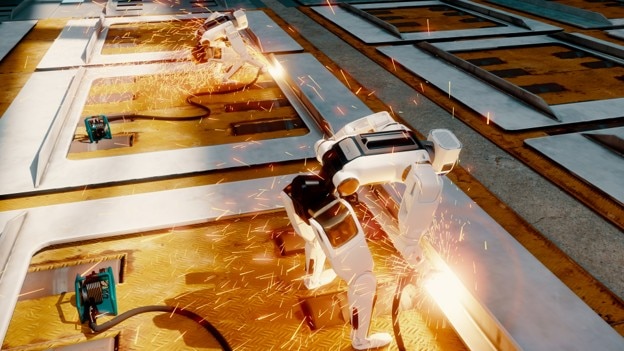
Building a particle system from scratch was out of the question with days disappearing from the calendar. Varis had a prior relationship with Pixel Lab, a commercial effects library, from a weather simulation project he’d done for YLE, Finland’s public broadcaster. Pixel Lab sent him a sample file to test compatibility with Omniverse and Isaac Sim to assess its overall feel for realism. It worked. He bought the full package, roughly 50 to 60 spark presets, and layered them into the welding animations.
“That was the secret to making good-looking sparkles, bouncing around in this tight deadline, because I couldn’t start to invent the sparkle system from nothing,” Varis said.
While waiting for NVIDIA’s approval of the initial cut, he used generative AI tools to upgrade the shipyard’s geometry and textures, which had come over from Unreal looking rough. The final render ran on a Linux-based farm with four GPUs using path tracing in Isaac Sim.
Persona AI accepted every artistic decision on the first version. In the film industry, Varis said, the opposite is standard. In the robotics world, where the teams are engineers with no background in visual storytelling, his judgment was respected. That was largely due to the fact that Persona AI had aligned Varis with their brand book and a clear visual tone early in the process. Varis maintained alignment via consistent communication with Jonathan Reichel, principal marketing architect, and Robert Effinger, behavior coordination lead at Persona AI. Reflecting on the experience, Effinger shared, “Simulations are a critical step in furthering client relationships. They validate use cases and serve to inspire our stakeholders. It feels like pulling a creative lever that allows everyone on the project to push toward new realities that we may have previously thought impossible or impractical. The visual effects Cineshare brought to the table made the difference between a simple promo and a masterpiece worthy of the big screen at NVIDIA GTC 2026.”
GTC’s viral keynote
The animation debuted before 20,000 people at GTC’s keynote presentation and went viral, garnering over 130,000 impressions and catching the eye of Fortune 100 executives. The project opened relationships with investors, potential clients and collaborators. Varis now works regularly with Persona AI. Recently, he’s developed a custom Omniverse extension called Welding Robot specifically for welding animations and cable simulations in Isaac Sim that supports dynamic bouncing sparkles and smooth cable simulation.
His journey proves that while engineers are hard at work building physical AI, artists, backed by immense computing power, provide a critical glimpse into a future where simulations become reality.
The standard issue desktop

The standard issue desktop at Persona AI is the Dell Pro Tower with NVIDIA RTX PRO Blackwell 4500. After seeing Varis’s rig during screen-sharing sessions, they purchased their own Dell Pro Max Tower T2 workstations with NVIDIA RTX PRO Blackwell 6000 GPUs. Now, they are able to dual-boot Linux and Windows for Isaac Sim, Isaac Lab and locomotion machine learning.
Separately, another Cineshare partner, inspired by Varis’s work, is putting in an order for their own Dell Pro Precision workstation. Cineshare’s next big production is with a Finnish cruise ship builder who needs crowd simulations. Varis is using Reallusion characters in Omniverse to populate restaurant decks, children’s play areas and lifestyle zones so the shipyard can sell interior themes to buyers.
Engineering teams can build the technology but need someone to tell their story to the people writing the checks. Artists are critical to design and delivery processes and continue to have a firm place in technical spaces. Reflecting on his long journey of navigating a rapidly changing industry, Varis says, “I’ve passed the valley of death. Customers are contacting me.”
About Persona AI
Persona AI is an AI and robotics company headquartered in Houston, Texas, developing the next generation of humanoid robots for heavy industry.
About Rob Effinger
Rob Effinger is the Behavior Coordination Lead at Persona AI, where he leads the company’s efforts in autonomous behavior development and digital twin simulations. He holds a PhD from MIT in Autonomous Systems and has a broad range of experience infusing autonomy into complex systems such as space telescopes, high-frequency trading systems and industrial inspection robots.
About Cineshare IO
Cineshare IO is a Helsinki-based creative tech studio merging cinematic storytelling with industrial engineering. As an NVIDIA Omniverse partner, they help enterprises visualize digital twins, robotics pipelines and AI simulations. From translating raw CAD data to delivering GTC-level keynotes, Cineshare transforms complex technical abstracts into compelling visual narratives that move stakeholders.
About Pekka Varis
Pekka Varis is the founder of Cineshare, a visionary cinematographer and a pioneering NVIDIA Omniverse Ambassador. Bringing a filmmaker’s sensibility to the “industrial metaverse,” he helps robotics and AI companies validate their engineering through world-class visualization. For Varis, the screen opens a window into the future of physical intelligence.

About the Author: Logan Lawler