
The Challenge of Protecting Brain Health Data
Privacy-first AI, faster research: Dell Pro Max workstations and NVIDIA RTX GPUs keep brain health data secure and accelerate discovery.
By Logan Lawler
Key takeaways
8 min read- Privacy at the source: Running the multi‑pass anonymization pipeline on Dell Pro Max workstations with NVIDIA RTX GPUs keeps sensitive brain health data fully local, cutting exposure risk while meeting HIPAA requirements and the spirit of patient privacy.
- Iteration velocity: GPU acceleration slashes processing time—from weeklong feedback loops to daily cycles—so researchers can refine models and heuristics much faster.
- Cost and control: On‑device compute eliminates unpredictable cloud fees and administrative complexity, enabling unlimited iterations and reproducible science.
- Industry shift: As health and life science teams bring AI to their data, AI‑ready workstations are becoming the first step in the AI journey, before scaling to clusters or the cloud when needed.
The first blog in our Child Mind Institute series laid out the hurdles of diagnosing and treating children with brain health conditions. One barrier to reducing the average eight-year wait between first symptoms and proper treatment is the challenge of protecting sensitive patient data at scale. Researchers need big datasets to find meaningful patterns, but brain health data carries unique risks that standard privacy protections don’t address.
Dr. Gregory Kiar is the Director of the Center for Data Analytics Innovation and Rigor (DAIR) at the Child Mind Institute. His team has compiled thousands of detailed neuropsychological evaluations through their work with the Healthy Brain Network study. Each evaluation results in a 24-page clinical report documenting behaviors, diagnoses, family histories, and treatment recommendations. If analyzed as a collection, the patterns in this data could transform how we understand childhood brain health, but sharing it, or even analyzing it effectively, requires solving a problem that has stalled the field for years.
Legal compliance isn’t the same as privacy
HIPAA defines 18 categories of protected health information, such as names, addresses, dates, and medical record numbers that must be removed before healthcare data can be shared. However, Kiar observed that legal compliance and actual privacy protection diverge sharply in brain health research. “On the one hand, sure, you can be legally compliant by just removing these things,” he explains. “However, the spirit of not having identifiable information means, in practice there’s a lot more things that can actually still tell you about the individual.”
The problem is fundamental to how brain health conditions work. Unlike cancer, where diagnosis requires biopsies and lab work that outsiders can’t access, brain health conditions manifest in observable behaviors. The symptoms clinicians document are visible in everyday life.
Consider a clinical report describing a 12-year-old with ADHD and a specific behavioral tic. Age is diagnostically meaningful because it indicates symptom progression and developmental factors. The behavioral description is clinically valuable; it characterizes the condition. However, if those two pieces of information are combined with knowledge of where the data was collected, the patient could then be identified as a real child in a real community.
“I’m never going to take a biopsy of someone on the street,” Kiar notes. “Whereas with brain health, you can much more easily connect data back to individuals.”
The catch-22 in brain health research
Brain health researchers find themselves in an intractable situation where, if they strip away every potentially identifying detail, they eliminate the information that makes the data valuable. “Perfectly anonymized data has no signal in it at all,” Kiar says. “But at that point, what are you sharing?”
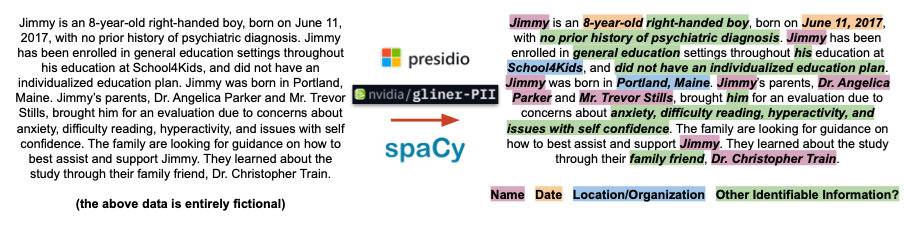
The Child Mind Institute’s goal is to strategically anonymize datasets so researchers can aggregate enough data to do meaningful analysis and advance the field, but every piece of information that makes data scientifically valuable also increases the re-identification risk.
This is why brain health research has been stuck. Standard anonymization approaches that work for other medical domains fail in brain health because the signal and the identifier are often the same thing.
Standards of rigor require equally robust infrastructure
Applying tactical anonymization isn’t the only problem Kiar and his team have had to solve. Processing thousands of clinical documents requires serious computing power, but the standard options all have disqualifying limitations.
University shared computing resources are non-starters because they allow too many users with potential access to sensitive data. Cloud providers like AWS, Google Cloud, or Azure are possible with Business Associate Agreements under HIPAA, but they introduce administrative complications and can be costly.
“Traditional options don’t align with the values of trying to practice reproducible, rigorous and safe science,” Kiar explains, “because you’re adding risk for your data and you’re incentivized to iterate as little as possible because you don’t want to foot an enormous bill.”
But research is an inherently iterative process that sometimes requires dozens of cycles to uncover meaningful patterns. Cloud costs limit the number of possible iterations, and every upload to third-party infrastructure, even with legal protections in place, adds risk of exposure.
Standard laptops can’t handle the scale that this research requires, which includes hundreds of gigabytes of clinical text and potentially hundreds of terabytes of data when imaging data is included.
Enter Dell Pro Max workstations with NVIDIA RTX GPUs. Purpose-built for AI workflows, these systems deliver the local, high-throughput compute that privacy-sensitive teams need to bring AI to their data – keeping protected information on-prem while unlocking GPU-accelerated pipelines that cut runtimes dramatically. This workstation-first approach aligns with how many organizations begin their AI journey before scaling to multi-GPU racks or the cloud.
The Child Mind Institute needed systems powerful enough to run state-of-the-art machine learning pipelines, private enough to keep sensitive data completely isolated, and affordable enough to support unlimited iterations. Dell workstations with NVIDIA RTX GPUs solved all three problems simultaneously.
Building a multi-pass anonymization pipeline
The Child Mind Institute’s approach uses multiple layers of AI-powered analysis to catch different types of identifiable information. The core framework is Microsoft’s open-source Presidio, which orchestrates named entity recognition (NER) models to identify and flag potentially sensitive content. NER systems scan text to locate and classify specific types of information such as names, dates, and locations.
For the entity recognition itself, the team uses NVIDIA’s GLiNER model. Unlike traditional NER systems that can only identify fixed categories like “name” and “address,” GLiNER allows flexible, on-the-fly definitions of what constitutes identifiable information. This is critical to the pipeline because brain health data contains context-dependent identifiers that standard tools often miss.
The pipeline runs in passes:
- First pass: Obvious identifiers, including names, dates, locations, organizations are anonymized.
- Human review: Annotators examine flagged content to catch what the model missed. They also identify patterns the model should learn.
- Second pass: The reconfigured model catches contextual identifiers—information that isn’t inherently identifying but becomes so in combination with corroborating data.
Why the hardware matters: NVIDIA RTX GPUs accelerate every stage—from document parsing and embedding generation to model inference and re-scoring—so the same team can run more passes per day, test new rulesets, and enforce stronger privacy without sacrificing signal. The result is text that’s been systematically stripped of re-identification vectors while preserving the clinical signal that makes the data valuable for research.
The hardware difference
Running this pipeline at scale requires substantial compute. The team’s Dell workstations with dual NVIDIA RTX professional graphics cards handle everything from document parsing to model inference without data leaving their secure local environment.
- Velocity: “We’re able to make many more iterations in a given week and move much faster as a result,” Kiar reports. Feedback loops that previously took a week to complete now cycle in a day, thanks to GPU-accelerated inference and batched text processing.
- Privacy & Sovereignty: No uploads to third-party infrastructure means fewer exposure vectors and easier audits.
- Cost control & Reproducibility: Local iteration avoids surprise cloud bills and supports methodical, repeated experiments—core to rigorous science.
- On-Ramp to Broader AI: When projects outgrow a single box, teams can step up to multi-GPU racks (e.g., Precision 7960 rack) or data-center nodes—but they start faster on a workstation.
Achieving research of this level of quality was previously impossible. Leveraging on-device processing, with the ability to rapidly iterate without incurring additional costs has transformed what the team could attempt.
The step beyond anonymization
Anonymization is a necessary starting point, but is not sufficient for publication or shared analysis. The next challenge—and the subject of our next blog in this series, is generating synthetic brain health data that captures real population patterns without replicating real individuals. Meaningful synthetic data must be realistic enough to be useful while different enough to be used ethically in research.
This direction aligns with ongoing Dell Pro Max activations around privacy-preserving AI in healthcare, including efforts modeled on collaborations like the Child Mind Institute initiative, which demonstrate how on-prem GPU workflows enable secure data pipelines and synthetic data experiments.
Ready to see how Dell Pro Max workstations with NVIDIA RTX GPUs accelerate privacy-first AI in healthcare and research? Click here to learn more.
This is the second post in a six-part series on advancing brain health research through secure data practices. The first post explored overcoming the eight-year treatment gap in childhood brain health. The next post will examine synthetic data generation and the challenge of evaluating its fidelity.

About the Author: Logan Lawler