AMD EPYC for AI Data Preparation: Computer Vision
Accelerating CV Pipelines with Optimized Data Preparation
As multi-modal AI workloads continue to expand across enterprises, the importance of fast and reliable image preprocessing has become the cornerstone of successful AI deployments. These core image processing tasks, including resizing, cropping, format conversion, and rotation, form the critical first stage of AI pipelines, impacting model training efficiency, inference speed, and overall AI system performance.
This demand for efficient image processing pipelines spans across industries; for example, in manufacturing, AI-powered quality control systems require image preprocessing to feed real-time defect detection models. In retail, computer vision analytics depend on standardized image inputs across thousands of camera feeds to power customer behavior AI models. Healthcare AI applications demand consistent processing of high-volume medical imaging data, while content moderation AI systems need to handle millions of user-uploaded photos daily with variable resolutions and formats.
While GPU acceleration dominates AI model inference, image preprocessing still presents an opportunity for optimization within the broader AI pipeline. Traditional GPU-centric approaches often introduce unnecessary complexity and cost overhead, particularly in large-scale enterprise environments. High-performance CPUs, such as AMD EPYC Processors, address these AI pipeline requirements directly, offering scalable, memory-optimized processing that integrates seamlessly with existing AI infrastructure while accelerating the critical data preparation phase.
In this paper, we examine how 5th Gen AMD EPYC™ processors accelerate the data preparation phase of AI computer vision pipelines. Leveraging the open-source imgproxy image server and a simulated high-load environment of 4,096 concurrent requests, we benchmark seven core image augmentation tasks across resolutions from HD (1280×720) up to 8K (7680×4320). Our per-core performance comparison between 5th Gen AMD EPYC processors and the prior generation AMD EPYC 9554 baseline demonstrates the generation-to-generation improvements that directly translate to faster AI pipeline throughput and reduced time-to-inference for production-scale AI deployments.
By accelerating image preprocessing, the critical first stage of computer vision pipelines, these performance gains compound throughout the entire AI workflow, from data preparation through model training and inference.

Faster data preparation means AI models can be fed training data more efficiently, inference pipelines can handle higher throughput, and AI applications can deliver results with lower latency. Here are our some of our key findings:
Performance Highlights
Performance Results
Across all benchmarking scenarios, we observed a clear 4th-to-5th Gen improvement –5th Gen EPYC processors consistently outperformed the 4th Gen EPYC 9554 when looking at image throughput performance per core. Here, we highlight our key observations:
Key Observations
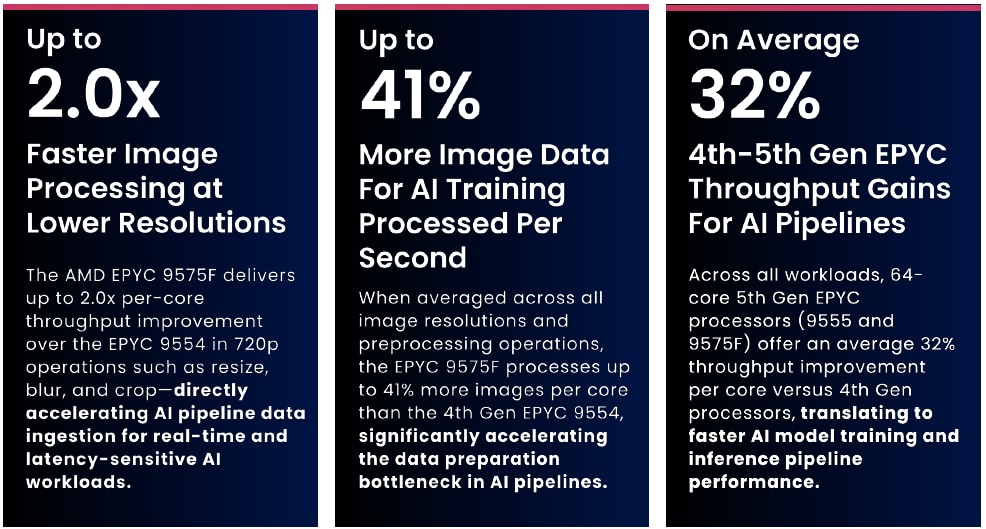
- Up to 2x Faster Image Processing at Lower Resolutions: The AMD EPYC 9575F delivers up to 2.0x per-core throughput improvement over the EPYC 9555 in 720p operations such as resize, blur, and crop—ideal for real-time or latency-sensitive AI workloads.
- Up to 41% More Images Processed Per Second Overall: When averaged across all image resolutions and preprocessing operations, the EPYC 9575F processes up to 41% more images per core than the 4th Gen EPYC 9554, showcasing a significant generational improvement.
- On Average 32% 4th–5th Gen Throughput Gains: Across all workloads, 64-core 5th Gen EPYC processors (9555 and 9575F) offer an average 32%throughput improvement per core versus 4th Gen processors, reflecting the impact of architectural enhancements.
- Strong Performance Even at 8K: While the 9575F’s advantage tapers at higher resolutions, it slightly outperforming the 9555 in several 8K operations, including crop, rotate, and blur.
- Consistent Throughput Across Resolutions: The EPYC 9555 demonstrates stable performance, making it an optimal choice for high-resolution or throughput-intensive environments with predictable scaling needs. Tailored Architecture for Workload Diversity: The 9575F’s higher frequency favors smaller, compute-burst workloads, while the 9555 delivers steady performance across a broader range of resolutions, enabling infrastructure flexibility without compromise.
Note: While we also tested the dual-socket 5th Gen AMD EPYC 9755 128-Core, we found that although it offered performance advantages when looking at total system throughput, it underperformed when analyzing performance per core.
Overall 4th-5th Gen Performance Gains
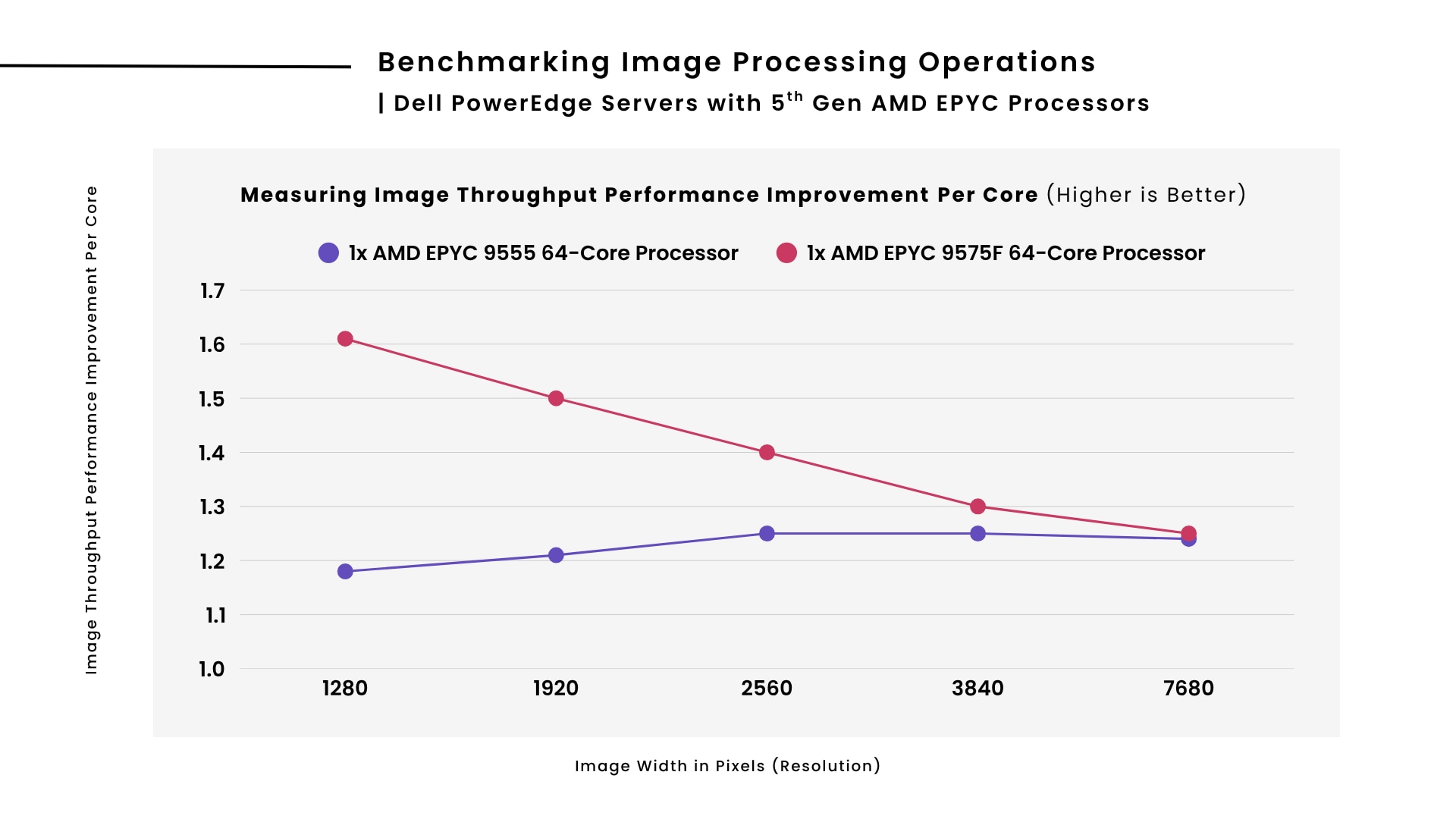
Figure 1: Image throughput (images processed per second) performance improvement per core, calculated by dividing the throughput of 5th Gen EPYC by the throughput of 4th Gen EPYC 9554, and then averaging this value across all image processing operations for each resolution. A higher improvement factor implies higher throughput for the 5th Gen SKU.
As illustrated in the chart above, we evaluated image throughput performance per core for a range of image resolutions using Dell PowerEdge servers powered by the following two configurations of 5th Gen AMD EPYC processors: single-socket AMD EPYC 9555 64-core and single-socket AMD EPYC 9575F 64-core.
The single-socket 9575F processor consistently delivers the highest per-core throughput across all tested resolutions—from 1280px up to 7680px—peaking at a 1.61x improvement at lower resolutions and gradually tapering to about 1.25x at 8K. This performance advantage highlights the 9575F’s strong per-core efficiency, especially for lower-resolution workloads where latency and memory bandwidth play a greater role.
The single-socket 9555, while trailing the 9575F setups, offers consistent per-core improvements in the 1.18x–1.24x range. It presents a balanced option for organizations seeking to optimize performance without the added power and complexity of high-frequency or multi-socket configurations.
Organizations prioritizing maximum per-core performance—particularly for lower-resolution or latency-sensitive workloads—will benefit most from the EPYC 9575F. Meanwhile, dual-socket configurations can still deliver strong throughput for highly parallel image workloads, with a minor trade-off in per-core efficiency.
Here, we zoom in on image processing performance for two different image resolutions, comparing single-socket 5 Gen AMD EPYC 9575F and 9555 performance to the prior generation AMD EPYC 9554 processor.
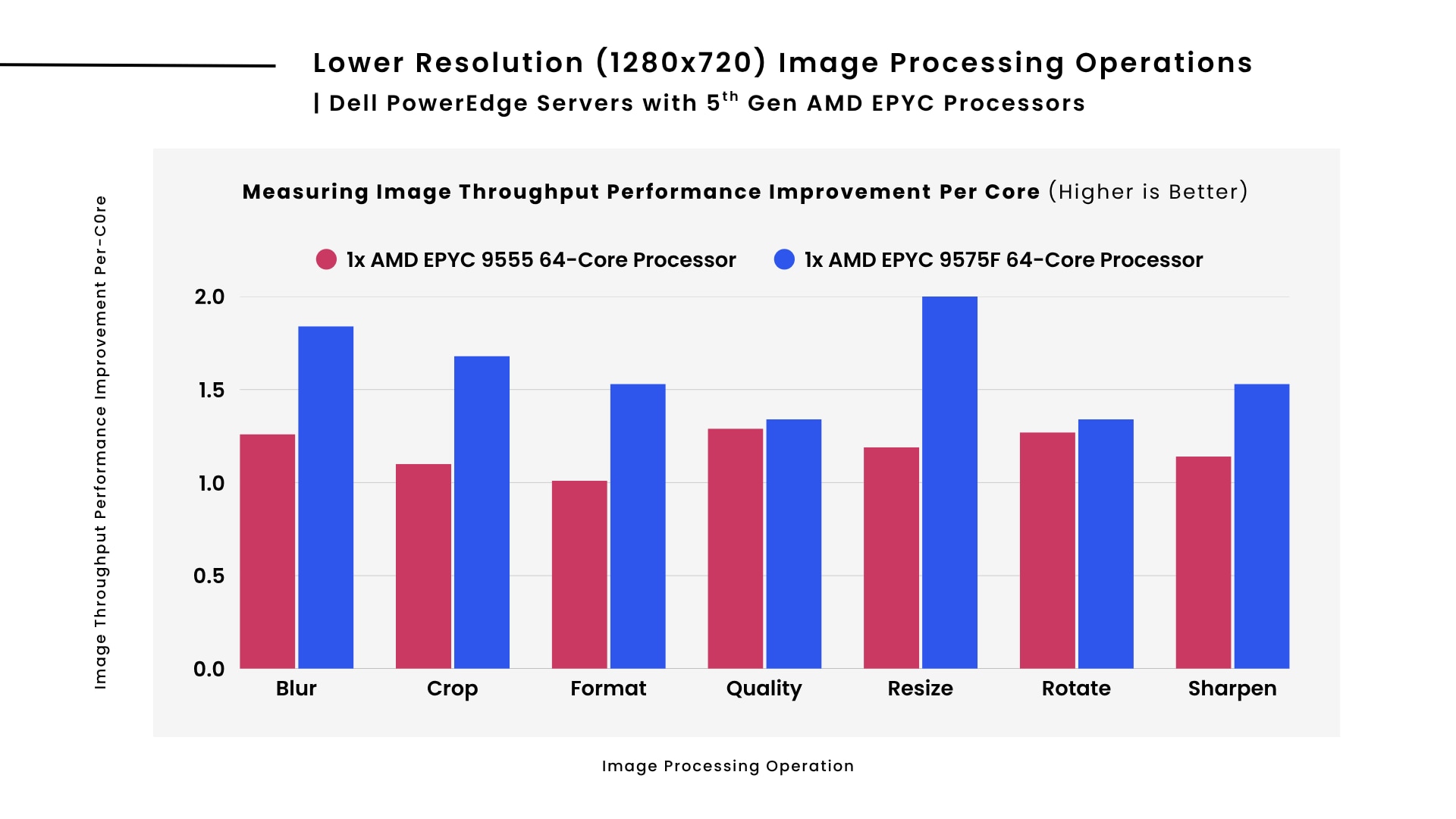
Figure 2: Image throughput (images processed per second) performance improvement factors for lower resolution images, calculated by dividing the throughput of 5th Gen EPYC processors by the throughput of 4th Gen EPYC 9554 to get an image throughput performance improvement factor. A higher improvement factor implies higher throughput for the 5th Gen SKU.
Our benchmarking of Dell PowerEdge servers with 5th Generation AMD EPYC processors reveals an interesting performance dynamic when processing lower resolution
(1280x720) images. The AMD EPYC 9575F 64-core processor consistently outperforms the EPYC 9555 across all image processing operations, delivering performance improvements ranging from 1.3x to 2.0x over previous generation processors.
In contrast, the EPYC 9555 configuration demonstrates less per-core efficiency at this resolution, with throughput improvement factors generally between 1.0x and 1.3x. These results underscore the value of the higher-frequency 9575F for image processing workloads, especially in scenarios dominated by lower-resolution imagery where latency and memory bandwidth are critical.
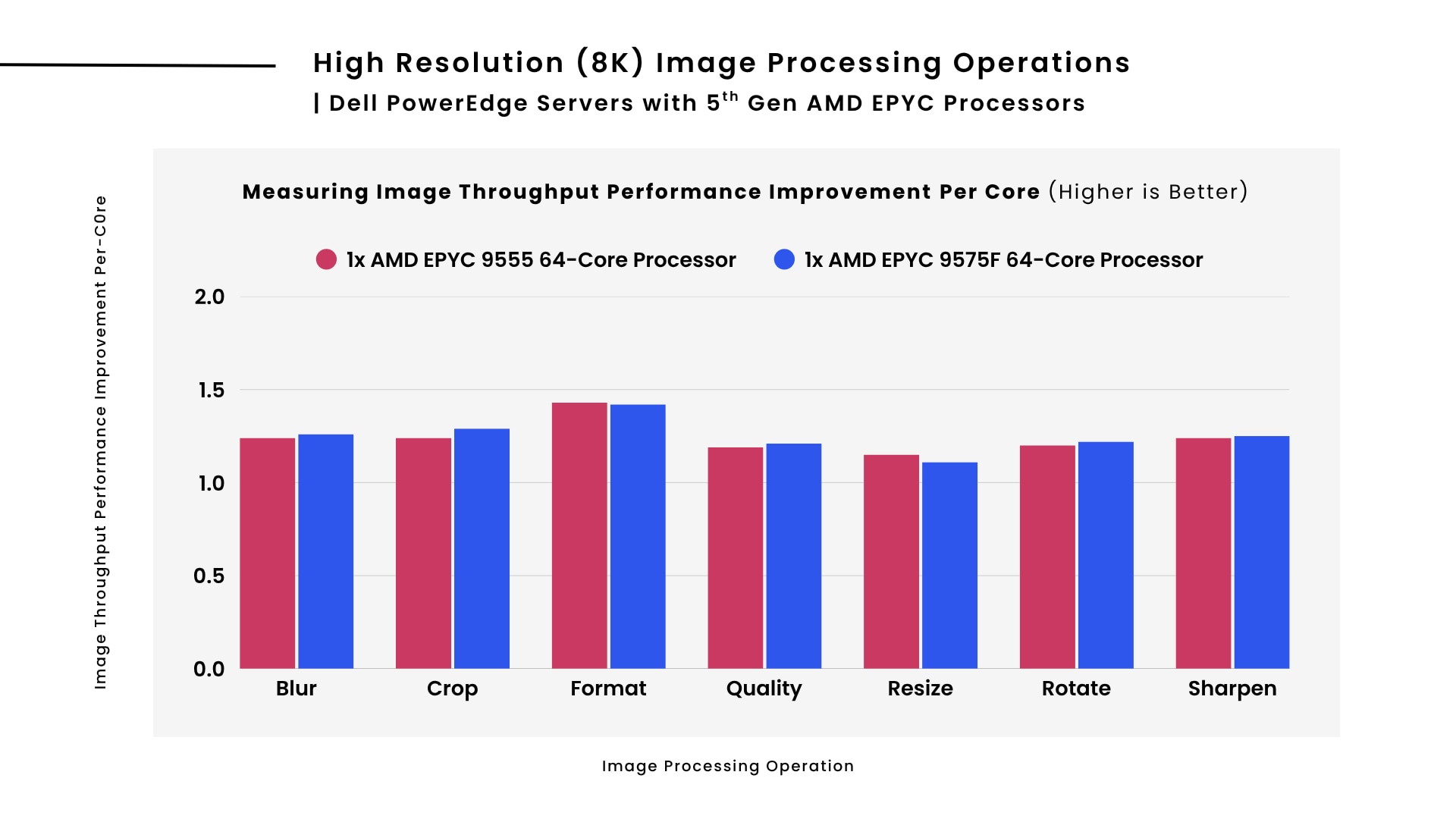
Figure 3: Image throughput (images processed per second) performance improvement factors for high resolution images, calculated by dividing the throughput of 5th Gen EPYC processors by the throughput of 4th Gen EPYC 9554 to get an image throughput performance improvement factor. A higher improvement factor implies higher throughput for the 5th Gen SKU.
Our benchmarking of Dell PowerEdge servers equipped with 5th Generation AMD EPYC processors highlights how per-core performance varies between processor models when handling high-resolution (8K) image workloads. At this resolution, both the AMD EPYC 9555 and 9575F 64-core processors deliver similar levels of throughput improvement, with performance factors ranging from 1.15x to 1.4x across operations like Blur, Crop, Format, Resize, and Sharpen.
Notably, while the AMD EPYC 9575F delivers standout per-core gains on lower-resolution tasks, which can be attributed to its higher frequency and cache architecture, its performance tapers at 8K resolution. Despite this decline in performance, the 9575F remains competitive, slightly outperforming the 9555 in several operations such as Crop and Rotate. This suggests that its architectural advantages continue to offer value even under the more memory- and bandwidth-intensive demands of high-resolution image processing.
In contrast, the EPYC 9555 shows a more uniform performance profile across resolutions. Its per-core throughput remains steady from 720p through 8K, making it a dependable option for applications that require consistent processing efficiency across a wide range of image sizes. For organizations running workloads dominated by high-resolution images, the 9555 offers predictable performance over both resolutions, while the 9575F remains a strong contender—particularly in mixed-resolution environments where its strengths at lower resolutions can still provide efficiency.
Power and Cost Analysis
Understanding both the power characteristics and cost-effectiveness of each EPYC processor is crucial for evaluating total cost of ownership in accelerating image processing for computer vision pipelines.
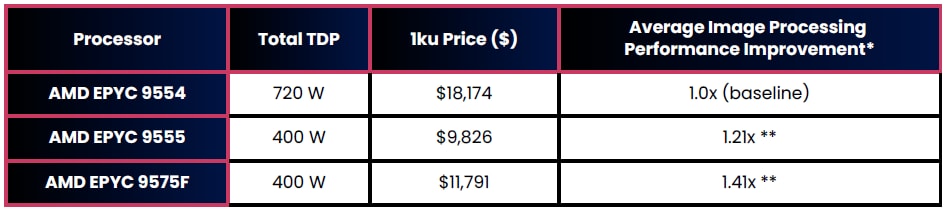
Figure 3: Summary table of TDP, 1ku pricing, and performance scores for the three tested AMD EPYC Processors.
*Average Image Processing Performance Improvement is calculated as the mean throughput improvement factor across all resolutions and operations compared to the dual-socket EPYC 9554 baseline.
**Based on actual performance data from paper: 9555 shows 1.18x-1.24x range (average ~1.21x), 9575F shows up to 1.41x averaged across all resolutions and operations (paper states "up to 41% more images processed per second overall").
Power and Performance Efficiency
While individual 5th Gen processors show a modest TDP increase from 360W (per processor) to 400W, the shift from dual-socket to single-socket configurations delivers substantial efficiency gains. Single-socket 5th Gen systems consume 400W compared to 720W for dual-socket 4th Gen setups—a 44% reduction in power draw while achieving superior image processing throughput. Performance per watt improvements are dramatic: the EPYC 9575F achieves 2.5x better efficiency (3.53 vs 1.39) than the dual-socket 9554, while the EPYC 9555 delivers 2.2x better efficiency. These gains translate directly to reduced operational costs in enterprise AI deployments.
Cost-Effectiveness Analysis
Both 5th Gen single-socket processors deliver superior price-performance ratios. The EPYC 9555 provides 21% better throughput at 46% lower cost ($9,826 vs $18,174), while the EPYC 9575F offers 41% better performance at 35% lower cost ($11,791 vs $18,174). Per-system savings range from $6,383 to $8,348 in processor costs alone, excluding additional benefits like reduced cooling, simplified architecture, and lower rack density requirements. At enterprise scale, a 100-system deployment would yield$638,300-$834,800 in processor cost savings while delivering better image processing capabilities.
Summary
Reduce TCO While Accelerating Computer Vision Pipelines with EPYC.
Our results clearly demonstrate that modern CPUs are essential for accelerating AI data preparation, directly impacting overall AI system performance and deployment efficiency. Both the AMD EPYC 9575F and 9555 deliver strong per-core throughput improvements, with each offering distinct advantages depending on the AI workload characteristics:
- Up to 2x faster image processing at lower resolutions with AMD EPYC 9575F, accelerating AI data ingestion
- Up to 41% more images processed per second averaged across all resolutions, speeding up AI pipeline throughput
- On average 32% 4th–5th Gen throughput gains across all workloads, demonstrating the AI infrastructure value of 5th Gen architectural enhancements
By accelerating image preprocessing, the foundational stage of computer vision workflows, enterprises can reduce AI pipeline bottlenecks, improve overall AI system utilization, and achieve faster time-to-inference without compromising model performance. 5th Gen AMD EPYC processors offer a scalable, efficient, and cost-effective foundation for building AI pipelines that can handle the demanding requirements of modern multi-modal AI applications. To learn more about our performance benchmarking methodology and results, reach out to us at contact@metrum.ai.
References
- AMD images and 1ku pricing information: AMD.com, AMD Partner Resource Library, https://www.amd.com/en/partner/resources/resource-library.html
- Dell images: Dell.com
Appendix A
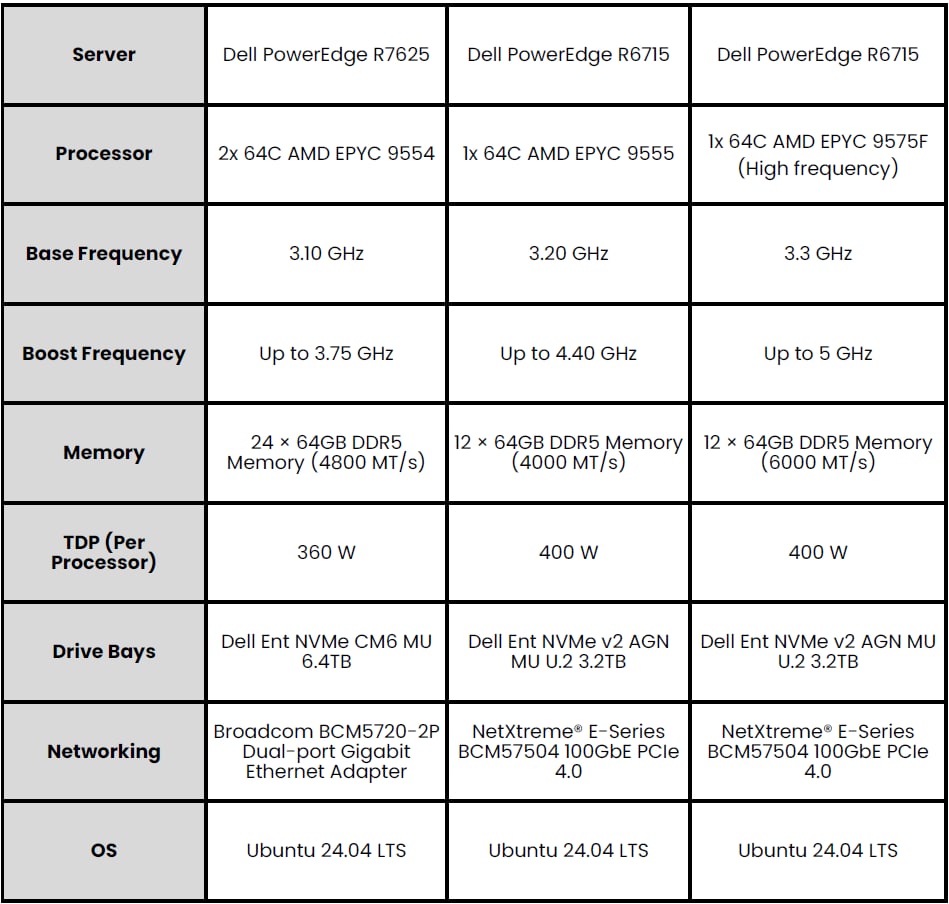
Hardware Configuration
Appendix B
Benchmarking Methodology
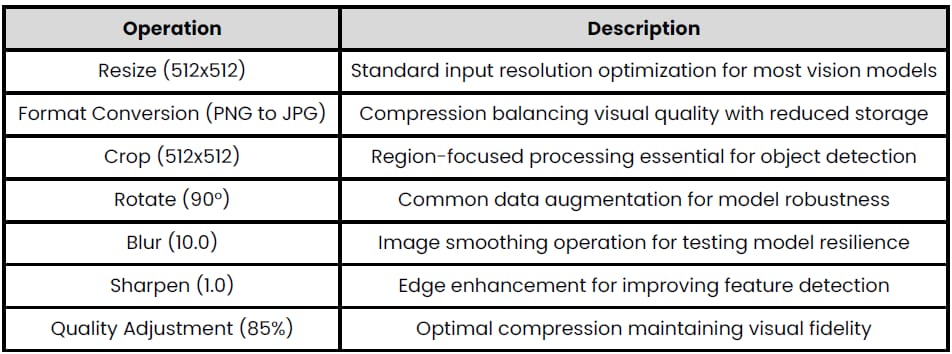
Our benchmarking methodology leverages the imgproxy image processing library running on various AMD EPYC CPU configurations. The benchmark simulates real-world computer vision preprocessing tasks under high-load conditions, focusing on seven image processing operations that are fundamental to computer vision data preparation:
Experiment Configuration: We used the DIV2K validation dataset from ETH Zurich, which provides high-quality diverse images suitable for benchmarking image processing performance. In this experiment, we varied the following input image resolutions: 1280×720 (HD), 1920×1080 (Full HD), 2560×1440 (2.5K), 3840×2160 (4K), 7680×4320 (8K). We also used the k6 load testing tool to simulate 4,096 concurrent user requests, creating a high-demand environment that challenged the processors' capabilities. We primarily evaluated throughput, measured in images processed per second, across following Dell PowerEdge servers with varying AMD EPYC CPU SKUs.
Copyright Notice
Copyright © 2025 Metrum AI Inc. All Rights Reserved. Metrum AI, the Metrum AI logo, and other trademarks are trademarks of Metrum AI Inc. The analysis in this document was conducted by Metrum AI Inc. and commissioned by Dell Technologies.
Dell Technologies, Dell, Dell PowerEdge, Dell logo, and other trademarks are trademarks of Dell Inc. or its subsidiaries. AMD, AMD logo, AMD EPYC, AMD ROCm, and combinations thereof are trademarks of Advanced Micro Devices, Inc.
Other trademarks may be the property of their respective owners.
Disclaimer
Performance varies by hardware and software configurations, including testing conditions, system settings, application complexity, the quantity of data, batch sizes, software versions, libraries used, and other factors. The results of performance testing provided are intended for informational purposes only and should not be considered as a guarantee of actual performance.
Metrum AI believes the information in this document is accurate as of its publication date. The information is subject to change without notice.