CXL: Memory Expanded and Optimized for Dell PowerEdge Servers
Introduction
Compute Express Link (CXL) is a high-speed, low-latency interconnect designed to enhance communication between CPUs, memory, and accelerators such as GPUs and FPGAs. By enabling memory expansion and device coherency, CXL improves performance and efficiency in modern data centers.
The Dell PowerEdge R7725, powered by AMD 5th Gen EPYC processors, supports CXL 2.0 Type 3 memory devices. This allows for scalable memory capacity beyond traditional DIMM limitations, making it ideal for memory-bound workloads such as in-memory databases, AI/ML, and large-scale simulations.
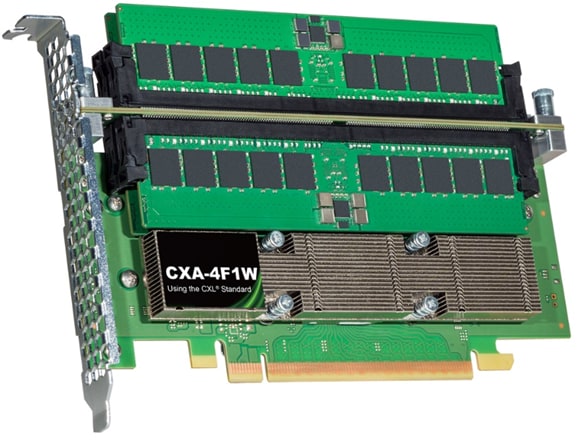
Fig 1. The CXA-4F1W used in testing the R7725
CXL-supported Dell PowerEdge platforms
Dell has integrated CXL support across several PowerEdge platforms, including the following models:
- PowerEdge R770
- PowerEdge R670
- PowerEdge R7725
- PowerEdge R7715
- PowerEdge R6725
These platforms support CXL 2.0 Type 3 memory expansion, PCIe Gen 5, and features like hot-plug support and PCIe link encryption for secure, serviceable deployments.
NUMA and CXL: understanding memory access
In systems like the PowerEdge R7725, memory is organized in a Non-Uniform Memory Access (NUMA) architecture, where each CPU socket has its own local memory. Accessing memory attached to another socket—or to a CXL device—can introduce additional latency.
CXL memory modules appear as separate NUMA nodes. While they offer significant capacity expansion, they typically have slightly higher latency than local Dynamic Random Access Memory (DRAM). This is evident in latency comparisons across logical CPU cores, where CXL-attached memory shows increased access times compared to native memory channels. However, this trade-off is often acceptable for workloads that benefit more from increased memory capacity than from ultra-low latency.
Performance insights
The AOCC5 benchmark results for the Dell PowerEdge R7725 demonstrate impressive performance across various memory functions. The benchmark evaluates the throughput of key memory operations as shown in the chart below:
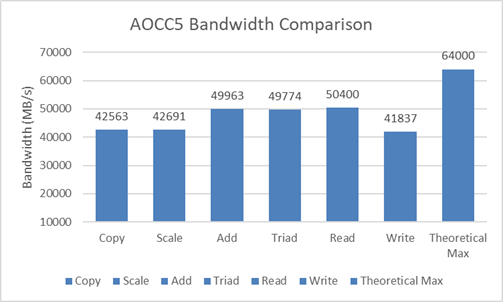
Fig 2. AOCC5 bandwidth comparison
These results highlight the server’s ability to handle memory-intensive tasks efficiently, making it well-suited for high-performance computing (HPC), AI/ML workloads, and large-scale simulations. The particularly high Read and Add performance indicates strong memory bandwidth and computational throughput—critical for data-intensive applications.
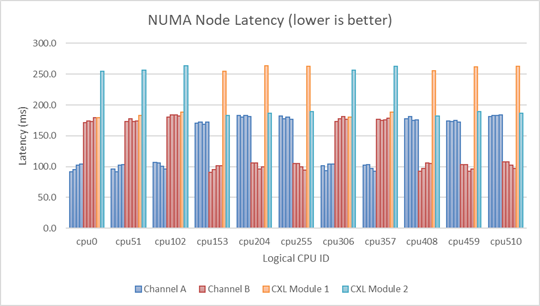
Fig 3. NUMA node latency
This chart compares memory access latency across CPU cores for local memory channels (A and B) and CXL-attached memory modules. While CXL modules show slightly higher latency, they provide valuable memory expansion without replacing existing DIMMs.
Value proposition of CXL on PowerEdge
- Expand memory bandwidth and capacity cost-effectively
- Support AI/ML, HPC, in-memory databases (IMDB), and virtualization
- Ensure broad CPU and OS ecosystem compatibility
- Enable memory pooling and tiered memory architectures
Server configuration
|
Server Model |
CPU |
System Memory |
CXL Memory |
|
PowerEdge R7725 |
AMD Zen5 128c CPU |
24x 64GB DIMM |
4x 96GB DIMM |
Summary
The Dell PowerEdge R7725 brings next-generation memory innovation to enterprise workloads with CXL 2.0 support. By enabling scalable memory expansion through Type 3 devices, the R7725 addresses the growing demands of memory-intensive applications. Whether you're running AI/ML models, large-scale simulations, or in-memory databases, CXL 2.0 offers a flexible, cost-effective path to higher performance and capacity without overhauling your existing infrastructure.