Dell PowerEdge R770AP Sets New Standard with World Record in SPEC Power Performance
Overview
The Dell PowerEdge R770AP redefines what is possible in modern data centers.
This 17thgeneration 2U, dual-socket powerhouse, powered by Intel® Xeon® 6 6900-series processors with up to 128 cores, delivers breakthrough performance for your most demanding workloads. From high-performance computing to advanced analytics and large-scale virtualization, the R770AP pushes innovation forward with unmatched compute density and efficiency.
Engineered for speed, flexibility, and future growth, it features blazing-fast DDR5 memory, PCIe Gen5 expansion, and versatile storage options, including NVMe and EDSFF drives, ensuring rapid data movement and a truly next-gen architecture. Built-in iDRAC management, fortified security capabilities, and an energy-efficient design make the R770AP a cyber-resilient platform that helps enterprises streamline operations, protect critical assets, and accelerate transformation.
Purpose-built for organizations that demand more, the PowerEdge R770AP empowers your business to unleash peak performance and stay ahead in an ever-evolving digital landscape.
Key SPEC Power Performance Highlights resulting in World Records
The Dell PowerEdge R770AP stands at the top of its class, earning both the winner and world‑record titles for overall efficiency score and power efficiency in the Intel Xeon 6980P server category, outperforming all competitive server submissions to SPECpower as of January 2026.
Overall Efficiency Score: 22,805 ssj_ops/watt: The R770AP delivers exceptional performance per watt, making it ideal for organizations seeking to maximize computational throughput while minimizing energy costs and environmental impact.
Exceptional Power Efficiency Range: The R770AP demonstrates outstanding power management capabilities, consuming 1,185 W at 100% load while delivering peak performance, and remarkably reducing power consumption to just 241 watts at active idle, only 20% of peak power. This dynamic power scaling significantly reduces operational costs during periods of low utilization while maintaining instant readiness for demanding workloads.
System Configuration
The tested Dell PowerEdge R770AP configuration represents an optimal balance of processing power, memory capacity, and energy efficiency for enterprise computing environments.
| Category | Details |
|---|---|
|
System Model |
Dell PowerEdge R770AP |
|
Form Factor |
2U rack-mount |
|
Processor Model |
Intel Xeon 6980P |
|
Processor Count |
2 chips |
|
Cores per Processor |
128 |
|
Total Cores |
256 |
|
Threads per Core |
2 |
|
Total Threads |
512 |
|
Base Clock Speed |
2.0 GHz |
|
Max Turbo Frequency |
3.9 GHz |
|
L1 Cache per Core |
64 KB I + 48 KB D |
|
L2 Cache per Core |
2 MB |
|
L3 Cache per Chip |
504 MB |
|
Total L3 Cache |
1,008 MB (1.008 GB) |
|
Memory Capacity |
768 GB |
|
Memory Type |
DDR5-6400 |
|
Memory Configuration |
24 x 32 GB 2Rx4 modules |
|
Memory Slots |
A1-A12, B1-B12 populated |
|
Storage |
1 x 960 GB NVMe Gen4 SSD |
|
Storage Controller |
PCIe SSD Backplane |
|
Network Controller |
Integrated |
|
Network Speed |
2.5 Gbps |
|
NICs Connected |
2 |
|
Power Supply |
3200W Titanium Efficiency |
|
Power Supply Count |
1 |
|
Operating System |
Microsoft Windows Server 2022 Datacenter |
|
OS Version |
21H2 (Build 20348.587) |
|
File System |
NTFS |
|
Power Management |
Balanced power plan |
Processor Architecture
The Intel Xeon 6980P processor features a revolutionary architecture designed for modern data center workloads:
- 128 cores per processor (256 cores total)
Provides exceptional parallel processing capabilities for multi-threaded applications, virtualization, and container orchestration platforms. - 504 MB L3 cache per processor
Large shared cache significantly reduces memory latency and improves performance for data-intensive workloads. - Intel Turbo Boost Technology up to 3.9 GHz
Dynamically increases processor frequency to deliver peak performance when needed while maintaining energy efficiency during normal operations.
Performance Analysis
The SPEC power_ssj2008 benchmark measures server-side Java performance across varying workload levels, from 100% utilization down to 10%, and includes an active idle state. This comprehensive testing methodology reveals how servers perform under real-world conditions where workloads fluctuate dynamically.
| Load Level | Performance (ssj_ops) | Power (watts) | Efficiency (ops/watt) |
|---|---|---|---|
|
100% |
31,355,700 |
1,185 |
26,457 |
|
90% |
28,282,000 |
1,114 |
25,396 |
|
80% |
25,133,800 |
888 |
28,296 |
|
70% |
22,006,300 |
812 |
27,118 |
|
60% |
18,867,700 |
738 |
25,571 |
|
50% |
15,708,600 |
664 |
23,666 |
|
40% |
12,560,600 |
588 |
21,364 |
|
30% |
9,437,730 |
516 |
18,281 |
|
20% |
6,295,700 |
450 |
13,989 |
|
10% |
3,135,650 |
381 |
8,232 |
|
Active Idle |
— |
241 |
— |
Performance Insights
Linear Scalability
The R770AP demonstrates excellent scalability across workload levels, with performance metrics that scale nearly linearly with utilization. From 100% load at 31.4M ssj_ops down to 10% load at 3.1M ssj_ops, the system maintains consistent per-core efficiency.
Peak Efficiency at Moderate Loads
While the system delivers impressive efficiency at full load (26,457 ssj_ops/watt), it achieves its highest efficiency rating of 28,296 ssj_ops/watt at 80% utilization. This characteristic makes the R770AP particularly well-suited for environments where sustained high utilization is common but occasional headroom is required for peak demands.
Energy Efficiency and Power Management
In modern data centers, energy efficiency is as critical as raw performance. The PowerEdge R770AP excels in this area, combining high computational throughput with intelligent power management.
| Operating State | Power Consumption | % of Peak Power |
|---|---|---|
|
100% Load |
1,185 W |
100% |
|
90% Load |
1,114 W |
94% |
|
80% Load |
888 W |
75% |
|
50% Load |
664 W |
56% |
|
Active Idle |
241 W |
20% |
Power Efficiency Analysis
Dynamic Power Scaling
The R770AP's power consumption scales efficiently with workload intensity. At active idle, the system consumes just 241 watts, representing only 20% of peak power draw. This demonstrates excellent power management capabilities that reduce operational costs during periods of low utilization.
Optimized for Variable Workloads
The performance-per-watt metrics reveal that the R770AP is exceptionally efficient across all operational states. The variance between the lowest efficiency (21,364 at 40% load) and the highest efficiency (28,296 at 80% load) is remarkably narrow, indicating consistent efficiency across workload levels.
Efficiency Across Operating Ranges
The following table illustrates the R770AP's efficiency (performance per watt) across the full spectrum of workload levels:
| Load Level | Efficiency (ssj_ops/watt) |
|---|---|
|
100% |
26,457 |
|
90% |
25,396 |
|
80% |
28,296 (peak efficiency) |
|
70% |
27,118 |
|
60% |
25,571 |
|
50% |
23,666 |
|
40% |
21,364 |
|
30% |
18,281 |
|
20% |
13,989 |
|
10% |
8,232 |
Total Cost of Ownership Benefits
The PowerEdge R770AP's combination of high performance and energy efficiency translates directly into measurable total cost of ownership (TCO) advantages:
Reduced Energy Costs
At typical utilization levels (60-80%), the R770AP maintains efficiency above 23,600 ssj_ops/watt while consuming between 664-888 watts. Over a three-year operational period, energy savings relative to less efficient alternatives can amount to thousands of dollars per server, with savings scaling with large deployments.
Lower Cooling Requirements
The R770AP's efficient power consumption reduces heat output, decreasing cooling infrastructure requirements. In data centers, where cooling accounts for 30-40% of total energy consumption, this efficiency gain compounds overall energy savings.
Higher Density Deployment
The 2U form factor, combined with exceptional performance, enables organizations to deploy more computing power per rack. This higher density reduces data center space requirements, allowing organizations to maximize their existing infrastructure investments or reduce facility costs.
Reduced Server Sprawl
The R770AP's high performance allows organizations to consolidate workloads that might otherwise require multiple servers. Fewer physical servers mean reduced hardware acquisition costs, simplified management, lower software licensing costs, and reduced network complexity.
Competitive Performance Analysis
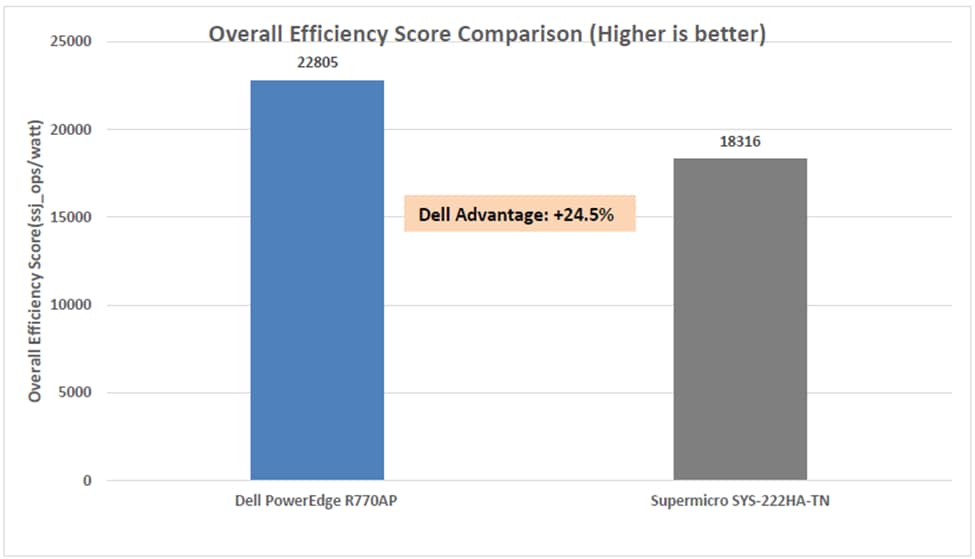
To demonstrate the Dell PowerEdge R770AP's competitive advantages, we compare its performance against the Supermicro SuperServer SYS-222HA-TN, a comparable 2U server also equipped with dual Intel Xeon 6980P processors and 256 cores. This direct comparison highlights the Dell platform's superior efficiency and power management capabilities.
Overall Efficiency Score Comparison
The Dell PowerEdge R770AP achieves an overall efficiency score of 22,805 ssj_ops/watt, representing a 24.5% advantage over the Supermicro SYS-222HA-TN's score of 18,316 ssj_ops/watt. This substantial efficiency gap translates directly into lower operational costs and reduced energy consumption across the entire spectrum of workload intensities.
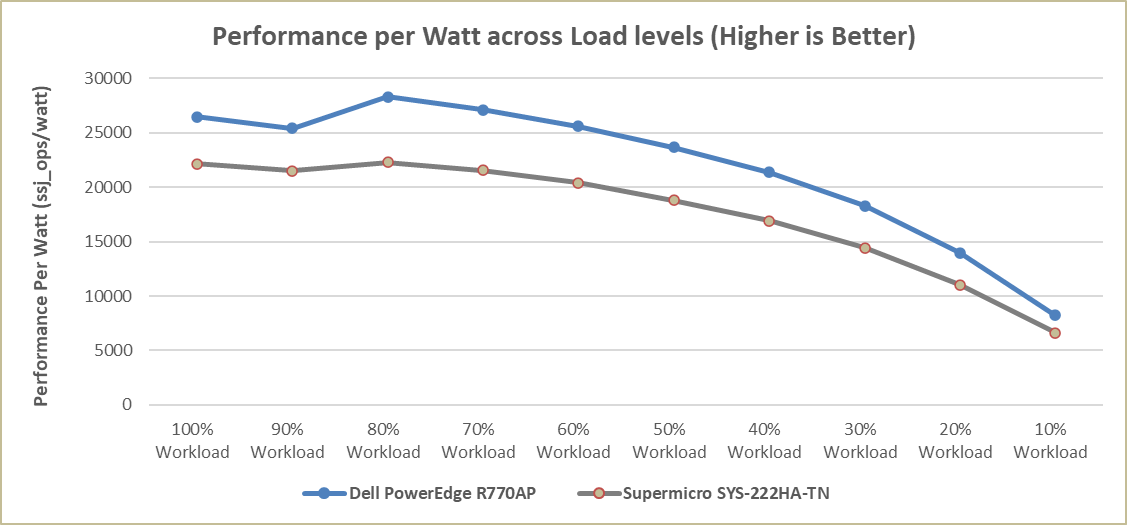
Performance per Watt Across Workload Levels
The Dell R770AP maintains its efficiency advantage across all workload levels from 100% utilization down to 10%. Notably, the Dell server achieves its peak efficiency of 28,296 ssj_ops/watt at 80% load, demonstrating exceptional performance in the critical mid-to-high utilization range where most enterprise servers operate. The Supermicro system's peak efficiency of 22,303 ssj_ops/watt at the same load level represents a 27% gap in favor of Dell.
Conclusion
The Dell PowerEdge R770AP server, equipped with dual Intel Xeon 6980P processors, represents a significant advancement in enterprise server technology. Its SPEC power_ssj2008 benchmark score of 22,805 ssj_ops/watt demonstrates industry-leading efficiency.
For organizations seeking to maximize performance per watt, reduce total cost of ownership, and future-proof their data center infrastructure, the Dell PowerEdge R770AP represents an optimal choice. Its combination of cutting-edge processor technology, intelligent power management, and proven Dell engineering makes it an ideal platform for modern enterprise workloads ranging from virtualization and cloud computing to big data analytics and high-performance applications.
About SPEC power_ssj2008
The Standard Performance Evaluation Corporation (SPEC) power_ssj2008 benchmark is the industry-standard measurement for server energy efficiency. It evaluates server performance and power consumption across a range of workload levels from 100% to 10% utilization, plus active idle state. The overall score represents the geometric mean of performance-per-watt measurements across all load levels, providing a comprehensive assessment of a server's efficiency profile. All benchmark results referenced in this white paper are publicly available at www.spec.org.
Disclaimer
The information in this white paper is based on official SPEC power_ssj2008 benchmark results available as of January 2026. Performance results are based on the specific configuration evaluated and may vary with different configurations. SPEC and the SPEC logo are registered trademarks of the Standard Performance Evaluation Corporation. Intel and Xeon are trademarks of Intel Corporation. Dell, PowerEdge, and the Dell logo are trademarks of Dell Inc.