CloudLink: How do you license a new node while adding it to an existing CloudLink cluster?
Summary: How do you license a new node while adding it to an existing CloudLink cluster?
This article applies to
This article does not apply to
This article is not tied to any specific product.
Not all product versions are identified in this article.
Instructions
CloudLink can be used as a Key Management Interoperability Protocol (KMIP) server. This is to store the encryption keys for a KMIP client such as VSAN. The general license that is used for KMIP can be applied to one or up to four nodes. It is limited to one CloudLink cluster.
One license can only be used, provided there is one partition to keep the keys for all KMIP clients. Any more partitions, require more license keys.
KMIP Licensing for CloudLink
"What licenses does a customer using CloudLink for VMware's VSAN/vSphere encryption need?"
The number of licenses you need, depends on the situation.
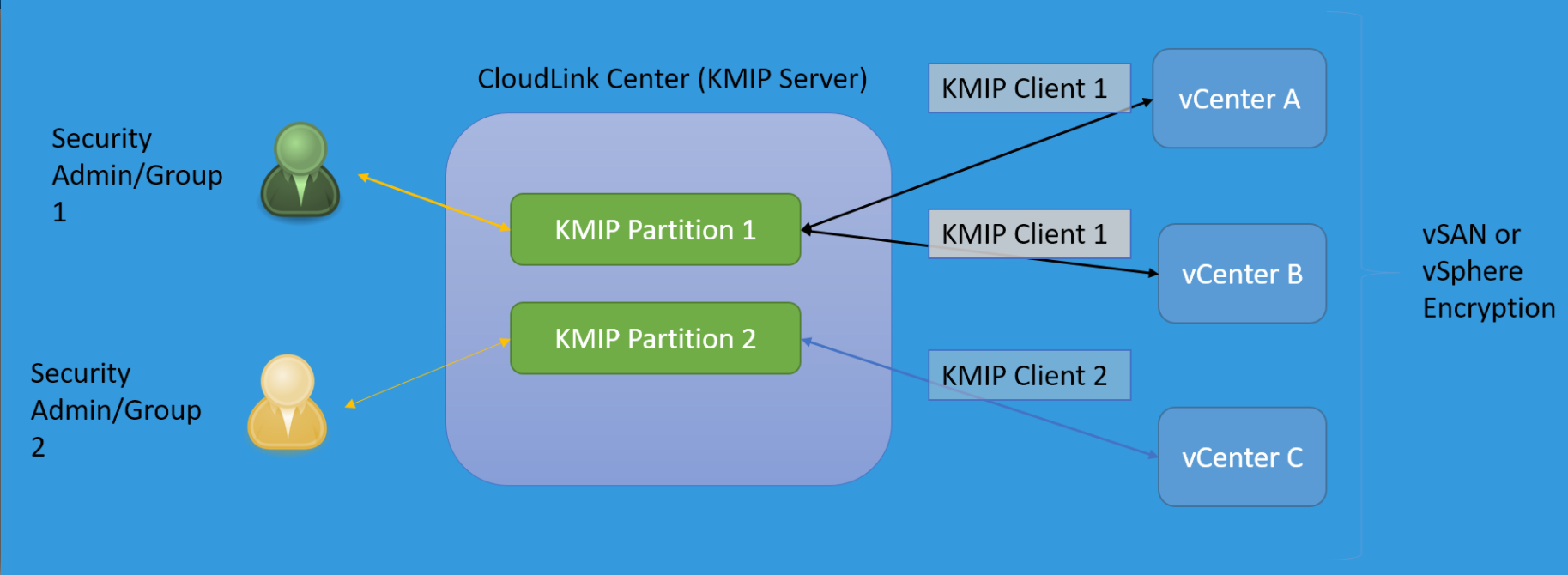
Each license allows a customer to create a single KMIP client account. This client in turn is linked to a KMIP partition, which runs on a single CloudLink Center or CloudLink Cluster.
Customers can have multiple KMIP clients/partitions per CloudLink Cluster, but nothing prevents a customer from using the same KMIP client on multiple vCenters.
Example of two KMIP licenses for three vCenters:
Common Questions:
Q) Do I need additional licensing if I am deploying a CloudLink Cluster?
A) No, a single KMIP license still allows the customer to deploy multiple CloudLink Center instances in a cluster, but only one cluster per license. CloudLink supports 1-4 nodes in an HA cluster.
Q) Can multiple vCenters use the same license?
A) Yes, provided the customer is OK to have all vCenters store keys in a single partition and therefore be managed by one user/group within CloudLink Center.
Q) When would I need more than one license?
A) Only if you want separate CloudLink Clusters (that is for different sites/vCenters), or the customer requires separate user/group administration for each site/vCenter.
Q) Is there a link between the number of licenses and the number of keys?
A) No. Although I would recommend keeping the number of VM/Keys to under 5k per Cluster.
Q) Can I mix KMIP licensing with other CloudLink encryption licensing (CloudLink SecureVM or ScaleIO encryption)?
A) Yes
Q) For VxRail, does the use of an internal vs external vCenter impact things?
A) No, VxRail can use the internal vCenter with vSAN or VM encryption. However you always need an external KMS when doing vSAN encryption (that is you do not want your keys stored inside the disks they're encrypting)
Q) Where can I get more information and sample BoM?
A) VMware Key Management Resources
One license can only be used, provided there is one partition to keep the keys for all KMIP clients. Any more partitions, require more license keys.
KMIP Licensing for CloudLink
"What licenses does a customer using CloudLink for VMware's VSAN/vSphere encryption need?"
The number of licenses you need, depends on the situation.
Each license allows a customer to create a single KMIP client account. This client in turn is linked to a KMIP partition, which runs on a single CloudLink Center or CloudLink Cluster.
Customers can have multiple KMIP clients/partitions per CloudLink Cluster, but nothing prevents a customer from using the same KMIP client on multiple vCenters.
Example of two KMIP licenses for three vCenters:
Common Questions:
Q) Do I need additional licensing if I am deploying a CloudLink Cluster?
A) No, a single KMIP license still allows the customer to deploy multiple CloudLink Center instances in a cluster, but only one cluster per license. CloudLink supports 1-4 nodes in an HA cluster.
Q) Can multiple vCenters use the same license?
A) Yes, provided the customer is OK to have all vCenters store keys in a single partition and therefore be managed by one user/group within CloudLink Center.
Q) When would I need more than one license?
A) Only if you want separate CloudLink Clusters (that is for different sites/vCenters), or the customer requires separate user/group administration for each site/vCenter.
Q) Is there a link between the number of licenses and the number of keys?
A) No. Although I would recommend keeping the number of VM/Keys to under 5k per Cluster.
Q) Can I mix KMIP licensing with other CloudLink encryption licensing (CloudLink SecureVM or ScaleIO encryption)?
A) Yes
Q) For VxRail, does the use of an internal vs external vCenter impact things?
A) No, VxRail can use the internal vCenter with vSAN or VM encryption. However you always need an external KMS when doing vSAN encryption (that is you do not want your keys stored inside the disks they're encrypting)
Q) Where can I get more information and sample BoM?
A) VMware Key Management Resources
Affected Products
CloudLink SecureVM, CloudLinkArticle Properties
Article Number: 000197481
Article Type: How To
Last Modified: 13 مايو 2026
Version: 4
Find answers to your questions from other Dell users
Support Services
Check if your device is covered by Support Services.