Live Optics | OS Licensing by Cluster
Summary: This article offers some observations on Live Optics OS Licensing by Cluster data.
This article applies to
This article does not apply to
This article is not tied to any specific product.
Not all product versions are identified in this article.
Instructions
Note: Licensing Optimization by cluster applies to larger organizations that have multiple hypervisor clusters running in their environment. For those that do, this could be a real money saver.
Windows and some variations of Linux can dictate operating systems licenses by the number of potential Cores or Sockets.
For Windows, the minimum number of cores that can be licensed on a machine are 16 and would require a Datacenter license. In a three-node cluster, this would mean a minimum of 48 licensed cores.
This might seem too obvious, but for that reason it is often overlooked. Here is an figure of how to read this AIR report graph and put it to use towards saving licensing fees in your environment.
Overtime people create new VMs and might not consider the licensing impact associated with where they place that VM. This can create an almost "Operating Systems Fragmentation" like effect.
Consider this scenario:
In this environment there are two clusters. Each cluster is consisted of three nodes. Each node has a two-socket/four cores per socket hardware spec.
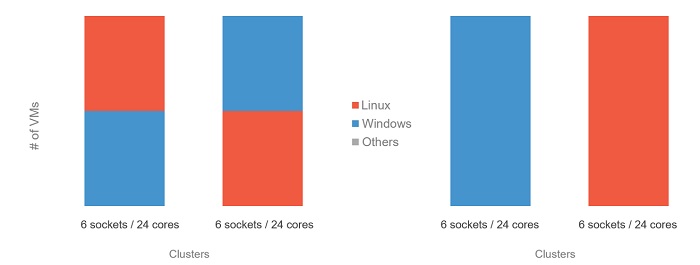
Example A (left graph):
Here we can see that each cluster is hosting approximately 50% licensable Linux and 50% licensable Windows Operating Systems.
The net effect is that each Operating System could cause an over licensing scenario whereby two clusters need Windows licensing instead of one. In a true-up scenario, this could be subject to heavy unforeseen fees.
Example B (right graph):
When concentrating all licensable operating systems to a single cluster, the net effect is that it is possible to reduce licensing overhead to only one cluster, thus reducing licensing overhead by 50% (and perhaps 50% associated with two different operating system vendors).
The larger the environment, the more potential for operating system licensing fragmentation and the greater the value of emphasizing the disbursement of operating systems between clusters
Here is another before and after way to look at this to drive the point home.
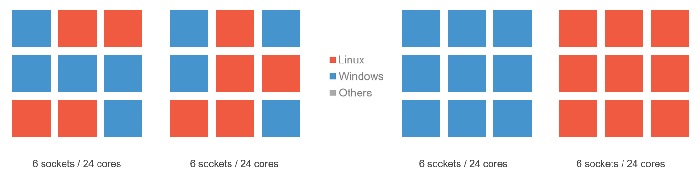
In reality this might force the assumption that all VMs are equal and swapping a VM from one cluster to another is an even trade; rarely the case. There are many other factors like function, location, and failover that factor into VM placement and licensing requirements.
While creating 100% homogenous clusters to an OS might not always be achievable, it is still worth paying attention to as licensing is expensive and any recuperation of overage is pure benefit.
Additional Information
If you have any questions, please reach out to Live Optics Support at liveoptics.support@dell.com.
Affected Products
LiveOpticsArticle Properties
Article Number: 000233946
Article Type: How To
Last Modified: 03 رمضان 1447
Version: 3
Find answers to your questions from other Dell users
Support Services
Check if your device is covered by Support Services.