Connectrix B-Series: How to use PuTTY for SSH key-based authentication
Résumé: Learn how to use PuTTY for SSH key-based authentication. Step-by-step instructions to create SSH keys, add SSH key to PuTTY, and connect with SSH key securely on Connectrix B-Series.
Cet article concerne
Cet article ne concerne pas
Cet article n’est associé à aucun produit spécifique.
Toutes les versions du produit ne sont pas identifiées dans cet article.
Instructions
Generate SSH keys Using Putty Gen Key:
1. Run the PuTTY key generation tool from C:\Program Files\PuTTY\puttygen or using the puttygen command from the command line.
2. Select Generate in the PuTTY Key Generator window. Move the mouse to create the random values used to develop the key.
3. Select specific key types and bit lengths. Options include RSA, Digital Signature Algorithm, Elliptic Curve Digital Signature Algorithm and more.
4. Select the entire contents of the "Public key for pasting into OpenSSH authorized_keys file" from the Key window. This is the public key. Copy it to the clipboard to paste into a notepad file "authorized_keys'.

5. Rename the authorized_keys file to authorized_keys.pub
6. Select Save private key. Select Yes in the PuTTYgen Warning window regarding passphrases.

7. Login to the switch and import the authorized_keys.pub key using "sshutil importpubkey" command.

Next steps are to configure Putty for SSH Authentication. The example used is for putty version 0.79.
1. Launch PuTTY but do not connect to a remote system.
2. In the Category window, browse to Connection>Data.
3. Set the Auto-login username to the remote SSH username. This is the user for whom you created the authorized_keys file in putty gen key.

4. Browse to Connection>SSH>Auth>Credentials. Select Browse. Find the saved private key (.ppk) created with the PuTTYgen application.
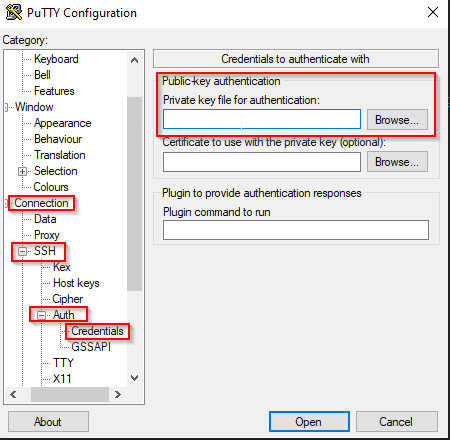
5. Test key-based authentication
You are now ready to test the connection. Expect the connection to be established without a password challenge.
At the top of the Category window, select Session to return to the main connection window. In the Host Name (or IP address) box, enter the destination hostname or IP address.
6. Select Open to test the session. A message indicating "Authenticating with public key" will appear in the SSH connection window if key-based authentication was configured correctly.
7. You have successfully configured PuTTY to use key-based authentication.
1. Run the PuTTY key generation tool from C:\Program Files\PuTTY\puttygen or using the puttygen command from the command line.
2. Select Generate in the PuTTY Key Generator window. Move the mouse to create the random values used to develop the key.
3. Select specific key types and bit lengths. Options include RSA, Digital Signature Algorithm, Elliptic Curve Digital Signature Algorithm and more.
4. Select the entire contents of the "Public key for pasting into OpenSSH authorized_keys file" from the Key window. This is the public key. Copy it to the clipboard to paste into a notepad file "authorized_keys'.
NOTE: Do not Create or use Public Key created by clicking on the radial button "Save public key".
5. Rename the authorized_keys file to authorized_keys.pub
6. Select Save private key. Select Yes in the PuTTYgen Warning window regarding passphrases.
7. Login to the switch and import the authorized_keys.pub key using "sshutil importpubkey" command.
Next steps are to configure Putty for SSH Authentication. The example used is for putty version 0.79.
1. Launch PuTTY but do not connect to a remote system.
2. In the Category window, browse to Connection>Data.
3. Set the Auto-login username to the remote SSH username. This is the user for whom you created the authorized_keys file in putty gen key.
NOTE: Skip this part if you want to enter user name manually everytime you login to the switch.
4. Browse to Connection>SSH>Auth>Credentials. Select Browse. Find the saved private key (.ppk) created with the PuTTYgen application.
5. Test key-based authentication
You are now ready to test the connection. Expect the connection to be established without a password challenge.
At the top of the Category window, select Session to return to the main connection window. In the Host Name (or IP address) box, enter the destination hostname or IP address.
6. Select Open to test the session. A message indicating "Authenticating with public key" will appear in the SSH connection window if key-based authentication was configured correctly.
7. You have successfully configured PuTTY to use key-based authentication.
Produits concernés
Connectrix B-SeriesProduits
ConnectrixPropriétés de l’article
Numéro d’article: 000217157
Type d’article: How To
Dernière modification: 10 avr. 2025
Version: 4
Trouvez des réponses à vos questions auprès d’autres utilisateurs Dell
Services de support
Vérifiez si votre appareil est couvert par les services de support.