Avamar: Manage SSH connection timeout
Résumé: This article shows how to manage the Avamar SSH timeout.
Cet article concerne
Cet article ne concerne pas
Cet article n’est associé à aucun produit spécifique.
Toutes les versions du produit ne sont pas identifiées dans cet article.
Instructions
WARNING: Changing the timeout configuration on Avamar is not recommended as it will not meet STIG compliance and leave sessions active longer.
In Avamar version 19.3 and later, the default configuration for Avamar SSH timeout is to be STIG-compliant.
There are three pieces to configuring an SSH timeout.
- SSH Daemon (SSHD) configuration
- Bash profile timeout environment variable
- SSH Client keep-alive configuration
SSHD Configuration
The Secure Shell Daemon application (SSH daemon or sshd) is the daemon program for ssh.
The following two options in the SSHD configuration file can be used to manage the ssh timeout.
ClientAliveInterval
ClientAliveCountMax
The default values used for Avamar are STIG compliant as part of Avamar hardening are below:
ClientAliveInterval 600
ClientAliveCountMax 1
This means, every ten minutes SSHD sends a request to the SSH client to provide any sort of keep-alive.
Since the "ClientAliveCountMax" is set to one, there is only one chance for the client to respond before SSHD terminates the ssh connection with a timeout.
To change this behavior, follow the steps below.
Edit the SSHD configuration file as root user:
/etc/ssh/sshd_config
Change the values as an example below:
ClientAliveInterval 7200
ClientAliveCountMax 4
With the example above, this means that every two hours, SSHD sends a request to the SSH client to provide any sort of keep-alive. Since the "ClientAliveCountMax" is set to four, the client has four chances to respond before SSHD terminates the connection.
Save the SSHD configuration file.
Test the configuration before restarting the service.
sshd -t
If there are no issues returned, restart the service.
service sshd restart
Bash Profile Timeout
Avamar sets the "TMOUT" environment variable in the bash profile used by both admin and root users.
This timeout is applied to the shell itself, separate from SSHD.
This is set in the following file:
/etc/profile
The variable is set to default below towards the bottom of the file:
TMOUT=900
The default value of 900 is in seconds, which is 15 minutes.
To change this behavior, edit the timeout variable:
TMOUT=7200
Save the bash profile file.
After changing the bash profile file, in order for the change to take effect, restart the ssh session.
SSH Client Keep-Alive Configuration
There are many different SSH clients that can be used.
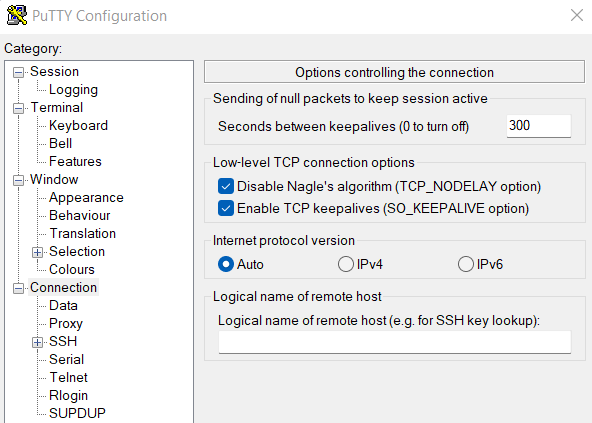
The following example is taken from PuTTY.
The SSH client can be configured to send ssh keep-alive packets to keep the connection open and satisfy the "ClientAlive*" options applied in the SSHD configuration file.
Set the seconds between keepalives, meaning every 300 seconds PuTTY sends an ssh keepalive packet to the server.
Also, select the checkbox to enable TCP keepalives in general.
Produits concernés
AvamarPropriétés de l’article
Numéro d’article: 000223301
Type d’article: How To
Dernière modification: 08 Jan 2026
Version: 4
Trouvez des réponses à vos questions auprès d’autres utilisateurs Dell
Services de support
Vérifiez si votre appareil est couvert par les services de support.