
Securing the Edge for the AI Era
The centre of gravity for enterprise computing is moving to the edge. More data is now created and used outside the …
By James Scott
The centre of gravity for enterprise computing is moving to the edge.
More data is now created and used outside the data centre, in stores, factories, hospitals, and vehicles. Dell defines the edge simply: where data is processed near its point of creation to drive immediate value. Advances in software and AI models have made that value far easier to capture, for organizations of every size and in every industry.
An earlier post, Security in the Generative AI Era, framed the central question for any AI strategy: whether to bring data to the model, or the model to the data. At the edge, that answer is increasingly obvious. Moving large volumes of data off-site is costly, slow, and often runs into data privacy rules, so bringing the model to the data keeps sensitive information where it is created. That is as much a security as advantage as it is a performance one, provided the hardware underneath can be trusted.
That shift to the edge creates a security problem. The data centre has a known perimeter, controlled access, and staff on site. The edge has none of that. Securing it is not the same job, and treating an edge site like a smaller data centre is where things can go wrong.
The edge redefines the security problem
Edge sites are distributed by nature, often unattended, and frequently run by operations teams rather than IT. A device can sit in a retail back room, on a factory floor, or in a roadside cabinet, exposed to dust, vibration, and, more importantly, to people. Physical access is the first risk. If a device can be opened, swapped, or replaced without anyone noticing, every control above it is already in question.
Scale makes the security issue harder. Protecting ten devices is a task. Protecting ten thousand across hundreds of locations is a discipline. A few realities separate edge security from data centre security:
- Sites are physically exposed and rarely have dedicated security staff.
- Many are managed by operational technology teams with different priorities than IT.
- Every new location widens the attack surface.
- Manual setup at each site introduces configuration drift and human error.
AI raises the stakes further. As more inferencing and decision-making move to edge sites to cut latency, those locations hold more valuable data and carry more operational weight, which makes a compromised device far more damaging than it was a few years ago. The core question for leaders is no longer whether the edge can process data. It is whether every device doing so can be trusted.
Trust starts in the supply chain, not the field
Hardware security is layered, and the supply chain is the foundation the other layers sit on. If you cannot prove that a device arrived exactly as it was built, then secure boot, encryption, and access controls all rest on an unverified base. This is where an edge security program should spend its early effort, not as an afterthought once devices are already in the field.
Dell builds that proof into manufacturing. Dell Distributed Private Cloud endpoints (formerly NativeEdge) are cryptographically signed and certified in the factory, and Secured Component Verification confirms that the hardware you receive matches what Dell built. A Trusted Platform Module and FIDO Device Onboarding create a verifiable chain of custody, so a device is validated automatically the moment it is powered on at a remote site. Security holds from the point of manufacture, along the supply chain, to the point of production. If a device is tampered with along the way, the platform isolates it instead of trusting it.
This is the difference between hoping a device is clean and being able to prove it, at scale, without sending an expert to every location.
Consistency is a security control
Software teams solved a version of security control problem years ago. Before containers and CI/CD pipelines, deployments were manual, inconsistent, and hard to audit. Those tools did more than speed things up. They made controls consistent, repeatable, and automated, and gave teams an enforceable way to deliver them. Secure practices became measurable rather than aspirational.
Edge hardware has been waiting for the same or higher level of security, and that gap is the real bottleneck. Automating and enforcing security across physical devices has always been harder than doing it in code.
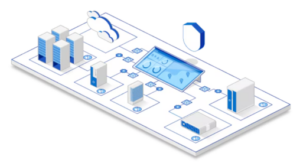
Dell Distributed Private Cloud closes that gap. It acts as the control plane for distributed edge operations: a full-stack platform that lets an enterprise centrally deploy, orchestrate, and manage infrastructure and applications across edge sites and distributed data centres. Zero-touch onboarding means a device ships from the factory, gets plugged in by local staff, and provisions itself against a single hardened baseline, with no specialist on site. Policy, role-based access, network segmentation, and continuous attestation are then enforced centrally, the same way from the first site to the thousandth. It also simplifies compliance with frameworks such as HIPAA, PCI, and GDPR by standardizing logging and configuration across locations.
The payoff is both operational and defensive. Fewer manual steps and fewer site visits mean a smaller window for error and tampering, and a consistent, auditable posture everywhere. Eaton is modernizing more than 230 factories on this model, unifying IT and OT, cutting software deployment from months to days, and strengthening its cybersecurity posture through zero-touch provisioning. CSX processes most of its data at the edge with zero-touch deployment and zero-trust security to improve safety and awareness across its rail network. In both cases, security and speed came from the same source: consistency enforced by automation, from the factory to the field.
Start with a secure foundation, then scale
The edge is increasingly where AI meets the physical world, which raises both the value of these deployments and the cost of getting security wrong. The answer is not to wait for a perfect stack, nor to let antiquated hardware management stall your ambitions at the edge. Pick a small number of high-value edge use cases, deploy them on a foundation that carries trust from the factory to the field, and prove out governance at those sites before scaling more widely.
Treat edge hardware with the same rigour and automation you already expect from your software, and the edge stops being a risk you inherit. It becomes an advantage you can defend.

About the Author: James Scott