
Activate More Data. Spend Less.
Introducing the new ultra-dense storage engine of the Dell AI Data Platform: Dell ObjectScale X7700 with release 4.4.
By David Noy
Key takeaways
7 min read- The next decade of AI will be won by organizations that can activate their data, not just store it.
- The new Dell ObjectScale X7700 is built for that future. As the dense object storage engine of the Dell AI Data Platform, it holds 45% more capacity in the same footprint, reads and writes data up to 3 times faster and queries it in place up to 4.5 times quicker, turning stored data into a living source of intelligence.
- New operational capabilities in the accompanying ObjectScale 4.4 release include QoS throttling, a refreshed management interface and seamless ECS intermix support to help organizations scale their storage environment with less complexity and lower total cost of ownership.
The organizations pulling ahead in AI share one trait: they treat data as something to put to work, not something to warehouse. Dell ObjectScale X7700, now available as the dense HDD bulk tier of the Dell AI Data Platform, is designed for that direction of travel, supporting key operations such as ingest, data prep (including ETL), enrichment and archive. It activates more of your data at a lower cost per token, accelerates intelligence pipelines and reduces operational overhead so your team invests its energy in AI outcomes. The data you already hold becomes the foundation of what you build next.
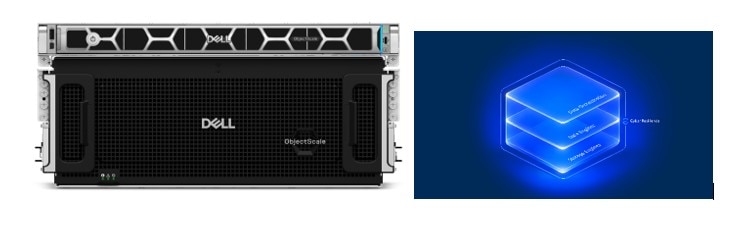
That foundation matters because the ground is shifting. Unstructured data keeps growing, analytics demands keep rising and compliance and sovereignty rules keep tightening. Many teams reached for the cloud only to meet unpredictable egress and processing costs. ObjectScale X7700 charts a different course, keeping more data accessible on premises and feeding it straight into the AI Data Platform, where storage and intelligence meet. This is the larger Dell arc: helping you turn the data you own into the outcomes you want.
Room to grow into what’s next
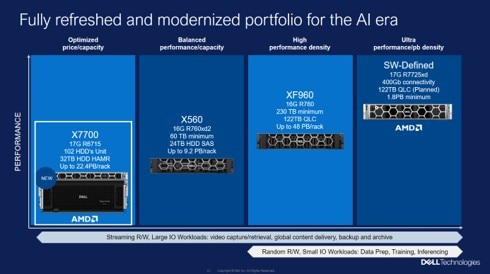
AI ambitions grow faster than data center floor space. ObjectScale X7700 anticipates that reality by delivering up to 45% more HDD capacity.¹ The architecture is disaggregated, built on a 1U compute and 4U storage design, so you can scale compute and capacity based on what your workloads actually demand.
Training data, compliance records and long-term archives stay close and ready. That density matters not just for cost efficiency but for the kind of broad, sustained AI initiatives that draw on deep data reserves over time.
Performance built for AI pipelines
Storage that can’t keep pace with AI data preparation becomes the bottleneck. ObjectScale X7700 addresses this directly with front-end networking at 100GbE, delivering four times faster throughput than its predecessor. Backup and restore windows shrink, and data flows to your models at the pace they require.
ObjectScale X7700 running release 4.4 also brings up to three times faster read and write performance compared to ECS EX5000 with release 4.3.² A single-node X7700 configuration delivers equivalent performance to a previous-generation dual-node EX5000 for most use cases.³ That’s a meaningful shift in what you can accomplish with the infrastructure you have.
Insight at the source
Copying data before you can analyze it adds time, cost and operational complexity. Production-ready S3 Tables in ObjectScale 4.4 support Apache Iceberg table workflows, letting you query structured data in place, up to 4.5 times faster⁴ with no data movement required. Insights come directly from where the data already resides.
Alongside faster querying, ObjectScale 4.4 delivers up to three times faster S3 listing performance compared to version 4.3.⁵ That means analysis reaches your team sooner, decisions happen on fresher information and the distance between a question and a useful answer keeps shrinking.
Operational simplicity at scale
Advanced capabilities are only valuable if your team can manage them without adding overhead. ObjectScale 4.4 software was built with that in mind:
- QoS throttling protects critical workloads from resource contention in shared environments.
- A refreshed management interface puts more routine tasks directly in your team’s hands, reducing dependency on specialized support.
- Customer-driven pre-upgrade health checks let you assess cluster readiness before a change window, reducing the risk of disruption.
- Seamless intermix support for existing ECS and ObjectScale customers means X7700 nodes can be added to live clusters after the appropriate software upgrade, protecting prior infrastructure investment.
With ObjectScale 4.4, that continuity extends beyond one system, giving you a modern software foundation across the refreshed ObjectScale portfolio of turnkey HDD, turnkey all-flash and software-defined options. This allows traditional content and AI data to be consolidated in one cloud-scale environment, simplifying standardization and expansion of AI-ready storage without rearchitecting for each new use case.
AI-era economics
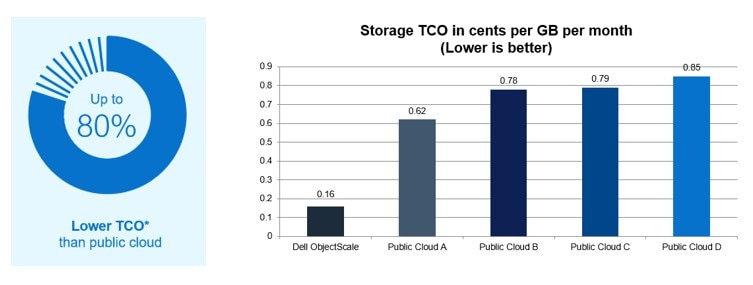
As part of the Dell AI Data Platform, ObjectScale X7700 connects dense, affordable storage to the intelligence pipelines, analytics engines and governance frameworks that turn raw data into usable insight. Organizations can benefit from up to 80% lower total cost of ownership compared to public cloud,⁶ making on-premises object storage a financially disciplined choice alongside the operational ones.
Take the next steps
The future belongs to organizations that activate their data, not just retain it. Talk to a Dell storage specialist about sizing ObjectScale X7700 for your environment or explore features and value in depth. Register now and join us Oct. 6–7 for the Dell AI Data Platform event showing how Dell customers are moving from AI pilots to production.
FREQUENTLY ASKED QUESTIONS
What is Dell ObjectScale X7700?
Dell ObjectScale X7700 is the new ultra-dense HDD object storage engine in the Dell AI Data Platform, designed to help organizations keep more data accessible on premises for AI, analytics, backup and long-term retention workloads.
How does ObjectScale X7700 improve storage efficiency?
ObjectScale X7700 delivers up to 45% more HDD capacity in the same footprint, helping organizations scale data-intensive environments while using less data center space.
How does X7700 support AI data pipelines?
It is built to accelerate AI and analytics workflows with faster networking, stronger read/write performance and quicker access to data so teams can move from ingest to insight with fewer bottlenecks.
What is new in ObjectScale 4.4?
ObjectScale 4.4 introduces capabilities such as production-ready S3 Tables, QoS controls, faster S3 performance and operational improvements that simplify management at scale.
Can existing ECS or ObjectScale customers adopt X7700 without starting over?
Yes. After the appropriate software upgrade, customers can add X7700 into supported existing environments, helping protect prior investments while expanding capacity and performance.
1 Based on Dell comparison of maximum available storage capacity on planned ObjectScale X7700 versus previous-generation ECS 5000, May 2026. Actual results may vary.
2 Based on Dell internal testing comparing object reads in ObjectScale X7700S with version 4.4 vs. ECS EX5000S with version 4.3, July 2026. Actual results may vary.
3 Based on Dell internal testing comparing an ObjectScale X7700S single-node configuration to a previous-generation EX5000D dual-node configuration across representative workloads, July 2026. Actual results may vary.
4 Based on Dell internal ObjectScale S3 Tables testing, Sept. 2025. Actual results may vary.
5 Based on Dell internal testing comparing S3 listing performance in ObjectScale 4.4 vs. ObjectScale 4.3, July 2026. Actual results may vary.
6 Omdia Economic Validation sponsored by Dell Technologies, “Analyzing the Economic Benefits of Dell ObjectScale: Economic Benefit Analysis of On-Premises Object Storage vs. Public Cloud,” Tony Palmer, July 2026. Cost savings based on Omdia comparison of ObjectScale to leading public clouds in active storage scenarios. Actual results will vary.

About the Author: David Noy