How to Use and Troubleshoot Dell Performance Docking Station WD19DC or WD19DCS
Summary: Learn how to set up, use, and troubleshoot Dell Performance Docking Station WD19DC or WD19DCS. Find information about drivers, setting up multiple monitors and troubleshooting steps to resolve common issues. ...
Instructions
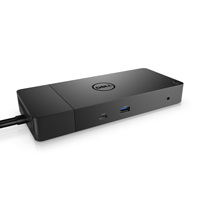
Dell Performance Docking Station WD19DC or WD19DCS is a device that links all your devices to your laptop using a dual USB Type-C (USB-C) cable interface. Connecting the laptop to the docking station allows you to access all peripherals without having to plug each device into the laptop. (For example: Mouse, keyboard, stereo speakers, external hard drive, and large-screen displays.)
For help with specifications, setup, connecting an external monitor, troubleshooting common issues, and so on, see an expanding section below.
| Laptop Connectivity | Dual USB-C (with DisplayPort over USB-C alternate mode or Thunderbolt 3) |
|---|---|
| Video ports |
|
| Audio ports (WD19DC Only) |
|
| Network ports |
|
| USB ports |
|
| Power or DC-in |
|
| Power Delivery | Dell laptops
|
The Dell Performance Docking Station WD19DC or WD19DCS is designed for laptops with dual USB-C ports that support DisplayPort over USB-C protocol. Before using the docking station, ensure that your laptop has dual USB-C ports.
| Product | Model number | WD19DC - 240 W AC adapter with 210 W Power Delivery |
|---|---|---|
| Latitude | 3390 2-in-1, 3400, 3490, 3500 and 3590 | Supported* |
| Latitude | 5280, 5289, 5290, 5290 2-in-1, 5300 2-in-1, 5300, 5400, 5480, 5490, 5500, 5580 and 5590 | Supported* |
| Latitude | 5491 and 5591 | Supported* |
| Latitude | 7200 2-in-1, 7280, 7285, 7300, 7380, 7389, 7390, 7390 2-in-1, 7400, 7400 2-in-1, 7480 and 7490 | Supported* |
| Dell Precision | 3520, 3530 and 3540 | Supported* |
| Dell Precision | 5520, 5530 and 5530 2-in-1 | Supported* |
| Dell Precision | 7520 and 7720 | Supported* |
| Dell Precision | 7530, 7730 and 7740 | Recommended |
| Rugged | 5420, 5424 and 7420 | Supported* |
| XPS | 9360, 9365, 9370 and 9380 | Supported* |
| XPS | 9560 and 9575 | Supported* |
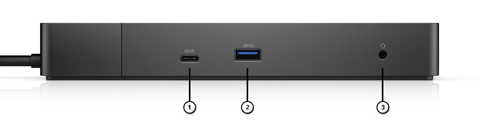
Figure 1: Dell Performance Docking Station WD19DC or WD19DCS Front Ports
| 1. | USB-C 3.1 Gen1 |
|---|---|
| 2. | USB 3.1 Gen1 |
| 3. | Headphone/Microphone Combo (WD19DC only) |
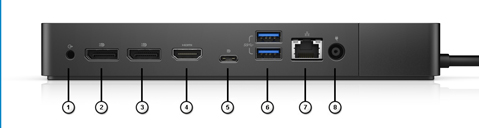
Figure 2: Dell Performance Docking Station WD19DC or WD19DCS Rear Ports
| 1. | Audio line-out (WD19DC only) |
|---|---|
| 2. | DisplayPort 1.4 |
| 3. | DisplayPort 1.4 |
| 4. | HDMI 2.0 |
| 5. | USB-C 3.1 Gen1 with DP 1.4 |
| 6. | 2 x USB 3.1 Gen1 |
| 7. | Gigabit Ethernet |
| 8. | AC power |
Dell highly recommends the following applications to automate the installation of BIOS, firmware, driver, and critical updates specific to your laptop and docking station:
- Dell | Update - for Dell XPS laptops only
- Dell Command | Update - for Dell Latitude, Dell Precision, or XPS laptops
Download and install the driver for the Dell WD19DC or WD19DCS docking station
- Browse to the Dell Drivers & Downloads page.
- Click Detect PC to auto-detect your product, or enter your computer’s Service Tag in the Enter a Service Tag or Express Service Code field, or click Browse all products to browse to your computer model.
- Select the Operating System.
- Download and install the latest Basic Input/Output System (BIOS) for the computer. This is available in the
;BIOS
section.Note: To learn more about updating the BIOS on a Dell computer, see the Dell knowledge base article: BIOS Update Guide - Download and install the latest Intel or NVIDIA or AMD graphics driver for the computer. This is available in the
;Video
section. - Download and install the latest Realtek USB Audio Driver for the docking station. This is available in the
;Docks/Stands
section. (WD19DC only) - Download and install the latest Realtek USB GBE Ethernet Controller Driver for the docking station. This is available in the
;Docks/Stands
section. - Restart the computer.
- After the driver update process completes, connect the AC adapter to the Dell WD19DC, or WD19DCS dock first and then attach the USB Type-C (USB-C) cable to the computer before using the docking station.
;Chipsetsection.
To learn more about installing drivers for Dell Performance Docking Station WD19DC or WD19DCS docking station, see the Dell knowledge base article: Driver Installation Guide for Dell Performance Docking Station WD19DC or WD19DCS
Microsoft Windows operating system includes the VGA graphics drivers only. We recommend that you install the latest Dell graphics drivers applicable for your laptop for optimum graphics performance. The latest version is available from the Dell Drivers & Downloads website under the ;Video
section.
- For NVIDIA Discrete Graphics solutions on the Latitude E-Family and Mobile Dell Precision laptops:
- First, install the Intel Media Adapter Graphics Driver applicable to your laptop.
- Second, install the NVIDIA Discrete Graphics Driver applicable to your laptop.
- For AMD Discrete Graphics solutions on the Latitude E-Family and Mobile Dell Precision laptops:
- First, install the Intel Media Adapter Graphics driver applicable to your laptop.
- Second, install the AMD Discrete Graphics driver applicable to your laptop.
Before connecting the docking station to your laptop and connecting a monitor and other external devices, ensure to install all the required drivers.
Connect the monitor to the docking station using the DisplayPort, HDMI, or USB-C cable provided with the monitor. The docking station supports up to 6* monitors (available on select Dell laptops only) connected simultaneously. See the Display Resolution Table below for more details about the supported resolution when connecting multiple monitors to the docking station.
To learn more about setting up and troubleshooting issues with multiple monitor setups, see these Dell knowledge base articles: How to Set up Dual Monitors or Multiple Monitors or How to Troubleshoot Multiple Monitor Issues
Display resolution table
External monitors require a certain amount of bandwidth to work properly. Monitors with higher resolution require more bandwidth.
- HBR2 is DP 1.2 (5.4 Gbps maximum link rate per lane). With DP overhead, the effective data rate is 4.3 Gbps per lane. Laptop supports HBR2 if the DisplayPort supports DP 1.2 protocol.
- HBR3 is DP 1.4 (8.1 Gbps maximum link rate per lane). With DP overhead, the effective data rate is 6.5 Gbps per lane. Laptop supports HBR3 if the DisplayPort supports DP 1.4 protocol.
|
Resolution |
Minimum bandwidth required |
|---|---|
| 1 x FHD (1920 x 1080) @ 60 Hz | 3.2 Gbps |
| 1 x QHD (2560 x 1440) @ 60 Hz | 5.6 Gbps |
| 1 x 4k (3840 x 2160) @ 30 Hz | 6.2 Gbps |
| 1 x 4k (3840 x 2160) @ 60 Hz | 12.5 Gbps |
| DisplayPort available bandwidth | Single Display (maximum resolution) | Dual Display (maximum resolution) | Triple Display (maximum resolution) | Quad Display (maximum resolution) |
|---|---|---|---|---|
| HBR2 (HBR2 x4 lanes - 17.2 Gbps) |
|
|
|
|
| HBR3 (HBR3 x4 lanes - 25.9 Gbps) |
|
|
|
Using Daisy-chain:
|
If the Display Port Data Rate is HBR2 then the maximum resolution that Linux supports is 8192 x 8192 (counted with integrated display plus external display).
Dell Precision 7530 and Dell Precision 7730 with AMD Graphics only supports dual 4K@60 Hz non-HDR monitors. That is when both monitors are plugged to the two DP ports. (They are not plugged to HDMI.)
Resolution support is also dependent on the monitor’s Extended Display Identification Data (EDID) resolution.
| Symptom | Possible Solution |
|---|---|
| The docking station appears to be unresponsive, not detected, or no power:. |
|
| No video on the monitors that are attached to the High Definition Multimedia Interface (HDMI), or DisplayPort (DP) port on the docking station. |
|
| The video on the attached monitor is distorted or flickering. |
|
| The video on the attached monitor is not displaying as an Extended Monitor. |
|
| The audio connector is not functioning or there is a lag in the audio. (WD19DC only) |
|
| The USB ports are not functioning on the docking station. |
|
| The HDCP content is not displayed on the attached monitor. |
Note: The monitor/display connected to the docking station must support HDCP 2.2.
|
| The LAN port is not functioning. |
|
| Cable LED is not ON after it is connected to your host. |
|
| USB port has no function in a pre-OS environment. | If your BIOS has a USB Configuration page, ensure that the following options are checked:
|
| PXE boot on dock does not function. | If your BIOS has an integrated NIC page, select Enabled w/PXE. If your BIOS Setup on your laptop has a USB Configuration page, ensure that the following options are checked:
|
| USB Boot does not function. | If your BIOS has a USB Configuration page, ensure that the following options are checked:
|
AC Adapter is displayed as ;Not Installedin the Battery Information page of the Dell BIOS Setup when the Type-C cable is connected. |
|
| Peripherals connected to the docking station do not work in a pre-OS environment. | If the BIOS Setup on your laptop has a USB Configuration page, check the following option to enable docking station function in a pre-OS environment:
|
The alert message ;You have attached an undersized power adapter to your systemis displayed when the docking station is connected to your laptop. |
|
| Undersized power adapter warning message that is displayed and cable LED are off. |
|
| No external display, and the USB or data and cable LED is off. |
|
| When the laptop or dock is moved, the cable LED turns off. |
|
| Troubleshooting multiple monitor issues. |
|
| With Ubuntu 18.04 LTS, the WIFI is turned off when the docking station is connected to the laptop. The WIFI turns On again after rebooting the laptop. |
|
To update the firmware on your docking staion, perform the following steps
- Go to the Dell Drivers & Downloads website.
- Identify your dock using its Service Tag, Express Service Code, or Model Number.
- Locate the Dell Dock Firmware Update Utility and click Download.
- Ensure the docking station is connected to your computer.
- After downloading, run the Firmware Update Tool. Ensure to start the firmware update tool in administrative mode, and follow the prompts.
Additional Information
Using Your Dell Performance Docking Station WD19DC or WD19DCS
Watch this video to learn how to use your Dell Performance Docking Station WD19DC or WD19DCS.
Duration: 03:02 (mm:ss format)
When available, closed caption (subtitles) language settings can be chosen using the Settings or CC icon on this video player.
Frequently asked questions
Dell Performance Docking Station WD19DC or WD19DCS works with laptops that support dual USB-C ports that support DisplayPort over USB-C. The WD19DC or WD19DCS docking station is also compatible with a laptop that has dual Thunderbolt 3 ports.
USB-C also known as USB Type-C, is an industry standard connector for transmitting both data and power over a single cable. USB-C is a common type of connector. Different protocols can be implemented. (For example: USB 2.0, USB 3.0, alternate modes like USB Power Delivery, DisplayPort over USB-C and Thunderbolt 3.) For more information, see: Guide to USB Type-C
DisplayPort over USB-C enables the delivery of full DisplayPort AV performance. (Driving monitor resolutions of 4K and beyond.) It is SuperSpeed USB (USB 3.1) data and up to 100 W of power with the convenience of reversible plug orientation and cable direction. DisplayPort is the first AV protocol to be carried over USB-C.
To identify if the USB-C port supports DisplayPort over USB-C, look for the DisplayPort icon next to the USB-C port.
Before using the docking station, ensure that your laptop has a DisplayPort over USB-C or Thunderbolt 3 port that is designed to support the docking station.
Dell Performance Docking Station WD19DC or WD19DCS is tested for specific Dell laptops. See the User Manual of the docking station to find a list of fully tested and supported Dell laptops. On non-Dell laptops that does have a dual USB-C port, you may notice limited or no functionality.
Dell Performance Docking Station WD19DC or WD19DCS provides power to the laptop over USB-C cable in the following scenarios:
Dell laptops
- 210 W to Dell Precision mobile workstations 7000 series with 240 W AC-adapter
- 130 W to Dell laptops (single cable plugged in) with 240 W AC-adapter
Non-Dell laptops
- 90 W support for USB Power Delivery 3.0 (single cable plugged in)
- Temperature triggers the fan. The dock fan does not rotate until the dock is hot enough to trigger a thermal threshold.
- Conversely, if your dock is not cool enough, the fan does not stop even when you disconnect the dock from the laptop.
- When you hear a loud fan noise, it is warning you that the dock is in some kind of a hot condition. For example, the vent in the dock may be blocked or the dock is working in a high working-temperature environment (> 35C). Eliminate these abnormal conditions from the dock. If you do not eliminate the abnormal condition, in a worst-case situation, the dock shuts down through the overtemperature protection mechanism. Once this happens, unplug the Type-C cable from the laptop and remove the dock’s power. Then, plug in the dock power to recover the dock back online.
- This is a normal condition. The first time plugging in of the dock’s AC adapter triggers the fan to rotate, but it turns off soon.
- The dock fan is designed with two different rotating speeds. The dock works on low fan speed. If you put the dock in a heavy loading or a high working-temperature environment, the dock fan may have a chance to work at a high speed. But, this is normal and the fan works at a low/high speed depending on the work loading.
- The Dell Performance Docking Station WD19DC or WD19DCS can charge your mobile or power bank even without being connected to the laptop. Ensure that your dock is connected to external power. The dock fan rotates automatically if the dock gets too warm. This is a normal working condition.
- When a new device is plugged in, the USB hub driver notifies the Plug and Play manager that a new device was detected. The plug and play manager queries the hub driver for all the device's hardware IDs and then notifies the Windows operating system that a new device must be installed. In this scenario, the user sees a hardware installation window.
- Step 1: The New Device is Identified
- Identifiers for USB Devices

- Our Dell dock is designed to operate on AC power only, and it does not support power from a laptop. (Powered by the laptop Type-C port.) A power loss event makes all devices on the dock fail to work. Even when you restore the AC power, the dock may still not function properly because the dock must still negotiate a proper power contract with the laptop's Type-C port and establish a laptop EC-to-dock-EC connection.