Powering enterprise deployments worldwide















Performance backed by benchmarks
Hyperscale data cataloging
Up to
946 million
Based on Dell internal testing, October 2026. Dell Data Orchestration Engine storage intelligence cataloged 964 million files in a single 24-hour run, sustaining approximately 11,200 files per second while capturing 61 metadata fields per file and completing the crawl with zero errors.
Reduced token usage
Up to
79%
Compared to an unstructured baseline. Based on Dell internal testing, September 2026, using a synthetic toll-plaza operations corpus and the benchmark configuration described in the AIDP Tokenomics benchmark study (20 questions, 6 workload types; NVIDIA Nemotron-3-Super-120B-A12B via NVIDIA NIM). Token counts are from the LLM API usage field. Actual results will vary based on workload, data characteristics, model selection and system configuration.
Precise queries and answers
Achieve
100%
from 65% and document Q&A from 83%. Based on Dell internal testing, September 2026, using a synthetic toll-plaza operations corpus and the benchmark configuration described in the AIDP Tokenomics benchmark study (20 questions, 6 workload types; NVIDIA Nemotron-3-Super-120B-A12B via NVIDIA NIM). Token counts are from the LLM API usage field. Actual results will vary based on workload, data characteristics, model selection and system configuration.
Retrieval pipeline efficiency
Up to
50%
Starting from a standard RAG configuration, the full Dell AI Data Platform stack delivered a further 50% reduction in median tokens (1,747 to 868) and an 18-percentage-point accuracy gain (76% to 94%) in internal testing. Based on Dell internal testing, September 2026, using a synthetic toll-plaza operations corpus and the benchmark configuration described in the AIDP Tokenomics benchmark study (20 questions, 6 workload types; NVIDIA Nemotron-3-Super-120B-A12B via NVIDIA NIM). Token counts are from the LLM API usage field. Actual results will vary based on workload, data characteristics, model selection and system configuration.
Why AI data pipelines stall
Enterprise data spans formats, systems, and environments. See how Dell Data Orchestration Engine helps teams turn that complexity into AI-ready workflows.


Dell Data Orchestration Engine
Dell Data Orchestration Engine coordinates ingestion, dataset creation, preparation, enrichment, and retrieval. It works with Dell AI Data Platform data and storage engines to make enterprise information usable for AI applications and agents.


Trusted context. Automated workflows. Flexible deployment.
Bring enterprise data together through shared business meaning, automate the AI data lifecycle, and orchestrate workflows across supported environments with Dell Data Orchestration Engine.
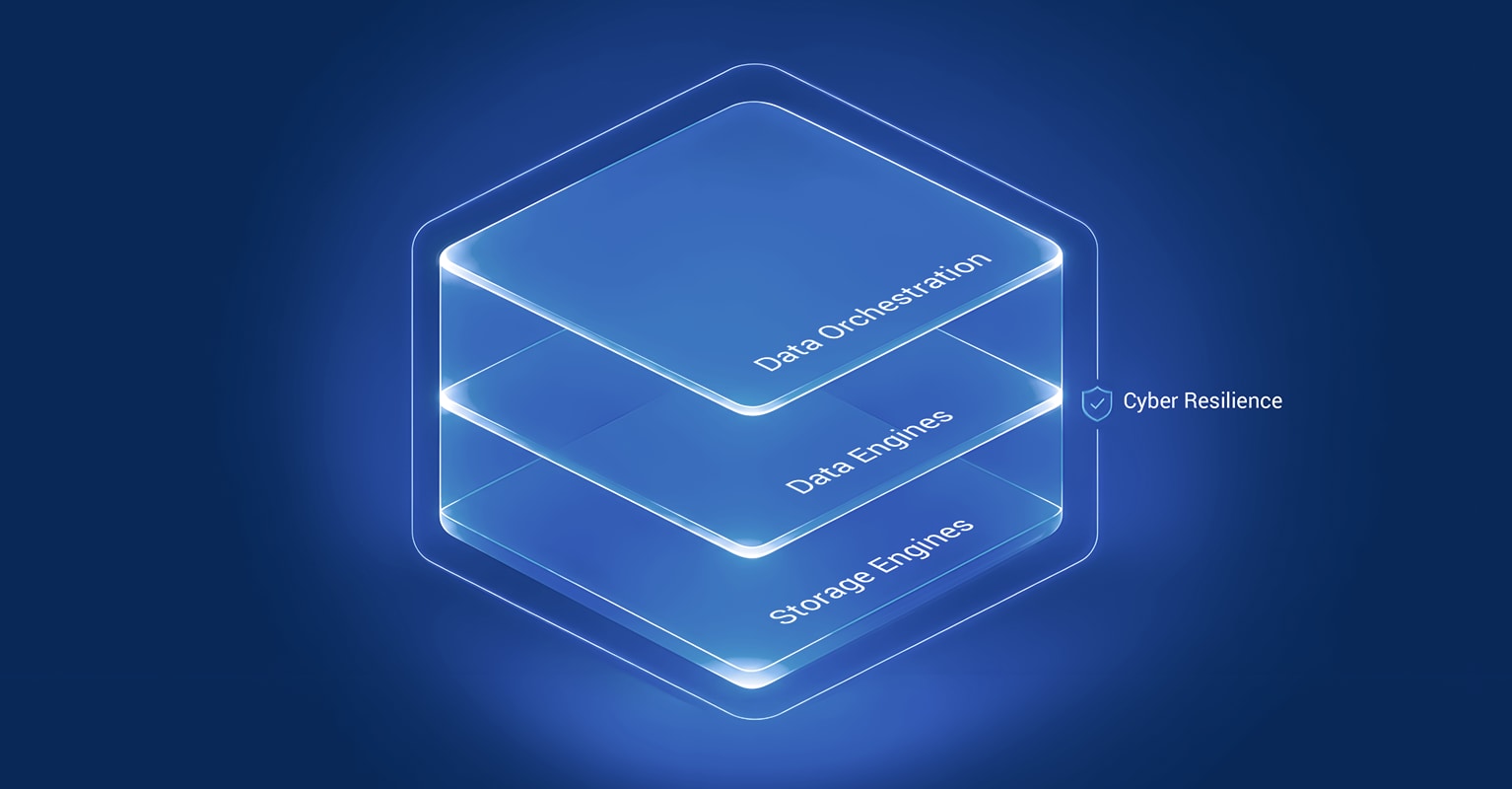
Why choose Dell Data Orchestration Engine
Simplify AI data preparation with trusted context, flexible orchestration, open integrations, and governance throughout the data lifecycle.
Resources
Questions
What is data orchestration for enterprise AI?
Data orchestration is the automated coordination of the AI data lifecycle — connecting ingestion, preparation, enrichment and retrieval into one governed flow. The Dell Data Orchestration Engine helps teams consistently deliver trusted, current context to AI applications and agents.
How does the Dell Data Orchestration Engine move AI from pilot to production?
It replaces fragmented, manual pipeline work with end-to-end orchestration across ingestion, preparation, enrichment and retrieval, with integrated evaluation and feedback loops. This helps accelerate pilot-to-production timelines, reduce operational overhead and run AI consistently across hybrid environments.
How do I architect a data pipeline from ingest to inference?
The Dell Data Orchestration Engine orchestrates pipelines from ingestion through preparation and retrieval. It coordinates data movement and transformation and the hand-off to inference, creating one governed flow from enterprise data to production AI.
How does it support agentic AI workflows?
The engine powers autonomous agents with governed data and coordinated multi-step reasoning. It connects agents to trusted, continuously refreshed enterprise context and orchestrates the retrieval and workflow steps agents depend on — enabling AI copilots and domain-specific agents to operate reliably on current, high-quality data.
How do feedback loops keep AI accurate as data changes?
The engine provides agents with governed, continuously refreshed enterprise context and coordinates the data and retrieval workflows they depend on — helping RAG and agentic applications operate reliably on current, high-quality data.
Does it run across on-premises and cloud environments?
Yes. The engine is hybrid-native, executing consistently across on-premises and cloud environments. This lets enterprises orchestrate AI pipelines wherever data and compute reside, maintain a single operating model across distributed infrastructure, and design secure hybrid AI architectures without rebuilding pipelines per environment.
How does it handle multimodal data for AI?
It provides multimodal data management across documents, images, video, audio, and sensor data, unifying them into high-quality datasets for AI applications. This is what enables multimodal search, content discovery, and assistants to retrieve and reason over diverse enterprise content through one orchestrated pipeline.
How does it enforce governance and lineage as AI scales?
The engine standardizes AI data operations with production-scale governance, lineage, and lifecycle controls. Platform and data leaders can enforce consistent policies, track data lineage across the pipeline, and reduce risk while scaling AI adoption — so growth in AI use doesn't outpace control.