Isilon: Using Powershell with Platform API - Creating Objects and RAN
Summary: This article explains how to use Powershell with the OneFS Platform API to create objects and RAN.
This article applies to
This article does not apply to
This article is not tied to any specific product.
Not all product versions are identified in this article.
Symptoms
Not required
Cause
Not required
Resolution
Introduction to JSON
The PAPI uses JSON as the data-interchange format. It is critical to understand how to leverage it to use PAPI to create, modify, or delete resources. Additional information about JSON is available at www.json.org
- A collection of name and value pairs
- An ordered list of values
Example output from getting an API object could look like this:
{
"<object>": {
     "<property>": <value>,
     ...
}
To know what JSON text outputs are available, we must issue a POST command to create an object; look at the PAPI self-documentation by sending the following request:GET /platform/1/quota/quotas?describe
Here is the relevant Powershell code:
#Get PAPI self documentation for quotas
$resource = "/platform/1/quota/quotas?describe"
$uri = $baseurl + $resource
$ISIObject = Invoke-RestMethod -Uri $uri -Headers $headers -Method Get
$ISIObject
The example output below outlines what you must POST to create a new quota. Pay attention to the required properties since they may not be the same properties required for the corresponding isi command.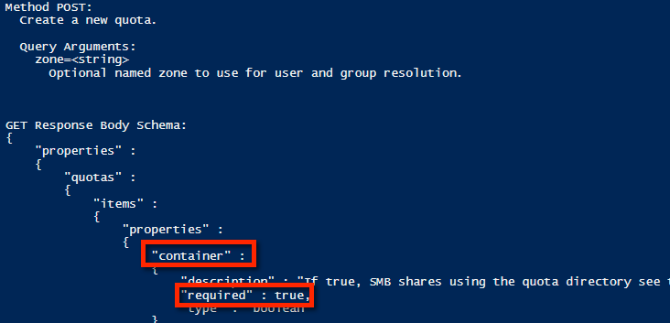
Using the example properties, the following is an example JSON string that can be used to create a directory hard quota:
$QuotaObject = @"
{"type":"directory","include_snapshots": false,"container": true, "path": /ifs/home/user1", "enforced": true, "thresholds": {"hard":10000000},"thresholds_include_overhead": false}
"@
With the JSON string completed, all that is left is to build the Invoke-RestMethod parameters and submit. In the example code below, the JSON string is the body of the POST and that the content type is application/json:
$headers = @{"Authorization"="Basic $($EncodedPassword)"}
$uri = $baseurl + $resource
$ISIObject = Invoke-RestMethod -Uri $uri -Headers $headers -Body $QuotaObject -ContentType "application/json; charset=utf-8" -Method POST
Write-Host "   Resulting Quota ID: "  $ISIObject.id
Putting It All Together
Using an example, let us assume your environment has many home directories for users under a single parent directory, (example: /ifs/home) and you want to set directory quotas for each of these home directories. Use the Isilon RESTful Access to the namespace (RAN) API to get the paths to each user home directory. The following code gets the subdirectories of a specified path and then set a directory quota on each subdirectory:
# Get subdirectories of path specified
$resource = '/namespace/' + $path
$uri = $baseurl + $resource
$ISIObject = Invoke-RestMethod -Uri $uri -Headers $headers -Method Get
#Loop through each directory and set the quota
ForEach($folder in $ISIObject.children) {
#Create quota
$resource ="/platform/1/quota/quotas"
Write-Host "Setting a $quotasize byte quota on $quotapath"
$QuotaObject = @"
{"type":"directory","include_snapshots": false,"container": true, "path": "$quotapath", "enforced": true, "thresholds": {"hard":$quotasize},"thresholds_include_overhead": false}
"@
$headers = @{"Authorization"="Basic $($EncodedPassword)"}
$uri = $baseurl + $resource
$ISIObject2 = Invoke-RestMethod -Uri $uri -Headers $headers -Body $QuotaObject -ContentType "application/json; charset=utf-8" -Method POST
Write-Host "   Resulting Quota ID: "  $ISIObject2.id
}
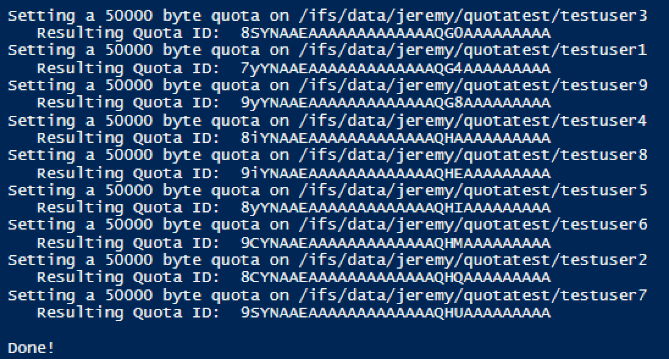
Here is the output from running the script attached to this post:
Affected Products
Isilon, PowerScale OneFS, Isilon Platform APIArticle Properties
Article Number: 000132770
Article Type: Solution
Last Modified: 02 Apr 2026
Version: 7
Find answers to your questions from other Dell users
Support Services
Check if your device is covered by Support Services.