

Blog
Dell Technologies World 2026: A Canadian Recap
A Packed House, a Canadian Crew, and an Industry Shifting in Real Time
Walking onto the show floor at Dell Technologies World on Day 1 meant one thing: running into half your customer base from across Canada in a single 10-foot radius, all asking the same question. “So, what does this actually mean for us back home?”
That energy held steady for four days. Between keynotes, breakouts, partner meetings, and the hallway conversations that turned into the best sessions of the week, DTW 2026 felt like part tech conference, part working session for the next chapter of enterprise IT.

Here’s what shipped, what shifted, and what we should all be watching closely.
Day 1: AI and Token Economics
Michael Dell opened the keynote with a line that stuck with me all week: “Abundant intelligence is here. It’s not coming, it’s here right now.” The message was clear. AI is no longer a workload you bolt on. It’s the operating model of the modern enterprise.
A few Day 1 announcements matter most for Canadian customers.
The Dell AI Factory Keeps Expanding
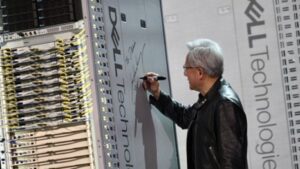
The Dell AI Factory with NVIDIA now has more than 5,000 customers deployed. The on-stage conversation between Michael Dell and Jensen Huang made one principle clear: architecture is still the differentiator. Move the AI to the data, not the data to the AI.
That idea drove nearly every announcement that followed, from the new liquid-cooled PowerEdge XE servers built on NVIDIA Rubin, to the Dell PowerRack rack-scale platform, to the Dell AI Data Platform as the foundation underneath it all.
Deskside Agentic AI
This one is critical for regulated customers in Canada. Deskside Agentic AI on the Dell Pro Precision workstations with NVIDIA NemoClaw lets teams build, test, and fine-tune agents locally. That spans models from 70B parameters all the way up to a trillion. No unpredictable cloud spend, and no IP leaving the building.
For public sector, financial services, and healthcare customers wrestling with where their agent development environment should live, this is a meaningful answer. I’ve had the chance to test NemoClaw on my GB10, and the added security and NVIDIA automation made it simple to get up and running. This isn’t the year to stop innovating, so removing monthly token worries from the teams leading the charge matters.
A Growing AI Ecosystem
The model and partner expansion was the headline most people picked up on, and rightly so.
- Google Distributed Cloud with Gemini 3.0 is now available on Dell in a confidential computing environment. This is the on-prem cloud our Google-aligned customers have asked for, running the Gemini frontier model in their own data center. For Canadian customers focused on data sovereignty, not just residency, this is an important option.
- OpenAI announced an on-premises solution built on OpenAI Codex for Dell, connecting GPT and GPT-Codex models through the Dell AI Data Platform. Codex on-prem will be a big deal for platform engineering and developer productivity, bringing one of the leading code-generation models inside the firewall.
- An expanded Dell Enterprise Hub on Hugging Face now includes MiniMax-M2.7, DeepSeek-V4, GLM 5.1, Kimi K2.6, and more, joining Gemma 4, Nemotron Super 3, Mistral Small 4, and Arcee Trinity.
Token Economics Is the Conversation We Should Be Having
The phrase that should stick with all of us coming out of Dell World is token economics. Getting the right workload, on the right model, on the right tier, across edge, on-premises, or cloud, will be one of the most consequential infrastructure decisions our customers make over the next 24 months.
Token routing isn’t a feature. It’s becoming an architectural discipline, giving customers the option to land each token where it makes the most sense: economically, operationally, and from a sovereignty standpoint.
Day 2: Building the Modern Data Center
Day 2 was the engineer’s day. The keynote pivoted from “what AI looks like” to “what it actually runs on.”
The Portfolio Update
- Dell PowerStore Elite: the next chapter of PowerStore, with the performance and AI-aware data services that put it firmly back in the conversation for the most demanding mixed workloads.
- PowerEdge XE, M, and R series, 18th generation: 11 new servers spanning air and liquid-cooled environments, with meaningful gains in data center efficiency.
- Dell PowerProtect One and Dell Cyber Detect: AI-driven cyber resilience built for the reality that ransomware has moved from a nuisance to a board-level risk in nearly every customer environment.
- Dell Private Cloud: expanded to deploy the latest Broadcom VCF, Azure Local, and Nutanix software innovations alongside Red Hat OpenShift.
- Dell Distributed Private Cloud: the rebranding of NativeEdge that better reflects what this product has become. Not just an edge play, but a distributed private cloud designed to simplify, secure, and scale environments well beyond the edge.
Automation Took Center Stage
The bigger story of Day 2 for me was automation. The Dell Automation Platform gained an agentic AI layer paired with a conversational talk. Together with the AIOps integration, they change how teams deploy, monitor, and manage infrastructure.
A few things I took away from the sessions:
- A siloed agent is an expensive agent. Automation has to plan, call tools, and execute across the whole stack.
- Every agentic action needs a receipt. When an agent acts on your behalf, you need to know what it did, why, and how to undo it.
- Treat your data like a product. Versioned, documented, with a clear owner and security built in at every release. You can’t drive automation off data you don’t trust. If you watched the live stream, this was my number one takeaway, and it’s what I believe ultimately makes AI projects successful.
Day 3: A Deeper Look at the Announcements
Day 3 shifted gears for me. The keynote energy gave way to deep-dive sessions, architecture conversations, and the breakouts where you figure out how everything from Days 1 and 2 fits the data center you’re trying to build.
From agent deployment to agent management. We’re moving past “how do I deploy agents across the business” and into “how do I govern an organization full of them.”
Data is the differentiator. Multiple analysts made the same point. In the agentic era, the model is increasingly commoditized. The real differentiator is the data: how it’s structured, where it lives, how it’s protected, and how cleanly it feeds the AI pipeline. Dell Exascale Storage, the AI Data Platform, and the integration across PowerStore, PowerScale, ObjectScale, and PowerProtect are all part of the same answer.
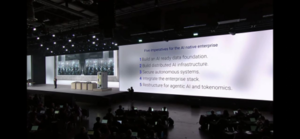
Five imperatives to take back. Jeff Clarke’s five imperatives from the Day 2 keynote will anchor a lot of discussions this year:
- Build an AI-ready data foundation.
- Architect for distributed AI infrastructure.
- Secure autonomous systems. Every agent action needs a receipt.
- Integrate the enterprise stack.
- Master token economics and routing.
That last one, token economics, was the most discussed item by the end of the week. It’s the strategic conversation we should be having with every customer right now.
What struck me most across customer and partner discussions was the openness about what isn’t working, and the willingness to share lessons learned. The shift to AI-native is no longer a future state. It’s the new baseline, and the customers furthest along are the most candid about the missteps. That candor is a gift, and we should all be taking notes.
The Sleeper Hit Most People Missed: Dell Automation Studio
If you walked away from DTW with only the headlines, Dell AI Factory, PowerEdge XE, OpenAI Codex, Gemini on Google Distributed Cloud, I wouldn’t blame you. Those announcements were genuinely big. But I want to spotlight the one that may turn out to be the most operationally important thing from the week: Dell Automation Studio.
Here’s why I think this is a sleeper hit.
Until now, the Dell Automation Platform has delivered curated, validated outcomes: Dell Private Cloud, Dell Distributed Private Cloud, and AI Solutions. Turnkey, tested, and opinionated. Great for customers who want speed-to-outcome with Dell’s stamp of approval on the architecture.
Dell Automation Studio is the other half of that conversation. It’s the official name for a tool we’ve used internally to build most of the Automation Platform outcomes. Studio puts the orchestration layer directly into customers’ hands.
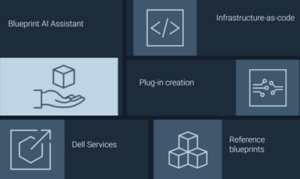
- Author your own full-stack orchestration across compute, storage, networking, and data protection, using the same orchestrator that delivers Dell’s validated outcomes.
- Build plug-ins that integrate enterprise systems and public cloud operations, so the Platform becomes the single execution and operational hub for multicloud, multisite environments.
- Reuse your existing IaC investments in Terraform, Ansible, and the toolchains your platform engineering teams already love. Studio is API-first and CI/CD-integrated by design.
- Use the Blueprint AI Assistant, a GenAI-driven assistant that lets teams author Blueprints (the declarative IaC specs that drive the orchestrator) using natural language, with versioning, semantic version control, and changelogs built in.
- Get the best of both worlds. Used alongside Dell Private Cloud or Dell Distributed Private Cloud, Studio lets customers extend a validated foundation with their own custom Day-2 workflows, without rebuilding from scratch.
Why It Matters
Most enterprise Canadian customers have mature DevOps and platform engineering teams. They’ve invested years in Terraform modules, Ansible playbooks, Jenkins pipelines, and ServiceNow workflows. They don’t want a black box, and they don’t want to rip and replace what they’ve built. What they want is a single, unified orchestration hub that lights up the rest of the stack and folds in everything they already use.
That’s exactly what Studio is. It transforms the Dell Automation Platform from “the easy button for validated outcomes” into “the orchestration backbone for the entire IT estate.”
Wrapping Up
The shift to AI-native is no longer the future state. It’s the new baseline. And from every conversation I had this week, I’m more convinced than ever that we have the right people, the right portfolio, and the right partner ecosystem to help our customers move forward.
If you’re mapping out your next 24 months, start with the conversation that matters most: how to build an AI-ready data foundation and master token economics. We’re ready to help you get there.