Powering enterprise AI deployments worldwide















AI storage performance backed by benchmarks
Accelerate AI workloads
Up to
12 times
Based on Elastic’s benchmark of Elasticsearch with NVIDIA cuVS (December 2025). Testing compared GPU-accelerated and CPU-only vector indexing on a single AWS g6.4xlarge instance with local NVMe storage, using 2.6 million 1,536-dimensional vectors at recall levels up to 95%. Results may vary.
Maximize query performance
Deliver to
3 times
Based on Dell internal analysis, May 2026.
Scale inference speed
Achieve
19 times
Based on internal Dell testing (October 2025) using the vLLM inference engine, LMCache with Dell connector, and NVIDIA NIXL library. Testing measured a 100% Key-Value (KV) cache hit rate on four NVIDIA H100 GPUs, using the LLaMA-3.3-70B Instruct model with Tensor Parallelism=4. Results may vary based on system configuration, workload, and other factors.
Boost storage efficiency
Gain
50%
Based on Dell preliminary testing comparing random and sequential throughput, January 2026. Performance may vary.
Why enterprise AI projects stall
Select the challenge that sounds familiar to see how Dell helps you move from pilot to production.


Dell AI Data Platform
Your team focuses on results — the Dell AI Data Platform handles the complexity. This open, secure, modular foundation unifies all enterprise data — structured, semi-structured, and unstructured — into one enterprise-wide context layer, from ingest to outcome. One integrated, supported platform, not a single appliance or fragmented build, powers your models and agents with trusted, real-time data.


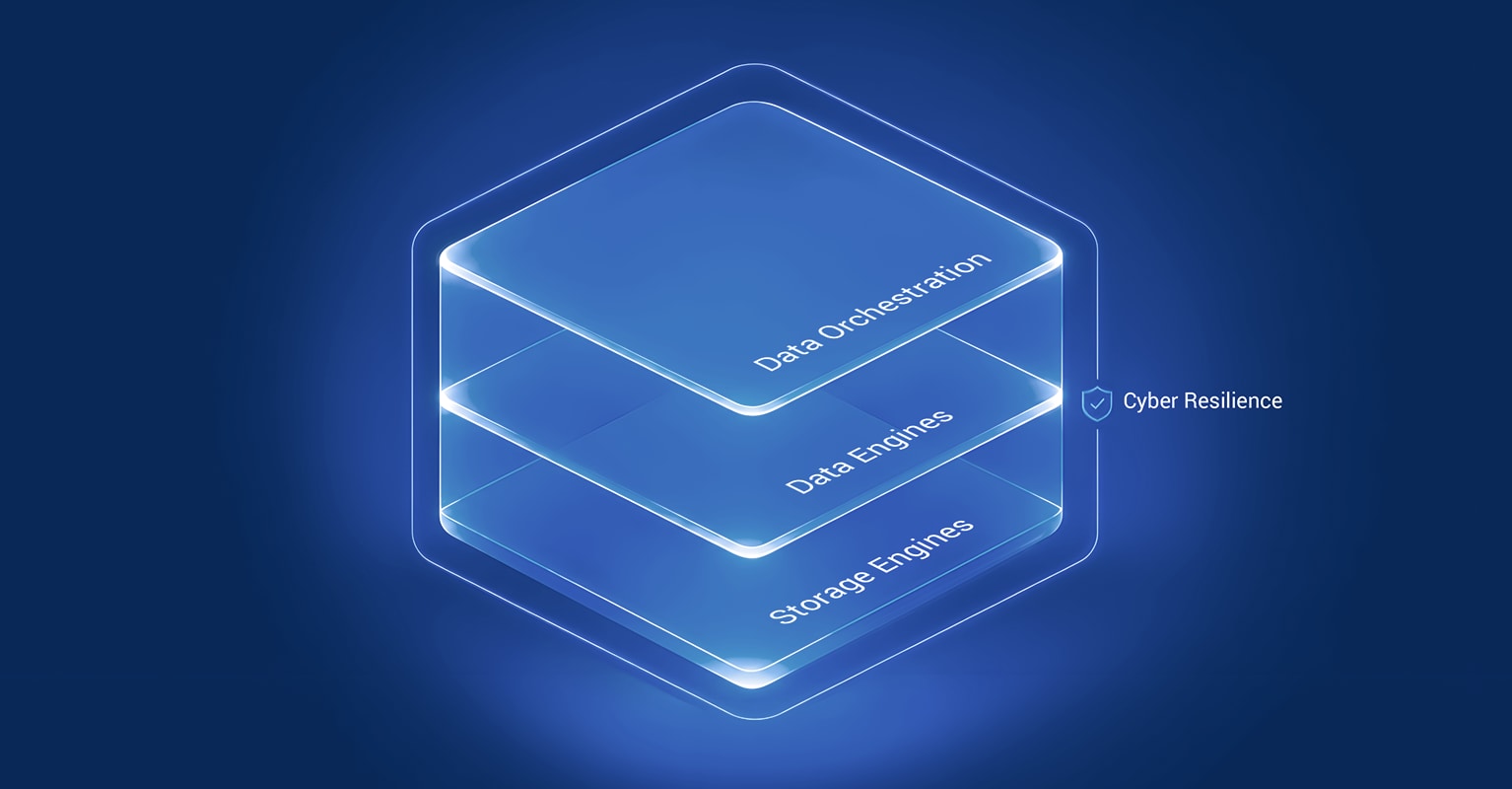
Storage, data, and orchestration — unified in three layers
A single integrated foundation for secure RAG, agentic retrieval, and governed memory — with cyber resilience built into every layer.

Architecture purpose-built for AI

Dell AI Data Platform uses open standards and formats to keep data in place while integrating best-of-breed tools that fit your environment. Modular data engines allow organizations to adopt essential components without proprietary lock-in or rip-and-replace cycles.

Dell AI Data Platform is anchored on the Dell enterprise storage portfolio—spanning file, object, and parallel file systems from Tier-0 performance to enterprise scale. This foundation runs the most demanding workloads, keeping GPUs saturated and feeding AI pipelines without bottlenecks.

A decoupled architecture lets storage, data engines, and GPUs scale independently, so you don’t overprovision one to grow another. This eliminates wasted GPU or CPU capacity, allowing infrastructure to grow with data and improving cost and token economics as AI moves into production.
Dell AI Data Platform uses open standards and formats to keep data in place while integrating best-of-breed tools that fit your environment. Modular data engines allow organizations to adopt essential components without proprietary lock-in or rip-and-replace cycles.
Dell AI Data Platform is anchored on the Dell enterprise storage portfolio—spanning file, object, and parallel file systems from Tier-0 performance to enterprise scale. This foundation runs the most demanding workloads, keeping GPUs saturated and feeding AI pipelines without bottlenecks.
A decoupled architecture lets storage, data engines, and GPUs scale independently, so you don’t overprovision one to grow another. This eliminates wasted GPU or CPU capacity, allowing infrastructure to grow with data and improving cost and token economics as AI moves into production.
Compare Dell AI Data Platform to other platforms
| Consideration | Dell AI Data Platform | Other data platforms |
| Architecture | Open, modular, and scalable — file, object, and parallel, with no data migration or forced data movement | Forced data movement into a proprietary format; lock-in |
| Storage choice | NFS, S3, and KV cache as a protocol — your choice of performance, cost, performance density, and media | Narrow storage tier or a single media type |
| Scaling | Storage, data services, and GPUs scale independently | Coupled scaling; overprovision one to grow another |
| Lock-in | Open standards and formats; keep data where it is | Proprietary formats; rip-and-replace risk |
| Vector indexing & time to token | 12× faster indexing vs. Elasticsearch (NVIDIA cuVS); 19× faster time to token vs. VAST | Varies by stack; often not benchmarked comparatively |
| Certifications | NVIDIA Cloud Partner (NCP) and NVIDIA-Certified Enterprise Storage | Rarely certified across the full NVIDIA stack |
| Services | Global Dell services to design, deploy, and operate | Multiple vendors to coordinate; limited services |
| Supply chain | Secure, resilient, global Dell supply chain | Limited or third-party dependent |
| Deployment | On-prem, hybrid, and cloud | Often a single environment |
Real-world results
Dell AI Data Platform helps customers more from pilot to production
Real-world results
Resources
Awards and reviews

Questions
What is Dell AI Data Platform, and what do I actually buy?
Dell AI Data Platform is an open, modular enterprise data foundation for AI. AIDP is composed of Storage Engines and Data Engines.
Storage Engines are PowerScale, ObjectScale and Lightning File System.
Data Engines are:
- DDAE – Data Analytics Engine powered by Starburst
- DDPE – Data Processing Engine powered by Apache Spark
- DDSE – Data Search Engine powered by Elastic
- DDOE – Data Orchestration Engine
Customers can mix and match Storage and Data Engines purchasing, and adding different engines overtime as their workloads evolve.
What are the Dell Data Analytics Engine (with Starburst) and the Data Orchestration Engine?
The Dell Data Analytics Engine, powered by Starburst, lets you query and analyze data across sources where it lives - no copying into a separate warehouse.
The Dell Data Orchestration Engine automates the pipeline (ingest, enrich, index, retrieve) and the feedback loops that keep embeddings and indexes current. Together they turn raw enterprise data into governed, AI-ready context.
The Dell Data Orchestration Engine automates the pipeline (ingest, enrich, index, retrieve) and the feedback loops that keep embeddings and indexes current. Together they turn raw enterprise data into governed, AI-ready context.
How does Dell AI Data Platform compare to Databricks and Snowflake?
The Dell AI Data Platform and Snowflake are strong for structured analytics and the data-warehouse/lakehouse layer. They typically operate in a cloud-only model with limited support for on-prem.
Dell AI Data Platform is complementary and broader for AI: an open, modular platform that unifies structured and unstructured enterprise data on the storage and data engines you already own - no forced migration into a proprietary cloud warehouse - and delivers RAG, agentic retrieval, and governed memory on-prem, hybrid, or in cloud.
How does Dell compare to NetApp for enterprise AI and unstructured data storage?
Both offer strong file and object storage.
- Dell's differentiation for AI is a purpose-built tiered portfolio
- Lightning File System for Tier-0 throughput
- PowerScale for scale-out NAS
- ObjectScale for S3 object
The AI data Platform scales storage, data services, and GPUs independently, on open standards with no rip-and-replace. It's a full data platform, not storage alone.
How does Dell AI Data Platform compare to VAST Data?
The Dell AI Data Platform and VAST both accelerate AI data pipelines, but they differ in architecture and openness.
Dell AI Data Platform is open and modular with federated access and open formats; VAST is a proprietary, vertically integrated stack that centralizes data into its VAST DataSpace before analytics can run.¹
In Dell head-to-head testing on the Qwen3-32B model, PowerScale (0.82 sec) and ObjectScale (0.86 sec) both delivered lower time-to-first-token than VAST (1.5 sec), with up to 14× acceleration over vLLM.²
For object pipelines, ObjectScale with S3 over RDMA delivers up to 230% higher throughput and up to 80% lower latency than VAST's CPU-bound, shared-everything design.³
Dell also extends governance across more data sources and engines without forcing consolidation, and offers GPU-accelerated vector search (HNSW ANN) today, whereas VAST's v5.4 vector search relies on CPU-based brute-force.⁴
AI Data Platform has the ability to perform one-click deployment of validated NVIDIA and Dell Blueprints from Dell’s Data Orchestration Engine to compute anywhere, on-prem with AI Factory, cloud or hybrid. Data Orchestration Engine has a robust pipeline building allowing for no code, low code and full developer SDK offering developers the ability to use off the shelf blueprints to building their own or a combination of both.
¹Based on an April 2026 Prowess Consulting Report, commissioned by Dell and based on publicly available sources, comparing architectural design, data-access patterns, RAG search capabilities, and operational factors between Dell AI Data Platform and VAST AI OS.
²Dell results are based on internal testing using the Qwen3-32B model. VAST results are disclosed in the following VAST online source: Accelerating Inference - VAST Data. Oct. 2025.
³Based on Dell internal analysis of competitor product features and capabilities. Results may vary and are subject to change without notice. Apr. 2026.
⁴Based on Dell internal analysis of competitor product features and capabilities. Results may vary and are subject to change without notice. Apr. 2026.
How does Dell ObjectScale compare to Pure Storage and Everpure for AI object storage at scale?
ObjectScale is Dell S3-native object platform built for exabyte-class scale with S3 as a first-class protocol (including S3-over-RDMA for high throughput). Versus Pure/Everpure, Dell emphasizes open standards, independent scaling of capacity and performance, choice of media and performance density, and integration into the wider Dell AI Data Platform rather than a single-appliance footprint.
How does Dell support HIPAA and regulated healthcare unstructured data?
The Dell AI Data Platform provides the controls regulated healthcare environments require—encryption, role-based access, audit logging, and data sovereignty—to support HIPAA compliance for unstructured data like medical imaging and clinical records, on-premises or hybrid so sensitive data stays under your control.
Does Dell support SEC 17a-4 WORM regulatory retention and Object Lock?
Yes. Dell supports immutable, write-once-read-many (WORM) retention (e.g., PowerScale SmartLock and ObjectScale Object Lock) with cross-site replication to meet regulatory retention regimes such as SEC 17a-4.
What ransomware defense and immutable snapshots are built in?
Cyber resilience is woven through the Dell AI Data Platform: immutable snapshots, WORM locks, encryption, and integration with Dell cyber-recovery and data-protection portfolio guard AI pipelines against ransomware and tampering - so the data grounding your models stays trusted and recoverable.
Does Dell AI Data Platform run on Kubernetes and integrate with public cloud (including Azure Blob-style object)?
Yes - the The Dell Data Orchestration Engine supports containerized/Kubernetes deployments and hybrid architectures spanning on-prem, public cloud and hybrid deployments.
ObjectScale is S3-compatible (a familiar model for teams using Azure Blob or AWS S3), enabling hybrid object workflows and replication across environments.
ObjectScale is S3-compatible (a familiar model for teams using Azure Blob or AWS S3), enabling hybrid object workflows and replication across environments.
How do I forecast and plan storage capacity and growth for AI/ML workloads?
Because storage, data services, and GPUs scale independently, you deploy what you need and grow without overprovisioning.
Dell provides monitoring, analytics, and services to forecast capacity and model growth as AI workloads expand - so you scale on your terms rather than through disruptive forklift upgrades.
With the Dell Data Orchestration Engine, workloads can scale up or down as needed on AI Factory, cloud or both.
What's the best platform for AI on distributed file, object, and table data?
Dell AI Data Platform is built to unify exactly that mix. PowerScale and Lightning File System handle file data, ObjectScale handles object data at scale, and the Dell Data Analytics Engine (powered by Starburst) federates SQL access across relational, lake, object, and NoSQL sources — all without moving or copying data first. It's one open, modular platform across file, object, and table data, instead of stitching together separate tools for each type.
Do you offer a subscription or as-a-service model with continuous in-place upgrades?
Yes. Through Dell APEX, you can consume the Dell AI Data Platform as-a-service with flexible subscription options, and Dell programs support in-place upgrades that help you avoid disruptive rebuy-and-refresh cycles.
Does Dell AI Data Platform support RAG, vector search, and agentic retrieval?
Yes. The platform is designed to support ingestion, enrichment, chunking, embedding, indexing, retrieval, re-indexing, and governed feedback loops for RAG pipelines. This extends to vector search, and agentic AI patterns that depend on enterprise context and memory.
The Data Orchestration Engine integrates with our Storage Engines to efficiently ingest the raw data.
Customers may choose to leverage cuVS with DDSE for efficient vector indexing and search or bring their own vector database.
How does Dell AI Data Platform lower latency and inference cost?
There are three primary methods in which the AI Data Platform lowers latency and inference cost:
- The Data Orchestration Engine allows customers to ingest unstructured data and curate the data ensuing quality data is saved to the vector database.
- Leveraging Knowledge Graph and entity relationship, AIDP assist AI applications by finding meaningful data quicker reducing GPU usage.
- AIDP offers KV-Cache solutions to persist GPU memory on shared storage allowing for reuse in the decode phase in context generation.
How does Dell AI Data Platform work with NVIDIA?
Dell AI Data Platform is built to work with NVIDIA accelerated computing, AI software, and validated blueprints.
- DDPE – Dell Data Processing Engine powered by Apache Spark leveages NVIDIA’s cuDF library to accelerate processing Spark Data Frames with GPU.
- DDSE – Dell Data Search Engine powered by Elastic leverages NVIDIA’s cuVS library to accelerate the building and searching of vectors.
- DDOE – Dell Data Orchestration Engine leverages NVIDIA blueprints with a 1-click deployment option on to AIDP or AI Factory of popular blueprints. This same process can be used to deploy foundation models.
Has Dell published independent AI storage benchmark results (e.g., MLPerf Storage)?
Yes. Dell participates in industry-standard storage benchmarking and publishes validated performance for AI training and inference. We also publish head-to-head figures such as time to token and vector-indexing throughput so buyers can compare on evidence.
Does Dell AI Data Platform support mixed Linux and Windows environments?
Yes.
Dell AI Data Platform Storage Engines support all popular protocols for mixed environments.
Dell PowerScale supports NFS, NFS over RDMA, SMB and S3. NFS over RDMA allows GPUs to directly talk to S3 storage reducing latency in AI workloads.
PowerScale is multiprotocol (NFS, SMB, S3, and more) so the same data is accessible across Linux and Windows clients without manual sharding or separate silos - a single namespace serving mixed enterprise environments.
Dell ObjectScale supports S3 and S3 over RDMA. S3 over RDMA allows GPUs to directly talk to S3 storage reducing latency in AI workloads.
Can Dell AI Data Platform handle long-term retention, backup, and archive at scale - including SharePoint archives to cold storage?
Yes.
ObjectScale provides cost-efficient, durable object storage for long-term retention, backup, and archive at scale, with tiering to lower-cost media for cold data. It's a strong target for archiving content such as SharePoint repositories while keeping it governed and, when needed, searchable for AI.
Customers may also use Dell PowerProtect for their cyber resiliency needs leveraging PowerProtect Data Manager and PowerProtect DataDomain as backup software and backup targets.
What storage networking gets data to GPUs fastest - RDMA, GPUDirect, S3-over-RDMA?
Dell accelerates the full GPU data path: PowerScale supports GPUDirect and NFS-over-RDMA to move data straight to GPU memory, and ObjectScale supports S3-over-RDMA for high-throughput, low-latency object access. RDMA removes CPU bottlenecks and cuts latency, keeping expensive GPUs saturated during training and inference.