
Dell AI Data Platform: A Technical Perspective
Why production AI depends on the data plane—and how Dell AI Data Platform uses open, federated architecture to remove bottlenecks.
Topics in this article:Artificial Intelligence
Key takeaways
13 min read- Enterprise AI usually stalls on data, not models.
- A strong AI data platform should be open, modular, accelerated and secure.
- Dell AI Data Platform is designed to reduce data movement and speed AI readiness.
- Open formats help teams avoid lock-in and evolve without major rebuilds.
- The biggest benefits are faster production paths and better GPU utilization.
Every enterprise AI conversation eventually collapses into a data conversation. Models are increasingly abundant, but differentiated, governed, trustworthy data remains scarce. For most architects, the bottleneck to production AI is rarely the GPU — it is the data plane feeding it. In a traditional architecture, data is stored according to organizational boundaries, creating silos that isolate information and make it difficult to share, combine, or analyze across teams, and for AI initiatives that depend on diverse, comprehensive datasets, those silos are a major roadblock. So before discussing any product, it’s worth asking a cleaner question: how should an enterprise AI data platform be architected?
What a well-architected AI data platform looks like
From an engineering standpoint, I’d argue there are six non-negotiable design principles.
- Decouple compute from storage. AI workloads are spiky and heterogeneous — a training run, a fine-tune, a RAG retrieval pass and an inference burst have wildly different resource profiles. Binding compute to storage forces you to overprovision one to satisfy the other. A decoupled architecture lets you scale each independently against demand, optimizing both cost and performance.
- Embrace open table and file formats. Vendor-proprietary formats are technical debt with compounding interest. Open standards — Apache Iceberg, Delta Lake and file formats such as Parquet, Avro and ORC — preserve compatibility across engines, avoid lock-in and let data be written once and read by many tools.
- Federate access; minimize data movement. The most expensive operation in most pipelines is copying data. A modern platform should query data where it lives through a distributed query engine, rather than forcing disruptive consolidation into a single monolithic warehouse.
- Be composable, not monolithic. Analytics, batch/streaming processing and search are genuinely different computational problems. Purpose-built engines that share a common data foundation beat a single do-everything system, provided they interoperate cleanly and can be adopted incrementally.
- Make acceleration a first-class citizen. At the data-volume scale AI demands, CPU-bound preparation and indexing become the critical path. GPU acceleration for SQL, data frame processing and vector indexing should be built into the data layer, not bolted on downstream.
- Build security and governance in, not on. Access control, masking, encryption and cyber resilience must be native properties of the platform — enforced consistently across every engine — rather than perimeter add-ons.
Mapping the Dell AI data platform to the architecture
The Dell AI Data Platform (AIDP) maps closely to these principles. Its architecture offers a composable, open, modular foundation designed to turn distributed, siloed data into AI-ready assets, and it maps to those principles almost point for point. By decoupling data storage from processing, it eliminates bottlenecks and provides the flexibility needed for AI workloads like training, fine-tuning, RAG and inferencing. Dell’s team describes the approach explicitly as composable — using specialized engines for data, storage and protection, where each engine plays a unique role, but together, they form a single foundation. The platform is built on decoupled compute and storage and integrated with PowerEdge servers and Dell ObjectScale and PowerScale storage, with engines operating on a shared, scalable data foundation with minimal data movement.
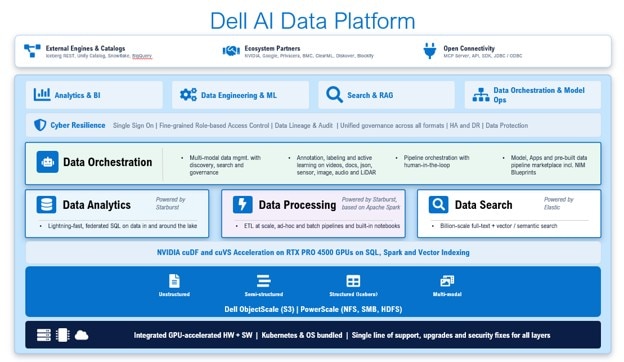
The platform is powered by five core building blocks:
- Data Analytics Engine, powered by Starburst, is the structured data workhorse of the platform. Built on Trino, the distributed SQL engine created to query data lakes at scale, it delivers the truest federation available in the industry today: a single query joins across data lakes, relational databases, file systems and object stores — on-prem, in cloud, or both — without moving or duplicating data. And it is fast enough that federation stops being the compromise you accept and becomes the access pattern you design for. Data Analytics Engine runs Dell’s own production analytics and powers query workloads in and around the data lake for enterprise customers today. With Hive, Iceberg and Delta Lake connectors underneath it, it is the essential structured data source for AI — the layer that makes governed enterprise data directly accessible by models, agents and retrieval pipelines, with no staging copy in between.
- Data Processing Engine, based on Apache Spark, handles large-scale batch, streaming and AI/ML workloads with fine-grained access control, resource optimization, notebooks, BYO-Spark image capabilities and resiliency built-in.
- Data Search Engine, powered by Elastic, is the unstructured counterpart — the retrieval substrate for everything AI does with documents, tickets, transcripts, logs and images. It handles distributed ingestion and indexing at corpus scale, with vector index builds accelerated in the data layer rather than offloaded downstream and then serves both halves of modern retrieval from one place: full-text search for precision on exact terms, part numbers and policy clauses, and vector search for semantic recall. Pure embedding search quietly fails on the literal strings enterprises query most, and pure keyword search misses intent entirely; retrieval quality in production almost always comes from having both. And because the Search Engine can act as a federated source for the Analytics Engine, a single query can reach across a governed table and an unstructured corpus at once — the join most RAG architectures never manage to make.
- Data Orchestration Engine has no real parallel in the market today. The unstructured data lifecycle is long, and the industry currently addresses it with half a dozen disconnected tools: discovery, tagging, labeling, annotation, curation, transformation and preparation for AI retrieval, plus the pipeline orchestration that keeps all of it moving across ingest, enrich, create, train and publish. The Orchestration Engine collapses that chain into a single engine — and then goes further, incorporating model deployment and scaling directly, so the same control plane that curated the data also serves the model consuming it. It coordinates pipelines, models and people across cloud, on-prem and hybrid environments while staying deliberately open at both ends: bring your own model, bring your own data and move neither.
- Data Engines Foundation provides Kubernetes-based built-in lifecycle management that automates Day 1 and Day 2 IT operations tasks like upgrades, alerts, logs, centralized metrics, disaster recovery and provides high availability for all components.
On the open standards principle, AIDP embraces an open architecture supporting Iceberg and Delta Lake and file formats including Parquet, Avro and ORC, explicitly to avoid vendor lock-in while remaining scalable and adaptable. With a built-in, modern metastore that can connect to multiple data lakes simultaneously and first-class support for Iceberg v3, AIDP matches the open standard that the industry is marching toward. And all metadata, tags and labels for unstructured data are also available outside of the platform. Storage Engines — PowerScale for file and ObjectScale for S3-compatible object — store, manage and protect structured, semi-structured and unstructured data, joined by Project Lightning for the largest deployments. And Cyber Resilience is engineered in from the ground up: access controls, data masking, encryption, plus data isolation and air-gapped architecture to defend against modern threats.
What does AI demand from a data platform?
The six principles above describe how to build. The harder question for anyone signing off on a platform decision is what the workload will ask of it once it is running, and what changes if you get the architecture right. In practice, AI makes three demands and they map onto the principles.
- It demands that the path from raw data to production be short
Most AI pilots don’t stall on model quality. They stall somewhere between ingest and inference, in a chain of hand-stitched pipelines each with its own scheduler, its own auth model, its own failure mode and its own copy of the data. Every hop is a copy, and every copy is a new governance question: who can see this, who masked what, which version did the model train on? What AI demands here is a single governed path rather than a relay race. Connectors instead of bespoke extractors — AIDP ships with 50+ supported connectors. One governance layer across all data instead of per-tool ACLs that drift apart within a quarter. And one governed pipeline with no intermediate copies, which is the part that matters most: the data the model sees at inference is provably the same data you governed at ingest, not a fourth-generation derivative of it. RBAC, audit logging and encryption are properties of the platform, so the audit trail survives the handoff between engines. The practical effect is that “time to value” stops being a function of how fast your data engineering team can write glue code.
- It demands freedom to be wrong about the future
Nobody architecting an AI platform today knows which model, embedding scheme, or vector index they will be running in eighteen months. Today’s frontier model is next year’s baseline. Embedding models get retired. Retrieval strategies that looked settled get replaced by hybrid approaches nobody had shipped when the platform was procured. An architecture that assumes stability in that layer is an architecture that will need a migration. So the demand is component-level replaceability without data-level migration — which is exactly what open formats, BYO-model and query-in-place buy you. Iceberg, Delta Lake, Parquet and S3-compatible object mean the data is legible to whatever engine comes next. Federated access means no forced migrations: data stays where it lives, and best-of-breed tools are integrated rather than displaced. Unified file and object under one architecture means an unstructured corpus and a tabular warehouse don’t require two operating models, two governance regimes and two teams. And by choosing the models you wish to integrate, you allow the data platform to get better with time as newer models arrive. The test for this principle is simple: can you replace one engine without touching the storage layer? If the answer is no, the openness is cosmetic.
- It demands that expensive silicon stay busy
The third demand is the least glamorous and the most expensive to get wrong. An idle GPU is a line item, and GPUs go idle for data reasons far more often than compute reasons — waiting on a preparation job, waiting on an index rebuild, waiting on a retrieval pass that is CPU-bound somewhere in the query layer. This is why decoupling and acceleration have to arrive together. Decoupling lets storage and data engines scale independently, so a heavy ingest window doesn’t compete with a training run for the same resources. Acceleration attacks the critical path directly: Dell AI Data Platform delivers ~6x better SQL query performance¹ and 12x faster vector indexing throughput with GPU acceleration in the data layer,² and up to 19x faster time to first token on retrieval-heavy workloads.³ Feed rate is the other half — up to 150 GB/s of throughput per rack unit,⁴ with GPUDirect support so data moves toward the accelerators rather than through host memory on the way. The platform is NVIDIA Cloud Partner certified and DGX SuperPOD validated, which matters less as a badge than as evidence the data path has been tested against the compute tier it’s expected to saturate.
Ready to build your AI data foundation?
If you’re looking to turn enterprise data into a real advantage for agentic AI, this is the next step. Dell AI Data Platform is built to help organizations create AI-ready datasets, automate data pipelines and support modern workloads across the full AI lifecycle. Start by registering for the event:
Then explore how Dell is helping customers build an open, modular data foundation for AI:
- Read about the Dell AI Data Platform to see how Dell is helping enterprises turn fragmented data into AI-ready fuel with an open, modular architecture.
- Explore Dell AI Storage to learn how Dell supports AI at scale with file and object storage designed to move AI from pilot to production.
- Discover the Dell Data Orchestration Engine to see how Dell connects ingestion, dataset preparation, retrieval and inference into unified AI data pipelines.
- Connect with a Dell specialist to continue the conversation.
Frequently Asked Questions
Why is data architecture now more important than model choice in enterprise AI? Because models are becoming more available and interchangeable, while governed, high-quality, accessible enterprise data remains much harder to operationalize at scale. For many organizations, the limiting factor is not model access but how efficiently data can be prepared, secured, moved and queried for AI workloads.
What makes an AI data platform different from a traditional data platform? An AI data platform must support more than reporting and BI. It has to serve mixed workloads such as training, fine-tuning, retrieval, vector search and inference while minimizing data movement, supporting open formats and enforcing security and governance consistently across the stack.
Why does decoupling compute from storage matter for AI? AI workloads are highly variable. Training, retrieval and inference all consume infrastructure differently. Decoupling lets organizations scale compute and storage independently, which improves utilization, performance and cost control.
Why are open formats and federated access important? Open formats reduce lock-in and improve interoperability across engines and tools. Federated access reduces the need to copy data into a single destination, which lowers cost, shortens pipelines and helps organizations work with data where it already lives.
Why does GPU utilization depend on the data platform at all? Accelerators stall waiting on data far more often than on compute — a preparation job, an index rebuild, or a CPU-bound retrieval pass will idle a GPU just as effectively as a hardware fault. Sustained feed rate, direct-to-GPU data paths and acceleration inside the data layer are what keep utilization high.
Where does acceleration have the biggest impact in the data layer? Acceleration matters most in preparation, indexing, analytics and vector operations, where data volume and latency can otherwise become the main barrier to production AI. Bringing GPU acceleration directly into the data platform helps remove those bottlenecks earlier in the workflow.
What is the practical benefit of composable architecture? A composable architecture allows organizations to adopt capabilities incrementally. They can start with federation and analytics, then add large-scale object or file storage, search or orchestration without replacing everything at once.
What should architects evaluate first in an AI data platform? They should look at how the platform handles data movement, interoperability, governance, workload separation and scale. Those choices usually determine whether the environment can support production AI efficiently over time.
1Based on Dell internal analysis, May 2026.
2Based on Elastic’s published benchmark of Elasticsearch with NVIDIA cuVS, December 2025. Testing used a single AWS g6.4xlarge instance with locally attached NVMe storage, 2.6 million vectors with 1,536 dimensions, and recall levels of up to 95%. Compares GPU-accelerated vector indexing with CPU-only indexing on the same hardware. Actual results may vary.
3Performance results are based on internal Dell testing using the vLLM inference engine, LMCache with Dell connector, and NVIDIA NIXL library. Tests were conducted with a 100% KV Cache hit rate on 4x NVIDIA H100 GPUs, using the LLaMA-3.3-70B Instruct model with Tensor Parallelism=4. Actual performance may vary based on system configuration, workload, and other factors. Oct, 2025
4Based on internal analysis of sequential and random read I/O. Actual results may vary. Feb. 2026.

About the Author: Vrashank Jain