
Trust the Test: Benchmarking Object Storage for AI
Run repeatable S3-compatible benchmarks and make more confident investment decisions with Dell Storage Performance Tool.
Key takeaways:
5 min read- Organizations use object-storage benchmarks to compare platforms more fairly, size environments with greater confidence, and reduce decision risk.
- For AI workloads, credible benchmarks go beyond peak throughput to measure latency, concurrency, client utilization, distributed-client consistency, workload realism, and repeatability.
- Dell Storage Performance Tool (Dell SPT) is an open-source tool for S3-compatible object storage, combining a task-oriented CLI, interactive terminal UI, and containerized engine to help teams run, monitor, and document repeatable tests.
Object storage has become a foundation of modern data infrastructure. Training data, model checkpoints, analytics datasets, backup images and application logs all flow through it. As AI pipelines, analytics jobs and other data-intensive workloads grow more demanding, the question shifts from whether an object store can hold the data to whether teams truly understand how it performs under pressure.
That is where benchmarking becomes both more critical and more complicated. Benchmarking is not just a technical exercise. It’s part of how organizations compare vendors, size environments and protect larger investments in infrastructure, applications and time. The better the benchmark data, the better the decision-making.
The problem with simple benchmark numbers
On the surface, testing object storage performance looks straightforward. Point a tool at an S3-compatible endpoint, run a set of PUT and GET operations and record the result.
But anyone who has spent time reviewing benchmark data knows the hard part is not generating a number. The hard part is knowing whether that number is trustworthy.
A result can look strong while masking real problems:
- Was the storage system actually the bottleneck, or had the load generator run out of CPU?
- Did one client in a distributed test silently underperform, skewing the aggregate?
- Did the test data accidentally trigger compression, deduplication, caching or tiering behavior that would not reflect production conditions?
- Did average latency hide tail latency that would matter to your application?
- Can anyone on your team reproduce the same result next week?
These are the questions that separate useful benchmark data from misleading noise.
Benchmarking that inspires confidence and trust
Dell Storage Performance Tool, or Dell SPT, is an open-source tool built specifically for S3-compatible object storage benchmarking. It is designed to make benchmark workflows easier to launch, easier to observe and easier to repeat.
Dell SPT pairs a task-oriented command-line experience with an interactive terminal UI and a containerized benchmark engine. Before a test begins, users can validate their environment to confirm that connectivity, Docker availability and port accessibility are all in order. From there, teams can launch local or distributed workloads, monitor live throughput and latency while the test runs and collect structured results for later review. For automation pipelines, the same workflow runs in headless mode without any changes to the configuration.
These capabilities help teams build confidence in benchmark results by validating test prerequisites, exposing live throughput and latency, checking distributed runs and preserving structured results for repeatability.
That makes Dell SPT useful not only for benchmarking Dell ObjectScale or Dell PowerScale, but also for evaluating other S3-compatible platforms through a more disciplined and repeatable approach.
Why benchmark discipline matters now
Object storage now supports workloads where performance surprises carry real consequences. AI pipelines waiting on training data, analytics jobs reading large datasets, backup and recovery windows and applications built around S3-compatible APIs all depend on storage behaving predictably under load.
Better benchmark discipline gives storage administrators, performance engineers, architects and IT teams the data they need to make sound infrastructure decisions. Knowing that a result is reproducible, that the test was not distorted by unexpected storage behavior and that every node in a distributed run performed as expected is what makes that data actionable.
Get started with Dell Storage Performance Tool
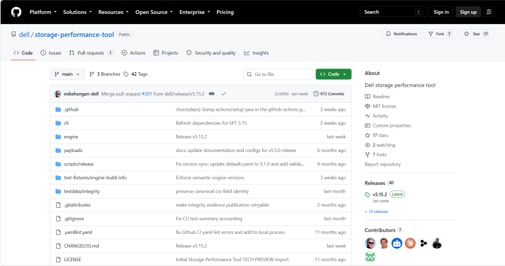
Dell Storage Performance Tool is available now on GitHub. Explore the project and get started at github.com/dell/storage-performance-tool.
For a deeper look at why S3 performance testing remains difficult — and how SPT addresses the challenges head-on — read “Object Storage Benchmarking Still Hasn’t Found Its fio.”
The rest of this series will explore topics such as environment validation, distributed testing, workload realism and latency analysis using Dell SPT.

About the Author: Michael Horgan