Why Kubernetes for AI?
Kubernetes helps runs AI. Dell makes it enterprise-ready with secure multi-tenancy, efficient GPU utilization, and operational scale for production.
Key takeaways
6 min read- Kubernetes is emerging as the default control plane for AI because it already manages scheduling, lifecycle, policy and shared infrastructure for complex workloads.
- Operators are what make Kubernetes AI-aware, adding automation for GPUs, distributed training, model serving and other platform services.
- Enterprise AI requires more than open-source Kubernetes alone, which is why Dell helps customers harden and scale it through Dell AI Factory and its partner ecosystem.
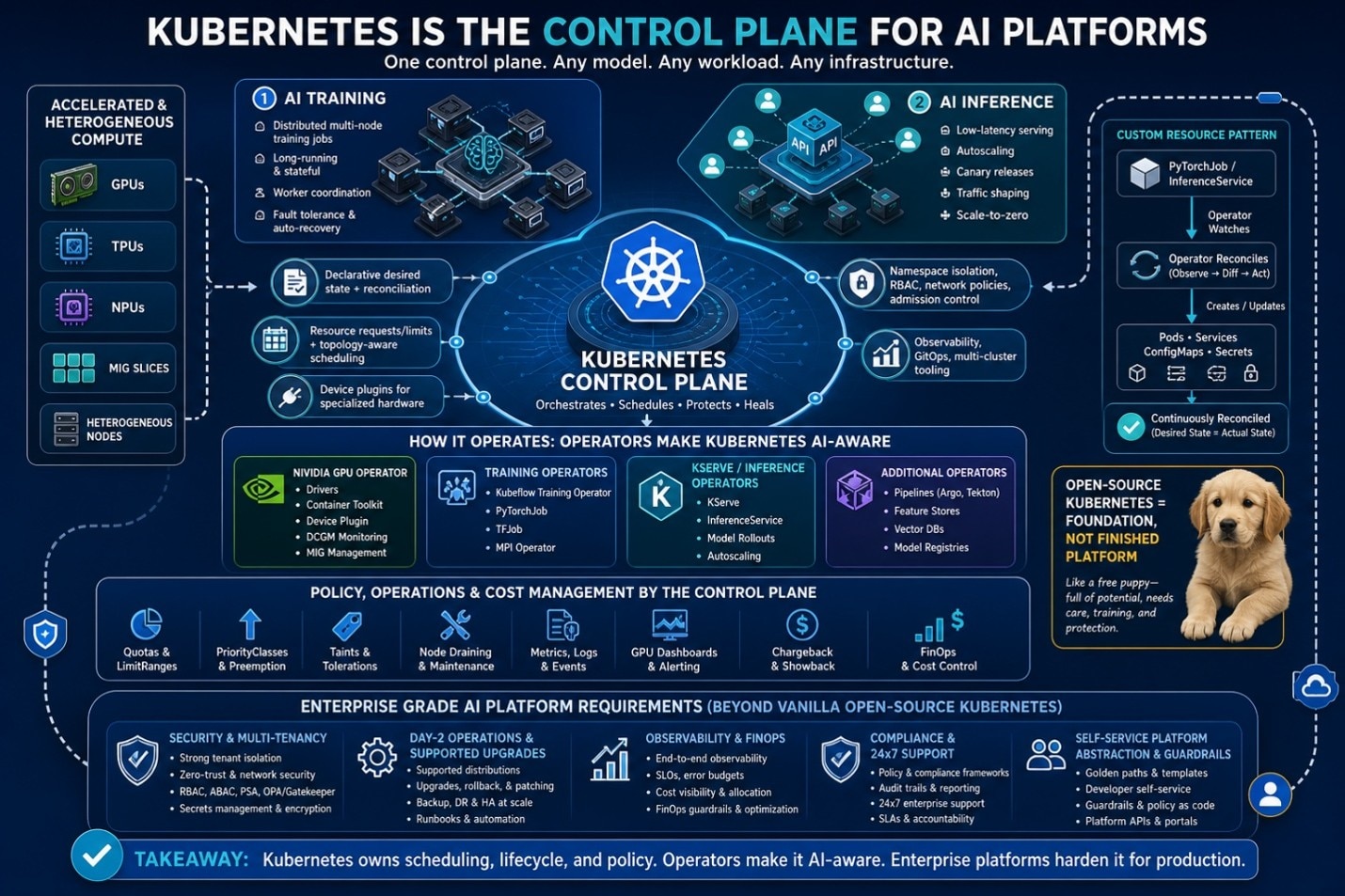
AI workloads are another version of the problems Kubernetes was designed to solve. Training jobs are long running, stateful and multi-node. Inference services demand low-latency scaling, canary releases and traffic shaping. Both consume scarce and expensive accelerators (GPUs, TPUs and NPUs) that must be shared efficiently across teams while remaining isolated. Kubernetes already provides the following capabilities:
- Declarative desired-state management and continuous reconciliation
- Fine-grained resource requests, limits and topology-aware scheduling
- Device plugins that expose specialized hardware as first-class resources
- Namespace isolation, RBAC, network policies and admission control
- A mature ecosystem of observability, GitOps and multi-cluster tooling
These constructs help turn a fleet of heterogeneous compute nodes into a single, programmable control plane. NVIDIA’s reference architectures and most major AI solution providers now treat Kubernetes as the default choice because it already owns scheduling, lifecycle management and policy.
What does the Kubernetes control plane do for AI?
As the control plane, Kubernetes continuously reconciles the gap between declared intent and actual cluster state for AI workloads:
- Resource discovery and allocation: Device plugins and the NVIDIA GPU Operator (or equivalents from AMD and Intel) expose GPUs, MIG slices and other accelerators so the scheduler can place pods using affinity, anti-affinity and topology constraints.
- Lifecycle automation: Controllers restart failed training workers, scale inference deployments and drain nodes for maintenance without manual intervention.
- Policy enforcement: Quotas, PriorityClasses, taints and tolerations and network policies prevent one experiment from starving production inference or leaking data across tenants.
- Observability and cost visibility: Metrics, logs and events flow through the same control plane, enabling GPU utilization dashboards, chargeback and FinOps practices.
As an example, Kubernetes turns “serve this 70B-parameter LLM with continuous batching, tensor parallelism across four H100s and automatic scale-to-zero” into a set of YAML objects that the control plane can easily enforce.
How it operates: Kubernetes + operators for AI
Vanilla upstream Kubernetes supplies the core control loop. Operators then encode the domain-specific knowledge AI requires. Examples include:
- NVIDIA GPU Operator: Installs drivers, the container toolkit, the device plugin, DCGM monitoring and MIG configuration automatically. It turns bare GPU nodes into ready-to-schedule AI capacity.
- Training operators (such as Kubeflow Training Operator and PyTorchJob): Manage distributed training, handle worker coordination, enable elastic scaling and improve fault tolerance.
- KServe and inference operators: Provide model serving with autoscaling, canary traffic splitting and multi-model endpoints.
- Additional operators: Support feature stores, pipelines (such as Kubeflow Pipelines or Argo), vector databases and model registries. All of these are expressed as custom resources that the Kubernetes control plane ultimately uses as it reconciles cluster state with workload requirements.
The pattern is consistent: define a high-level custom resource, such as PyTorchJob or InferenceService, and the corresponding operator watches it, creates the underlying pods, services and ConfigMaps, and continuously manages the system. Platform engineering teams can then expose self-service APIs to data scientists while retaining governance through the Kubernetes control plane.
Why vanilla open-source Kubernetes Is not enterprise-grade for AI platforms
Open-source Kubernetes is an excellent foundation, but it is deliberately minimal by design. Running production AI at enterprise scale exposes the gaps in the upstream version:
- Security and multi-tenancy: Default RBAC and network policies are often insufficient for regulated environments. Stronger isolation, encrypted traffic by default, policy-as-code and confidential computing capabilities must be added and maintained.
- Day-2 operations: Upgrading the control plane, operators and GPU drivers across dozens of clusters while keeping training jobs alive requires tested, supported upgrade paths and rollback strategies that community distributions rarely guarantee.
- Observability and FinOps: Default metrics do not provide GPU-level utilization, carbon accounting for sustainability or accurate chargeback across namespaces and teams. Enterprise platforms add specialized telemetry and cost-management capabilities.
- Compliance and support: Audit logging, FIPS-validated cryptography, sovereign cloud certifications and 24×7 vendor support with SLAs are not part of upstream Kubernetes.
- Platform abstraction: Data scientists should not be writing raw PodSpecs or debugging device-plugin failures. Enterprise AI platforms instead build curated self-service portals, blueprints and guardrails on top of Kubernetes so the control plane remains largely invisible to end users.
Without these additional layers, clusters can become fragile, underutilized and noncompliant for enterprise-grade requirements. That is why virtually every AI platform starts with Kubernetes and then hardens, extends and supports it for production AI. Dell addresses this challenge by using Kubernetes as the enterprise-grade control plane foundation within the Dell AI Factory, then pairing it with trusted Kubernetes and operator ecosystem partners to turn open-source building blocks into a production-ready AI platform. Rather than leaving customers to stitch together scheduling, GPU utilization, lifecycle management, security and multi-tenancy on their own, Dell helps deliver a hardened platform that supports scalable training and inference, efficient accelerator sharing, governance, observability and Day-2 operations at enterprise scale.
In practice, that means customers get the flexibility and extensibility of Kubernetes, along with the support, integration and operational guardrails needed to run AI workloads reliably, securely and efficiently in real-world environments.
Summary
When positioning AI platforms in the field, present Kubernetes as a proven, extensible control plane layer that already owns scheduling, lifecycle management and policy for AI workloads. Also emphasize that operators are what turn that control plane into an AI-aware, integrated platform. Finally, make it clear to customers that open-source Kubernetes alone does not equate to a finished enterprise platform. Free is not really free; it is more like a free puppy, to use a familiar analogy. Customers who need security, multi-tenancy, supportability and self-service at scale require a hardened distribution, along with the operator ecosystem and platform services built on top of it. The good news is that Dell Technologies, through the Dell AI Factory, can partner with a range of Kubernetes solution providers to help ensure this layer of a customer’s AI platform is truly enterprise-grade.
Resources: Artificial Intelligence | Dell Technologies Info Hub

About the Author: Colin Rutherford