AMD EPYC for AI Data Preparation: Document Processing
Introduction
The exponential growth of digital documents presents a critical challenge for AI development: converting vast, diverse unstructured data (PDFs, images, emails) into structured, AI-ready datasets. This transformation is the foundation of successful AI implementations, enabling enterprises to unlock the value of their proprietary data and enhancing state-of-the-art models with comprehensive knowledge bases.
The Business Imperative for Efficient AI Data Preparation
Efficient document processing directly impacts AI pipeline development; this is evident across AI stakeholders:
- Enterprises: Organizations seeking to leverage AI must first convert their document repositories into training-ready datasets, where processing delays directly impact time-to-AI-value and competitive advantage.
- Research Labs: Advanced AI research requires massive, diverse text corpora extracted from documents, patents, and technical literature to enhance model capabilities and knowledge depth.
- Industry-Specific AI: Financial institutions processing regulatory documents for compliance AI, healthcare systems digitizing patient records for medical AI, and legal firms preparing case documents for legal AI discovery.
- Government: Patent offices and academic institutions processing technical documentation to build specialized AI knowledge bases and research datasets.
Combined with the complexity of modern document formats and the scale requirements of AI training pipelines, automated document processing solutions are essential for scalable AI data preparation.
Accelerating Document Processing with EPYC
While document processing traditionally required manual intervention, AI-driven enterprises now demand automated solutions that can extract and structure information at the scale and speed required for modern AI development. CPUs play a critical role in AI data preparation pipelines that involve text extraction, OCR, metadata analysis, and content structuring for AI training datasets.

In this paper, we examine the role of CPUs in optimizing document processing workflows, comparing 5th Gen and 4th Gen AMD EPYC processors to showcase generation-over-generation performance improvements on real-world document processing tasks.To evaluate performance, we used a benchmarking suite based on Elasticsearch Rally, an industry-standard open-source tool that simulates enterprise document processing workloads. Our findings demonstrate that 5th Gen AMD EPYC processors significantly reduce document processing times, making them an excellent choice for large-scale document processing operations.
Performance Highlights
Using Elasticsearch Rally
Elasticsearch has emerged as an industry-standard platform for enterprise document processing and search operations, offering capabilities for document indexing, full-text search, and analytics at scale. With widespread adoption across content management systems, knowledge bases, and enterprise search applications, Elasticsearch has established itself as a leader in the document processing ecosystem.
To assess how well CPUs handle document processing workloads, we used Elasticsearch Rally, a performance testing framework that simulates real-world document indexing and search operations. Rally provides a standardized methodology for benchmarking Elasticsearch clusters under various conditions and configurations, making it ideal for evaluating CPU performance in document processing scenarios.
The benchmark suite utilizes the github_archive track, a ~100GB dataset that performs index-and-search operations by default. This track closely resembles real-world enterprise document processing workloads, including large-scale log analysis, content indexing, e-commerce catalog management, and enterprise search functionality, evaluating key document processing functions including:
- Document indexing and processing performance to measure throughput on multi-core systems
- Complex search operations that analyze and retrieve relevant information from massive document collections
- Index building operations that organize document data for retrieval and analysis
We measured efficiency using two critical metrics:
| Document Indexing Time | The time required to process and index document collections, measured in minutes (lower is better) |
| Query Latency (90th Percentile) | Response times for search queries, measured in milliseconds (lower is better) |
This methodology allowed us to evaluate AMD EPYC CPUs' capabilities in processing large-scale document workloads, ensuring they can handle complex, document-intensive tasks across diverse industries. For more details on our benchmarking configurations and systems under test, refer to Appendix A.
Performance Results
Across our benchmarking suite, we observed clear 4th-to-5th Gen improvements in document processing performance. 5th Gen EPYC processors consistently outperformed the 4th Gen EPYC 9554 across both document indexing and query operations. Here, we highlight our key observations:
Key Observations
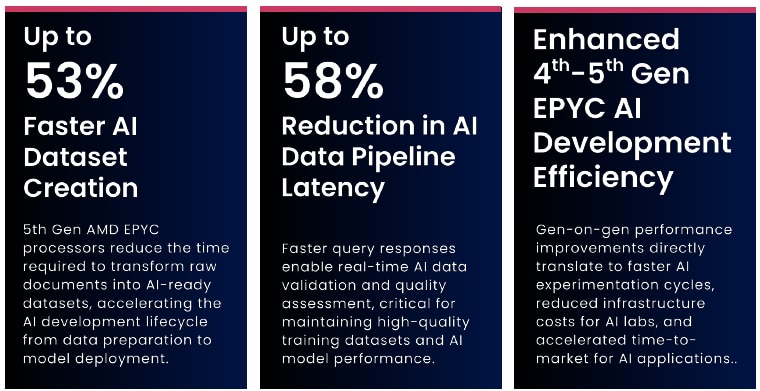
- Up to 53% Faster Document Indexing: The 5th Gen AMD EPYC 9575F delivers document indexing times of just 2.55 minutes compared to 5.41 minutes for the Dual-Socket 4th Gen EPYC 9554, representing a 53% improvement in document processing throughput.
- 58% Query Latency Reduction: Single-Socket 5th Gen EPYC 9575F achieves query response times of 4.79 milliseconds compared to 11.46 milliseconds for Dual-Socket 4th Gen EPYC 9554, delivering a 58% reduction in search latency for enterprise document retrieval operations.
- Consistent Cross-Generation Performance Gains: The benchmark results demonstrate substantial 4th-to-5th Gen performance improvements across all tested configurations, with even the standard 5th Gen EPYC 9555 single-socket processor outperforming dual-socket 4th Gen systems in both indexing speed and query responsiveness.
In the following sections, we visualize latency performance averaged across scale factors for each of the systems under test, and also provide a more detailed per-query performance analyses.
Document Indexing Time
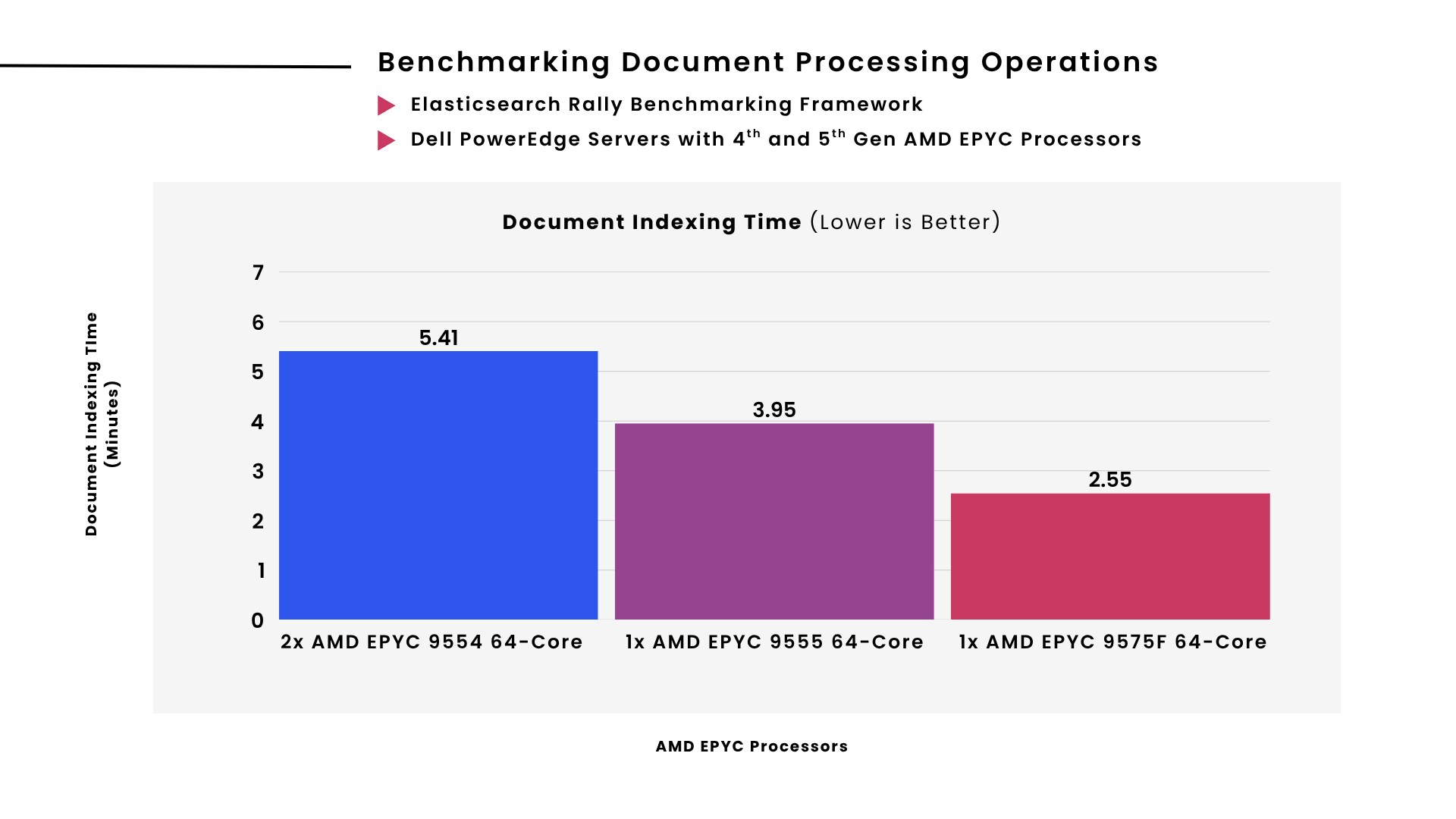
Figure 1: Document indexing time measured in minutes using the Elasticsearch Rally benchmarking framework. Testing Dell PowerEdge Servers with 4th and 5th Gen AMD EPYC Processors.
As shown in the chart above, document indexing performance results reveal significant advantages for 5th Gen AMD EPYC processors across all tested configurations.
The high-frequency single-socket 9575F delivered the best overall performance at 2.55 minutes, representing a 53% improvement over the dual-socket 4th Gen configuration and a 35% improvement over the standard 5th Gen single-socket processor, demonstrating the value of optimized clock speeds for document processing workloads. Following suite, the single-socket EPYC 9555 (5th Gen) required 3.95 minutes for document indexing, compared to the dual-socket EPYC 9554 (4th Gen) which required 5.41 minutes, representing a 27% performance improvement while using half the socket count.
Overall, single-socket 5th Gen processors consistently outperform dual-socket 4th Gen systems, providing superior performance while reducing hardware complexity, power consumption, and software licensing costs associated with multi-socket deployments. These indexing performance improvements directly translate to faster AI dataset creation, reduced data preparation backlogs, and improved overall system responsiveness in AI data pipeline operations, enabling organizations to accelerate their journey from raw documents to production-ready AI models.
Query Latency
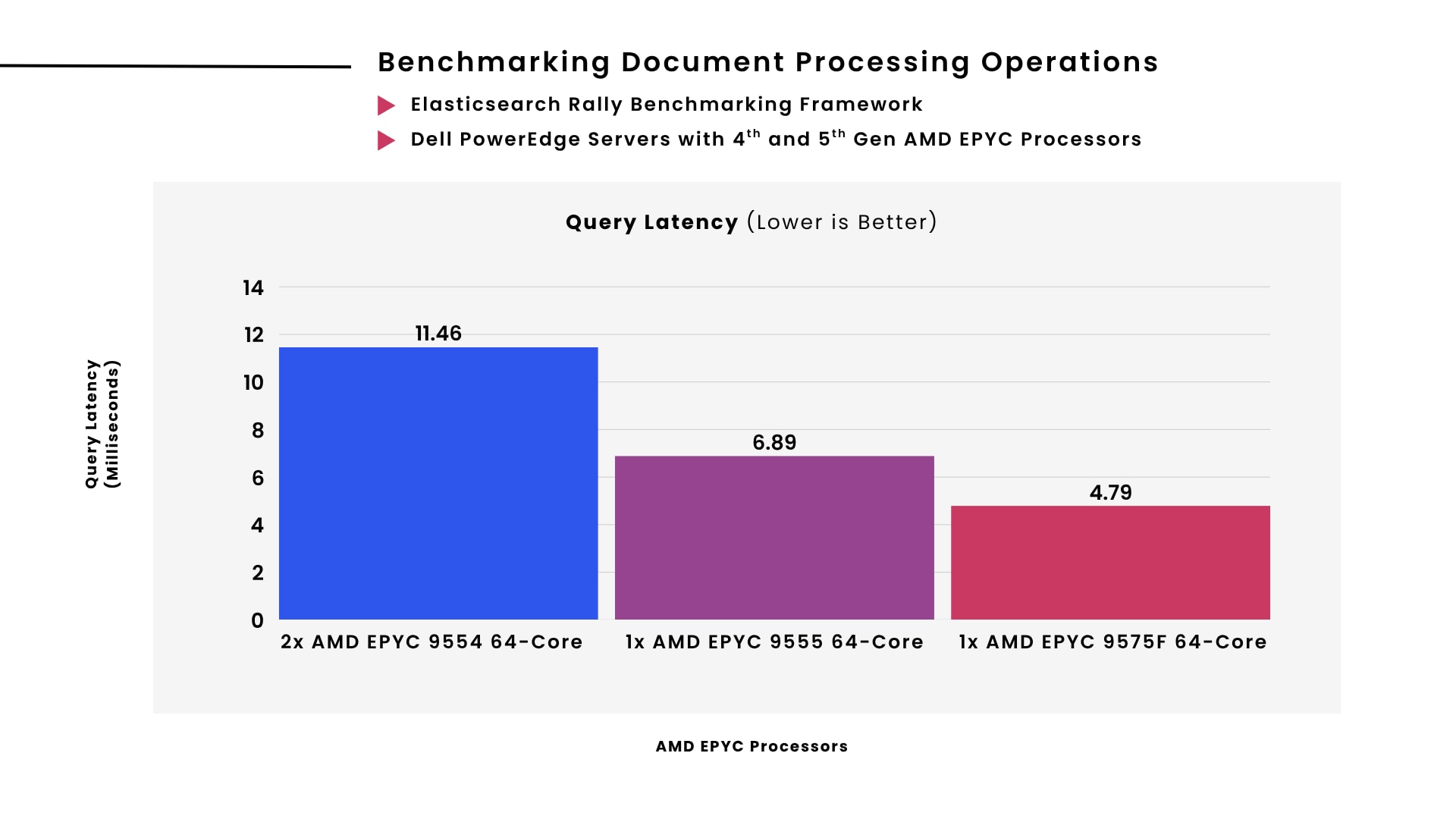
Figure 2: Query latency performance measured in milliseconds using the Elasticsearch Rally benchmarking framework. Testing Dell PowerEdge Servers with 4th and 5th Gen AMD EPYC Processors.
The query latency results demonstrate similar performance improvements, with 5th Gen AMD EPYC processors delivering substantial reductions in search response times across all tested configurations.
As shown above, the single-socket high-frequency EPYC 9575F achieved just 4.79 milliseconds, a 58% improvement over the 4th Gen dual-socket baseline, representing the best query latency performance in our test suite. The single-socket EPYC 9555 also outperforms the 4 Gen SKU, achieving 6.89 milliseconds compared to 11.46 milliseconds, representing a 40% reduction in query response time with half the socket count.
This combination of reduced indexing times and improved query latencies is valuable for AI applications requiring rapid information retrieval from large document repositories, such as AI-powered legal assistants, technical documentation for AI training datasets, and knowledge base construction for internal enterprise AI applications.
Power and Cost Analysis
Understanding both the power characteristics and cost-effectiveness of each EPYC processor is crucial for evaluating total cost of ownership in accelerating document processing for AI pipelines.

Figure 3: Summary table of TDP, 1ku pricing, and performance scores for the three tested AMD EPYC Processors. *Performance Score is a composite metric that combines both indexing and query performance, calculated with the following formaula: (1/normalized_indexing_time) + (1/normalized_query_latency)
Power and Performance Efficiency
Despite slight per-unit TDP increases from 360W to 400W, 5th Gen processors achieve better performance per watt than the 9554 when comparing our calculated performance scores over theoretical max system power consumption. As shown above, dual-socket 4th Gen configurations can consume up to 720W (2×360W) while single-socket 5th Gen systems consume only 400W, a 44% power reduction while delivering superior performance, translating to significant operational cost savings in large-scale deployments.
Cost-Effectiveness Analysis
The single-socket EPYC 9555 delivers lower document indexing and query latency times for only an 8% price premium ($739 increase per-unit), resulting in higher performance per dollar. The single-socket EPYC 9575F provides 125% (performance scores of 225 vs 100) better performance for a 30% price premium ($2,704 increase per-unit). When accounting for total system costs, dual-socket 4th Gen deployments require $18,174 in processor costs alone, while single-socket 5th Gen configurations achieve superior performance for $9,826-$11,791, representing savings of$6,383-$8,348 per system before considering additional benefits.
Summary
Enterprises and AI research organizations require robust, scalable, and cost-efficient infrastructure for AI data preparation operations. The benchmarking results clearly demonstrate the value of AMD EPYC CPUs for AI-focused document processing workloads, offering:
- AI Pipeline Performance Gains: 5th Gen AMD EPYC processors demonstrate substantial performance improvements over 4th Gen systems, with document indexing improvements of up to 53% and query latency reductions of up to 58%. These gains directly translate to faster AI dataset creation and improved model training efficiency, enabling organizations to accelerate their AI development cycles and reduce time-to-deployment for AI applications.
- Infrastructure Consolidation Benefits: Single-socket 5th Gen AMD EPYC 9555 processors outperform dual-socket 4th Gen EPYC 9554 configurations while reducing hardware complexity, power consumption, and cooling requirements. This consolidation enables cost savings through reduced software licensing fees and simplified infrastructure management.
-
High-Frequency Optimization: The single-socket EPYC 9575F high-frequency processors deliver the best performance across both indexing and query operations, making them ideal for performance-critical AI data preparation workloads. Organizations can achieve sub-6-milliseconds query response times and sub-3-minute document indexing with these optimized processors.
-
Scalable Architecture: The benchmark results across varying core counts and socket configurations validate AMD EPYC's ability to scale AI data preparation performance based on enterprise requirements, from single-socket deployments for cost-sensitive applications to dual-socket configurations for maximum performance.
This combination of improved performance, reduced hardware requirements, lower power consumption, and cost-effectiveness positions 5th Gen AMD EPYC processors as compelling solutions for AI data preparation infrastructure. By strategically implementing AMD EPYC processors, enterprises can accelerate AI development pipelines, optimize compute resources for model training, and enhance knowledge extraction while achieving cost savings across hardware, licensing, power expenses.
To learn more about our benchmarking methodology and results, reach out to us at contact@metrum.ai.
Appendix A
Benchmarking AMD EPYC CPUs
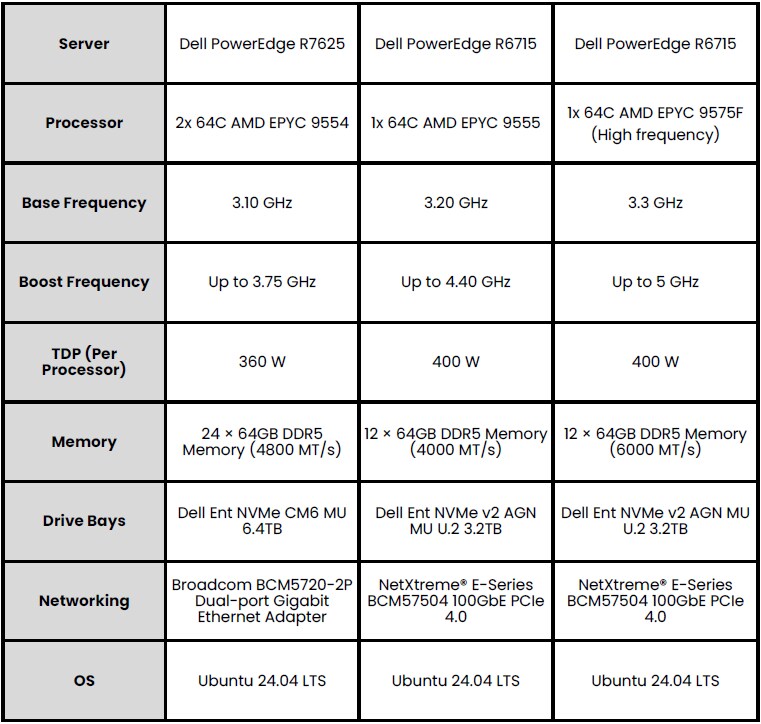
Leveraging our document processing benchmark methodology based on Elasticsearch Rally, we evaluated performance across the following Dell PowerEdge servers with varying AMD EPYC CPU configurations.
Systems Under Test

Figure 3: Table listing Dell PowerEdge Servers with AMD EPYC Processors that we evaluated. Refer to Appendix B for detailed hardware configurations.
Our benchmarking methodology followed industry-best practices for Elasticsearch performance evaluation. Each system was configured with optimized BIOS settings based on AMD EPYC 9005 tuning guidelines, including maximum performance power profiles, manual TDP control, and enabled SMT for optimal multi-threading performance. This benchmark environment utilized the following components:
- Operating System: Ubuntu 24.04 LTS with kernel version 6.8.0-35-generic
- Elasticsearch: Version 8.18.0
- Rally: Version 2.12.0
- Dataset: github_archive track (~100GB)
Key benchmark parameters included configurable client connections and bulk processing sizes to optimize CPU utilization across different core counts and socket configurations. System monitoring was implemented using Prometheus with node_exporter and ipmi_exporter toolkits to capture comprehensive performance metrics including CPU utilization, memory usage, power consumption, and thermal characteristics. Multiple benchmark runs were conducted to ensure statistical significance, with warm-up periods implemented to stabilize system performance before measurement collection.
Appendix B
Hardware Configuration Details
Appendix C
References
- AMD images and 1ku pricing information: AMD.com, AMD Partner Resource Library, https://www.amd.com/en/partner/resources/resource-library.html
- Dell images: Dell.com
Copyright Notice
Copyright © 2025 Metrum AI Inc. All Rights Reserved. Metrum AI, the Metrum AI logo, and other trademarks are trademarks of Metrum AI Inc. The analysis in this document was conducted by Metrum AI Inc. and commissioned by Dell Technologies.
Dell Technologies, Dell, Dell PowerEdge, Dell logo, and other trademarks are trademarks of Dell Inc. or its subsidiaries. AMD, AMD logo, AMD EPYC, AMD ROCm, and combinations thereof are trademarks of Advanced Micro Devices, Inc.
Other trademarks may be the property of their respective owners.
Disclaimer
Performance varies by hardware and software configurations, including testing conditions, system settings, application complexity, the quantity of data, batch sizes, software versions, libraries used, and other factors. The results of performance testing provided are intended for informational purposes only and should not be considered as a guarantee of actual performance.
Metrum AI believes the information in this document is accurate as of its publication date. The information is subject to change without notice.