Dell Exascale Storage Platform
Executive summary
Executive summary
Overview
The scale and demands of unstructured data continue to grow at a relentless rate, making the need for optimized file-based data storage, and its simplified management, more crucial than ever.
OneFS secure snapshots help customers maximize the long-term value of their critical business data and drive down storage management cost and complexity. This simple, scalable solution offers fast, space-efficient, consistent copies of large datasets on Dell PowerScale NAS storage.
This white paper presents information for managing secure snapshots in a Dell PowerScale cluster. This document does not intend to provide a comprehensive background to the OneFS architecture.
See the OneFS Technical Overview white paper for further details about the OneFS architecture.
Audience
The target audience for this white paper is anyone configuring and managing secure snapshots within a OneFS-powered clustered storage environment. It is assumed that the reader has an understanding and working knowledge of the OneFS components, architecture, commands, and features.
More information about OneFS commands and feature configuration is available in the OneFS Administration Guide.
Revisions
| Date | Part number/ revision | Description |
| August 2026 | H04744 | Exascale released in conjunction with OneFS 9.15.0 |
| September 2026 | H04744.1 | Updated Licensing and Consumption Model information |
We value your feedback
Dell Technologies and the authors of this document welcome your feedback on this document. Contact the Dell Technologies team by email.
Overview
Overview
Introduction
Dell PowerScale OneFS is the operating system that powers the Dell PowerScale family of scale-out NAS storage solutions. Designed to handle large-scale unstructured data with high performance, efficiency, and security, OneFS provides a unified, scalable file system that integrates data protection, eliminates volume management, and supports multiple protocols and workloads across edge, core, and cloud environments.
OneFS 9.15 introduces support for the PowerScale Exascale Storage Platform — Dell's first software-defined, subscription-licensed PowerScale product. Rather than shipping as a fixed appliance, the Exascale platform decouples hardware and software: the Dell PowerEdge R7725xd server is procured through standard server sales channels, and OneFS (or ObjectScale) is licensed separately as a subscription. This model gives large AI and HPC customers access to the latest server generation significantly faster than traditional appliance refresh cycles allow.
The PowerEdge R7725xd is the first AMD-based node in the PowerScale lineup. It pairs dual AMD EPYC SP5 9455 processors (96 cores per node) with 768 GB of DDR5-6400 memory, 24 PCIe Gen5 NVMe U.2 SSDs, and 400GbE front- and back-end networking. Per-node raw capacity ranges from 184 TB (24 × 7.68 TB TLC) to 2.88 PB (24 × 122 TB QLC), and sequential throughput reaches 21 GB/s read and 12.4 GB/s write per node.
PowerScale Portfolio Overview
The Dell PowerScale portfolio is a family of scale-out NAS storage solutions built to handle any type of unstructured data — files, images, video, instrumentation data, and AI training datasets. PowerScale combines the performance, flexibility, and efficiency of the OneFS operating system with hardware innovations including all-NVMe, all-flash, hybrid, and archive nodes. PowerScale enables customers to run diverse workloads across multiple protocols, clouds, and locations while ensuring data security, protection, and management at scale.
The current PowerScale all-flash portfolio spans a range of performance, density, and cost points:
- PowerScale F910: The densest all-flash appliance node. 2U, dual-socket Intel Sapphire Rapids, 24 NVMe SSDs, up to 1.47 PB raw per node, 100GbE front and backend.
- PowerScale F710: Mid-range all-NVMe node. 1U, dual-socket Intel Sapphire Rapids, 10 NVMe SSDs, up to 610 TB raw per node.
- PowerScale F210: Entry all-NVMe node. 1U, single-socket Intel Sapphire Rapids, 4 NVMe SSDs, up to 61 TB raw per node.
OneFS 9.15 extends this portfolio with the Exascale Storage Platform, a software-defined offering built on the Dell PowerEdge R7725xd.
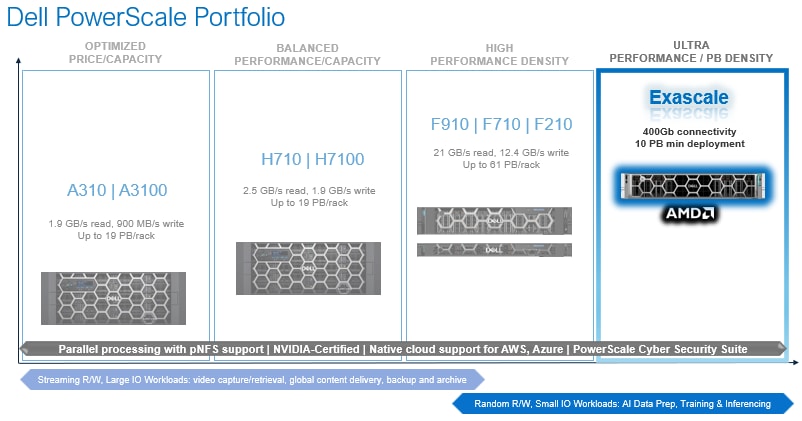
The R7725xd raises the performance ceiling significantly, quadrupling backend network bandwidth to 400GbE, and introducing the AMD EPYC SP5 processor — a first for PowerScale.
Target customers and workloads
The Exascale platform is designed for large, strategic AI and HPC accounts that require extreme-scale storage: organizations training large language models, running distributed inference at scale, processing genomics or financial market data, and operating multi-petabyte media pipelines. Minimum deployments start at 10 PB and scale to 61 PB or more per rack.
- AI/ML Training: High-throughput sequential reads to feed GPU clusters during model training. The R7725xd's 400GbE connectivity and PCIe Gen5 drives deliver sustained data rates that can feed 16,000+ GPUs.
- HPC and Simulation: Parallel file system access patterns requiring both large sequential bandwidth and low-latency metadata operations at scale.
- AI Inference and RAG: Mixed random and sequential access to active datasets, vector stores, and retrieval-augmented generation pipelines.
- Data Management and Pre-processing: Large-scale ETL, data ingestion, and transformation pipelines that require high-throughput writes and scalable namespace management.
Dell Exascale Storage Platform Overview
Architecture
Dell Exascale Storage is a software-defined storage platform that runs PowerScale OneFS, ObjectScale, or — in future releases — Dell Lightning File System and PowerFlex, on a shared hardware foundation: the Dell PowerEdge R7725xd server. The platform is designed for deployments of 10 PB or larger and introduces several architectural capabilities not available in traditional PowerScale appliances.
| Capability | Exascale Platform | Traditional Appliance |
| Hardware procurement | Standard server sales channels | Fixed appliance SKU |
| Software licensing | Subscription-based, separate from hardware | Bundled with hardware |
| Hardware refresh | Immediate access to the latest PowerEdge generation | Follows appliance lifecycle |
| Multi-personality | PowerScale, ObjectScale, Lightning on same node | Fixed storage software per SKU |
| Node re-purposing | Can re-license node for different storage engine | Not supported |
| Minimum deployment | 10 PB | 3 nodes (varies by model) |
| Subscription options | 1, 3, 4, 5 years with TLA | Standard hardware purchase |
Three storage engines, one platform
A key design principle of the Exascale platform is that the same PowerEdge R7725xd hardware can host any of three distinct storage software stacks — without any hardware differences between them. The choice of storage engine is a software licensing decision, not a hardware decision.
- Dell PowerScale OneFS: Industry-leading scale-out NAS for unstructured data. POSIX-compliant, multi-protocol (NFS, SMB, S3, HDFS), with enterprise data protection, SmartSync replication, and the full OneFS security suite. Targeted at AI training pipelines, HPC scratch and home directories, media and entertainment, and general-purpose NAS at extreme scale.
- Dell ObjectScale: High-performance S3-compatible object storage. Designed for AI data lakes, model checkpointing, and large-scale object repositories. ObjectScale on R7725xd (Project Hornet) supports S3 over RDMA with CUDA libraries and GPUDirect Storage integration.
- Dell Lightning File System (future): An extremely high-performance, POSIX-compliant, NCP-compatible parallel file system targeting the most demanding AI training and HPC scratch workloads. Lightning on Exascale is planned for a future release.
The shared hardware foundation enables flexible consumption: a customer who initially deploys nodes as PowerScale can, in a future period of their Total License Agreement, re-license some or all nodes as ObjectScale — or vice versa — without any hardware change. This is a capability Dell calls Exascale substitution, enabled by the Total License Agreement (TLA) mechanism described in the licensing section.
PowerScale Portfolio
The following table shows the Exascale R7725xd node in context with the existing PowerScale all-flash portfolio. The Exascale platform occupies a new tier above the F910 in performance density and is the only software-defined offering in the lineup:
| Platform | Form Factor | NVMe Drives | Max Raw/Node | Back-End NW | Software Model |
| PowerScale F210 | 1U | 4 × PCIe Gen5 | 61 TB | 100GbE | Appliance |
| PowerScale F710 | 1U | 10 × PCIe Gen5 | 610 TB | 200GbE | Appliance |
| PowerScale F910 | 2U | 24 × PCIe Gen5 | 2.88 PB | 200GbE | Appliance |
| Exascale R7725xd | 2U | 24 × PCIe Gen5 | 2.88 PB | 400GbE | Software-defined |
PowerEdge R7725XD Hardware Platform
The PowerEdge R7725xd is a 2U server purpose-engineered for extreme-density NVMe storage workloads. It is the foundational hardware for the Exascale Storage Platform and the first PowerScale node built on AMD EPYC processors.

The R7725xd features 24 PCIe Gen5 NVMe U.2 drive bays, dual 400GbE NVIDIA ConnectX-8 frontend NICs, dual 400GbE backend NICs, and 768 GB of DDR5-6400 memory. In a standard 42U rack, the platform delivers up to 61 PB of raw NVMe capacity.
To the right of the node frontend is the RCP (Right Control Panel).
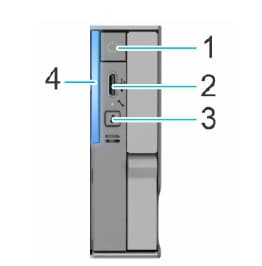
This RCP sub-assembly contains the following components:
| Component | Details |
| 1 | Power button with integrated power LED |
| 2 | USB 2.0 Type-C port |
| 3 | Status LED for Host |
| 4 | System ID button |
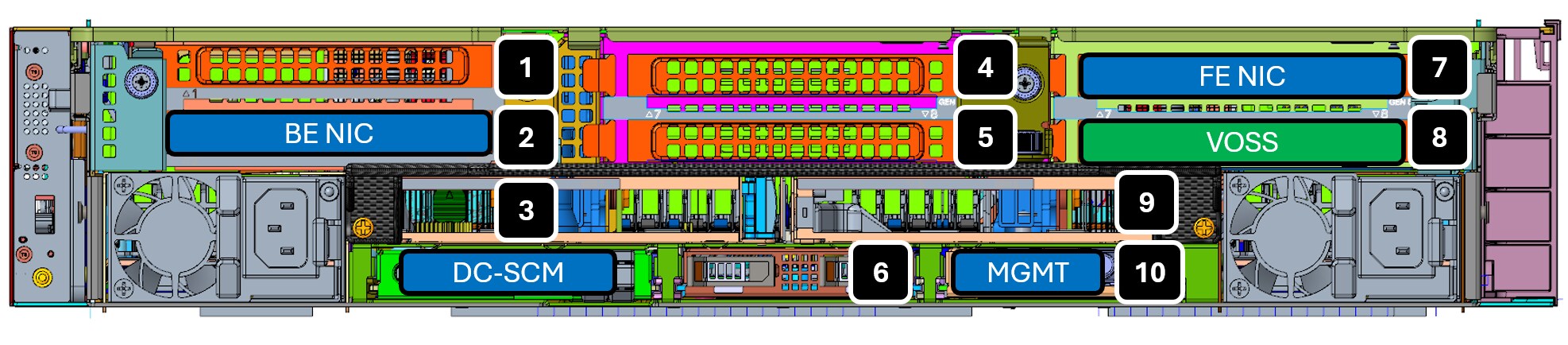
As shown above, the backend PCI slots on an Exascale node are populated as follows:
| Slot Number | Function |
| 1 | Unused |
| 2 | Backend NIC |
| 3 | Unused |
| 4 | Unused |
| 5 | Unused |
| 6 | BOSS module |
| 7 | Frontend NIC |
| 8 | Unused |
| 9 | Unused |
| 10 | Management NIC |
Specifications
| Attribute | Specification |
| Chassis | 2U Dell PowerEdge R7725xd |
| CPU | Dual-Socket AMD EPYC SP5 9455 (48 cores/socket, 96 cores total) |
| CPU Clock Speed | Base 3.15 GHz / Boost 4.4 GHz, 300 W TDP, 256 MB L3 cache per socket |
| Memory | 768 GB DDR5-6400 (24 × 32 GB RDIMMs) |
| Journal | 64 GB Software Defined Persistent Memory (SDPM) |
| Boot Drive | BOSS N-1 — dual-mirrored 960 GB ISE |
| NVMe SSD Drives | 24 × U.2 NVMe PCIe Gen5 x4 |
| Frontend Networking | 2 × 400GbE NVIDIA ConnectX-8 (PCIe Gen5 x16) |
| Backend Networking | 2 × 400GbE NVIDIA ConnectX-8 (PCIe Gen5 x16) |
| Backend Switch | NVIDIA Spectrum-SN5610 |
| Management NIC | Dual-port OCP 3.0 NIC, 1GbE |
| Trusted Platform Module | Yes |
| Drive Interface | PCIe Gen5 NVMe (ISE only — no SED/FIPS drives) |
| Minimum OneFS Version | OneFS 9.15 |
| Minimum NFP Version | NFP 14.1 |
AMD EPYC Processor
The R7725xd marks the first use of an AMD CPU in the PowerScale lineup. The AMD EPYC SP5 9455 is AMD's processor of choice for AI, HPC, and hyperscaler workloads. Each socket delivers 48 Zen 4 cores, 256 MB of L3 cache, and 800 GB/s of memory bandwidth at DDR5-6400 speeds. With two sockets, the R7725xd provides 96 cores, 1.6 TB/s of aggregate memory bandwidth, and significantly more PCIe Gen5 lanes than the prior Intel-based generation — enabling higher NVMe drive counts without contention.
The transition to AMD is not simply a CPU swap. The broader AMD platform enables the 64 GB Software Defined Persistent Memory (SDPM) journal, providing persistent, battery-free write journaling with performance characteristics of DRAM and the durability of flash, helping improve both write latency and recovery speed.
| Attribute | R7725xd (Exascale) | F910 / F710 (16G) |
| CPU Architecture | AMD EPYC SP5 (Zen 4) | Intel Sapphire Rapids |
| Cores per node | 96 (2 × 48) | 48 (2 × 24) |
| Memory capacity | 768 GB DDR5-6400 | 512 GB DDR5 |
| Memory bandwidth | ~1.6 TB/s aggregate | ~800 GB/s aggregate |
| PCIe Generation | Gen5 | Gen5 |
| Journal | 64 GB SDPM | 32 GB SDPM / 16 GB SDPM |
| Backend networking | 2 × 400GbE | 2 × 100GbE |
NVMe Drive Configuration
Each Exascale R7725xd node has twenty four U.2 NVMe drive bays connected at PCIe Gen5 x4 per drive. Five drive capacities are available, including two TLC ISE and three QLC ISE options, which cover a raw per-node range from 184 TB to 2.88 PB. All drives are ISE (Instant Secure Erase) only; SED and FIPS drive options are not supported on the Exascale platform in the initial release.
| Drive Type | Capacity per Drive | Raw Capacity (24 Drives) | Notes |
| TLC ISE | 7.68 TB | 184 TB | Highest performance per TB; lowest latency |
| TLC ISE | 15.36 TB | 368 TB | Performance tier; balanced performance/capacity |
| QLC ISE | 30.72 TB | 737 TB | Capacity tier; excellent sequential throughput |
| QLC ISE | 61 TB | 1,464 TB (1.43 PB) | High-density; maximum capacity/rack |
| QLC ISE | 122 TB | 2,928 TB (2.88 PB) | Ultra-density; highest PB per rack unit |
Networking Architecture
The R7725xd introduces 400GbE networking on both the frontend (client-facing) and backend (intra-cluster) paths — a 4× increase over the 100GbE backend of the F910. This architectural upgrade is critical for extreme-scale deployments where the aggregate I/O demand from tens of thousands of GPU cores saturates lower-bandwidth fabrics.
- Frontend: 2 × NVIDIA ConnectX-8 PCIe Gen5 x16 adapters, each supporting 400GbE. Clients connect via NFS, SMB, S3, or HDFS over standard Ethernet. NFS over RDMA is supported for GPU-direct storage access patterns.
- Backend: 2 × NVIDIA ConnectX-8 PCIe Gen5 x16 adapters at 400GbE. The backend fabric carries intra-cluster traffic (data mirroring, striping, and OneFS internal communications) over NVIDIA Spectrum-SN5610 switches.
- Management: Dual-port OCP 3.0 NIC at 1GbE. Replaces the legacy LOM (LAN On Motherboard) design of prior-generation nodes.
Serial Console: There is no physical serial port on the R7725xd platform. Instead, the node’s serial console is accessed via SSH to the iDRAC. First, connect to the iDRAC IP address with an SSH client. From here, at the ‘racadm>>’ prompt, enter the ‘console com2’ command to connect to the virtual serial (OneFS) console. For example:
$ ssh root@10.10.20.100
(root@10.10.20.100) Password:
racadm>>console com2
Connected to Serial Device 2. To end type: ^\
File System Journal
The OneFS write journal is implemented as 64 GB of Software Defined Persistent Memory on the R7725xd — the first SDPM implementation on an AMD-based PowerScale node and double the 32 GB SDPM capacity of the PowerScale F910 and F710 nodes. SDPM provides battery-free persistent write journaling: writes are committed to SDPM synchronously and acknowledged to the client before being destaged to NVMe SSDs asynchronously. Because SDPM is non-volatile (implemented via capacitor-backed DRAM modules), there is no risk of journal data loss on power failure, and no batteries to monitor or replace.
The larger 64 GB SDPM capacity on the R7725xd provides a larger write coalescing window, improving write efficiency for workloads with small random writes — common in AI checkpointing and metadata-intensive data pre-processing pipelines.
OneFS on Exascale
OneFS on Exascale
File system capabilities
The Exascale platform runs PowerScale OneFS 9.15 and later releases, leveraging the same industry-leading distributed file system that powers the entire PowerScale portfolio. All OneFS features, protocols, and administrative interfaces are available on Exascale nodes, and Exascale nodes can join existing Ethernet-based PowerScale clusters.
Protocol Support
OneFS on the Exascale platform supports the full PowerScale multi-protocol stack:
| Protocol | Use Case |
| NFSv3, NFSv4, NFSv4.1, parallel NFS (pNFS) | Linux/UNIX clients; GPU cluster training pipelines |
| NFS over RDMA (NFS-RDMA) | High-throughput GPU-direct access; reduced CPU overhead |
| SMB 2.x / 3.x | Windows clients; collaborative workloads |
| S3 (via OneFS S3 gateway) | Object access to NAS data; S3-compatible applications |
| HDFS | Hadoop-compatible workloads on existing pipelines |
| HTTP/WebDAV | Web-based file access |
Data Protection
OneFS provides erasure-coding based data protection (FlexProtect) across all Exascale nodes. Protection levels are configurable per directory or file policy and range from mirroring (N+1 through N+4) to erasure coding schemes optimized for different cluster sizes and performance requirements. FlexProtect continuously monitors for drive and node failures and automatically rebuilds data to the configured protection level without requiring manual intervention or downtime.
The Exascale platform does not change the protection model — customers configure protection levels in OneFS exactly as they do on appliance nodes, and Exascale nodes participate in protection groups that can span both Exascale and traditional appliance nodes.
SmartSync Data Mobility
OneFS 9.15 includes SmartSync — a unified replication and data mobility capability built on the Dell Data Mover service. SmartSync provides an alternative to SyncIQ for policy-based replication and includes native migration capabilities from existing SyncIQ policies with no re-baseline required. Exascale clusters can participate as SmartSync source or target endpoints, enabling push or pull-based data mobility between Exascale software-defined clusters and traditional PowerScale clusters, and between on-premises and cloud targets.
Security
The PowerScale Cyber Security Suite is fully supported on the Exascale platform, in addition to the standard OneFS data management and protection service catalog. This includes:
- SmartPools and CloudPools: File policy-driven tiering and access control for cloud integration.
- SmartLock: WORM (Write Once Read Many) compliance for regulatory data immutability requirements.
- Ransomware detection and anomaly alerting: Machine learning-based detection of unusual access patterns with configurable response actions.
- FIPS 140-3 compliant encryption: Encryption at rest and in flight using FIPS-validated cryptographic modules.
Note: ISE drive-level secure erase is supported; SED hardware-encrypted drives are not available in the initial Exascale release.
- Role-based administration: Granular administrative privilege model with Active Directory and LDAP integration, plus SSO, Secure Root, and Multi-party Authorization.
- Trusted Platform Module (TPM): Hardware root of trust for boot integrity verification.
NVIDIA Certification
The Exascale platform is currently undergoing NVIDIA NCP (NVIDIA Network-Certified Program) certification. NCP certification validates that the platform delivers the throughput, protocol compatibility, and reliability expected by NVIDIA DGX SuperPOD and AI Enterprise workloads. Certification status should be confirmed with your Dell account team for the latest update.
Licensing and Consumption Model
Unlike traditional PowerScale appliance products, where software is bundled into the appliance SKU and licensed per hardware purchase, the Exascale platform uses a separate, subscription-based software licensing model. Hardware is procured through standard Dell server sales channels, and OneFS (or ObjectScale) is licensed independently based on raw storage capacity.
.
Subscription terms
OneFS software subscriptions for Exascale are available in 3, 4, and 5-year terms and are priced per raw terabyte of licensed capacity. ProSupport or ProSupport Plus is included in all Exascale subscription terms. A single licensing tier covers all Exascale deployments regardless of drive type or node configuration.
Transformational License Agreement (TLA)
The Exascale platform is designed to operate within a Dell Transformational License Agreement (TLA), which provides a contractual framework for consuming licensed capacity across multiple storage products over the term of the agreement. The TLA enables two key capabilities:
- Substitution: Within the contracted TLA value, a customer can exchange license capacity between PowerScale SDS and ObjectScale SDS on a 1:1 basis. For example, a customer who originally planned to deploy 100 TB of PowerScale and 100 TB of ObjectScale can — at an annual health check — shift some ObjectScale license capacity to PowerScale (or the reverse) without additional charge, provided total consumption does not exceed the contracted TLA value.
- True-up and amendment: If consumption in a given period exceeds available TLA capacity, the customer can amend the TLA to increase the contracted value.
The following table describes the life cycle phases:
| Phase | Description |
| Purchase | Modern Software Subscription. Raw capacity-based subscription (3, 4, 5 years) with ProSupport or ProSupport Plus included. Pricing is aligned with ObjectScale SDS to enable seamless Exascale 1:1 substitution between PowerScale SDS and ObjectScale SDS. RPQ is required. |
| Deploy | Engineering-led deployment transitioning to Dell Professional Services. PowerScale SDS and ObjectScale SDS SKUs are used to fulfill License Activation Keys (LAKs). OneFS is installed on-site on the validated Common Hardware BOM. The product is fully featured for the capacity purchased. |
| Manage | Ongoing visibility and flexibility. TLA simplifies lifecycle operations: add capacity or change product personality without hardware changes. An amendment is required only if the license consumption exceeds the total contracted value. |
Deployment Options
Deployment Options
The Exascale platform supports two deployment models: greenfield (a new dedicated Exascale cluster) and brownfield (expanding an existing PowerScale cluster with Exascale nodes). In both cases, the minimum supported deployment is 3 nodes for initial cluster formation; however, commercial minimums are set at 10 PB of usable capacity.
Greenfield deployments
A greenfield Exascale deployment provisions a new OneFS cluster consisting entirely of R7725xd nodes. This is the primary use case for AI Clouds+ customers building dedicated AI training or inference storage infrastructure from scratch.
Greenfield clusters use the Exascale Phase 1 Pave automation (available from June 2026 general availability) to provision multiple nodes simultaneously. The Pave tooling handles initial OneFS configuration, cluster formation, back-end network setup, and license activation from a single workflow. Engineering-led deployment is available during the initial rollout, transitioning to Dell Professional Services as the customer base scales.
- Back-end networking: Exascale clusters use a shared NVIDIA Spectrum-SN5610 back-end fabric. A standard rack configuration includes two SN5610 switches in redundant pairs.
- Minimum configuration: 3 nodes per cluster formation; 10 PB commercial minimum (RPQ-qualified). A full rack of R7725xd nodes with 122 TB QLC drives reaches 61 PB of raw NVMe capacity.
- Scale-out: Additional R7725xd nodes are added to an existing Exascale cluster through the standard OneFS node addition workflow. Data rebalancing is automatic.
Brownfield Deployments
Exascale R7725xd nodes are compatible with existing PowerScale clusters running OneFS 9.15 or later. An organization with an existing F910, F710, or F210 cluster can add Exascale nodes to the same cluster namespace, sharing the same data, directories, and OneFS policies across both node types. This enables a gradual capacity and performance expansion without requiring data migration or cluster replacement.
- OneFS version alignment: The entire cluster must be upgraded to OneFS 9.15 before adding Exascale nodes. Mixed-generation clusters running an older OneFS version cannot add R7725xd nodes.
- Networking alignment: The back-end networking of Exascale nodes (400GbE) operates independently of the back-end networking of prior-generation appliance nodes (100GbE). Both coexist in the same cluster; the 400GbE fabric carries traffic specifically between Exascale nodes.
- Dynamic licensing: In a mixed cluster, traditional appliance node capacity and Exascale node capacity are tracked separately within OneFS. Exascale capacity is billed under the SDS subscription model; appliance node capacity is billed under its original hardware SKU model.
Data protection and security
- OneFS FlexProtect provides transparent, distributed data protection across all Exascale nodes. Unlike traditional RAID, FlexProtect distributes protection stripes across all nodes in the cluster, enabling data recovery from simultaneous drive and node failures without the performance penalty of traditional RAID rebuild operations. Protection rebuilds occur in the background during normal cluster operation and can be throttled to minimize impact on foreground workloads.
The larger NVMe drive capacities available on the R7725xd (up to 122 TB per drive) make protection rebuild time a more significant consideration than with prior generations. Dell Technologies recommends selecting appropriate protection policies based on drive capacity and total cluster size; guidance is provided in the OneFS Best Practices Guide for AI Workloads.
Security Capabilities
| Feature | Description |
| Encryption at rest | AES-256 encryption via ISE drives. All Exascale drives support Instant Secure Erase. |
| Encryption in flight | TLS 1.3 for all client-facing protocols and administrative interfaces. |
| SmartLock (WORM) | Compliance-grade write-once data immutability with independent clock. Meets SEC 17a-4, FINRA, CFTC, and HIPAA immutability requirements. |
| Ransomware protection | Behavioral anomaly detection, snapshot-based rollback, and FPolicy integration with third-party security tools. |
| Multi-tenancy isolation | Access Zones provide fully isolated namespace segments with separate authentication and protocol configurations per tenant. |
| Role-based access control | Granular privilege model with integration to Active Directory, LDAP, and NIS. |
| Audit logging | Per-file and per-directory access audit logging for compliance and forensic use. |
| Trusted Platform Module | Hardware root of trust (TPM 2.0) for boot integrity validation. |
| FIPS 140-3 cryptography | OneFS 9.15 FIPS-validated cryptographic modules for all encryption operations. |
Conclusion
Conclusion
The Dell PowerScale Exascale Storage Platform represents a significant evolution in the PowerScale portfolio — the first software-defined, subscription-licensed offering built on a shared hardware foundation across multiple storage engines. By decoupling hardware procurement from software licensing, Dell can deliver the latest PowerEdge server technology to AI and HPC customers faster than traditional appliance cycles allow, addressing a critical gap for organizations whose infrastructure roadmaps demand immediate access to the latest silicon, memory, and NVMe generations.
The PowerEdge R7725xd raises the performance and capacity ceiling for PowerScale: up to 2.88 PB of raw NVMe capacity per 2RU node, 21 GB/s of sequential read throughput, 400GbE front- and back-end networking, and the introduction of AMD EPYC SP5 processors with 96 cores and 768 GB of DDR5 memory. These specifications position the platform to feed the largest GPU clusters — 16,000+ GPUs — without storage becoming the bottleneck.
Key takeaways: The Exascale platform is purpose-built for extreme-scale AI and HPC workloads. It is not a replacement for the broad enterprise NAS market served by the F210, F710, and F910 appliance platforms. Rather, it is a specialized offering for customers with 10 PB or more of storage requirements who value rapid access to the latest server technology, flexible consumption through subscription licensing, and the ability to re-purpose hardware between PowerScale and ObjectScale without hardware changes.
As the needs of the AI storage market continue to grow, the Exascale platform positions Dell to address the most demanding AI and HPC workloads with a software-defined architecture that can evolve rapidly alongside the pace of innovation in GPU compute, networking, and storage media.