Edge Simulation for Advanced Development Systems
Contents
Overview
Fueled by semiconductor advances and a spread in software ecosystems, autonomous technology innovation continues to accelerate. Increasingly, system validation is deployed in edge environments outside of data centers and cloud. Edge is deployed with semiconductor and systems enhancements, the intensity of massive data generation and consumption, and the need for software to operate in real time. One important use case includes AI-enabled computer vision and sensor fusion to enable perception system training and validation for autonomous and safety critical systems. You can think of autonomous systems as capabilities that are AI enabled for perception, prediction, planning, and control. Examples include:
- Autonomous Vehicles
- Robotic Process Automation
- Virtual Agents
Today’s Advanced Driver Assistance Systems and Autonomous Driving (ADAS/AD) vehicles lead the advancements in autonomous system innovation.
A key emerging requirement for all autonomous systems development, and now a requirement for ADAS/AD, is high-fidelity environmental simulation. Environmental simulation creates a virtual world in which the system under test operates for testing and development. High-fidelity physics-based environment simulation is an essential component of development for any autonomous system.
Dell Technologies is performing research innovation in this emerging area with key ecosystem partners like monoDrive and others.

The Importance of Environmental Simulation
Unlike deterministic software systems, autonomous systems are developed and trained through AI learning frameworks. These frameworks consume labeled training data, and the AI system adapts to provide the optimal response through a process called Network Training. Once the system is developed and trained, it is essential for the system that is under test to perform in a new environment that is not seen during the Networking Training process. The Network Validation process determines if the system makes the right or optimal decision and performs accordingly. This process is especially important for systems like ADAS/AD that are life-safety critical.
The ADAS/AD development cycle must ensure the safety of the vehicle and passengers. NHTSA believes that advanced crash avoidance and mitigation technologies will dramatically increase the safety of a vehicle.[1] One key automotive safety technology that falls into the advanced crash avoidance category is the Automatic Emergency Braking (AEB) system. The vehicle perceives and predicts that it will impact another vehicle or object, so a decision is made within milliseconds to activate the braking system in order to avoid an impending collision. This action requires the receipt of input from multiple sensor systems (camera, radar, lidar, and ultrasonic), interpretation of the meaning of the data, and then performing the appropriate action. ADAS/AD systems require testing and operation in real-world conditions for tens to hundreds of millions of kilometers to ensure that they can safely operate. The systems must also be validated using thousands of targeted safety scenarios like AEB. But once in production, the vehicle’s models will decay and will require upgrades while enhancements will require reverification.
The thorough testing of autonomous capabilities with real vehicular systems is not only cost prohibitive, but often, impossible to validate without environmental simulation. It is much more cost effective and flexible to use high-fidelity simulation systems that harness the power of compute and storage to automate environmental and scenario testing.
The simulation system needs to operate and process immense levels of data (up to ten terabytes/hour per system under test), and react within a short timeframe. It also needs to meet other key requirements:
- Physics based: Must follow the same rules of nature as we all do the application of force, motion, and the reaction to gravity. The simulation environment needs to correctly model material and channel effects in ultrasonic (20 to80 kHz), electromagnetic frequencies (24 GHz to 79 GHz), and infrared optical wavelengths (905 to1550 nm).
- Photorealistic: Must match spectral imaging, white balance, color space, lens distortion, color depth, and exposure time to appear authentic to the system under test.
- Interactive: Interactions must be realistic and interactive with the environment, adjusting as the system under test is stimulated and reacts to the environment.
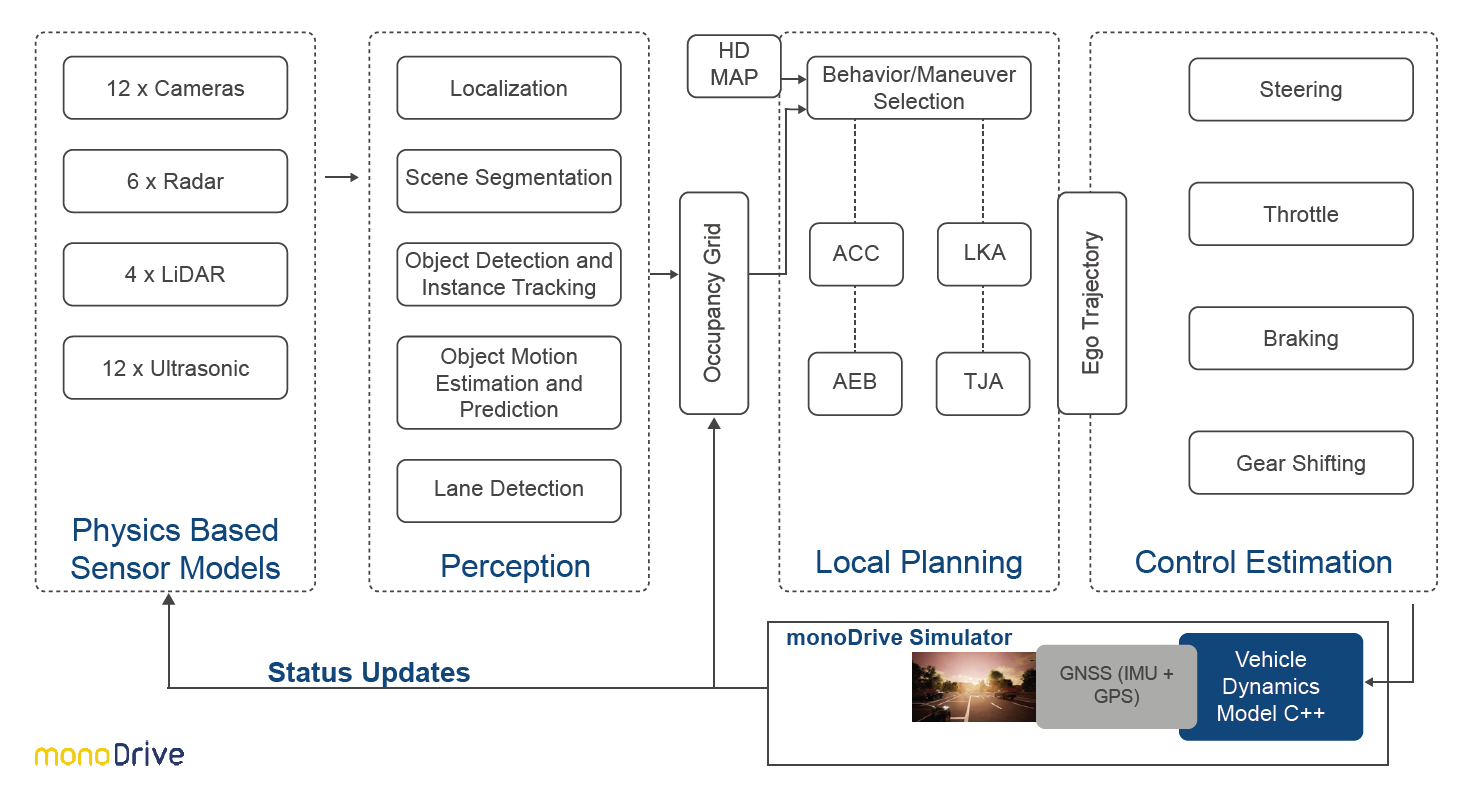
When the simulation system is remote or in the cloud, the conditions cannot be effectively managed. They are most optimally performed in edge environments on optimized platforms that are grouped with systems that are tested under latency-controlled conditions. All ADAS/AD systems require this capability as a fundamental component of the development process. Further, all autonomous systems require the flexibility of simulation to define unique scenarios for development and integration testing.
[1] https://www.safercar.gov/Vehicle-Shoppers/Safety-Technology/aeb–1
Dell Technologies Collaboration with monoDrive
Dell Technologies

The information in this publication is provided as is. Dell Inc. makes no representations or warranties of any kind with respect to the information in this publication, and specifically disclaims implied warranties of merchantability or fitness for a particular purpose. Use, copying, and distribution of any software described in this publication requires an applicable software license.
Copyright © 2020-2021 Dell Inc. or its subsidiaries. All Rights Reserved. Dell Technologies, Dell, EMC, Dell EMC and other trademarks are trademarks of Dell Inc. or its subsidiaries. Other trademarks may be trademarks of their respective owners. Published in the USA December 9, 2020 FY21Q4_0051_edge_simulation_for_advanced_dev_systems_whitepaper_012721.
Dell Inc. believes the information in this document is accurate as of its publication date. The information is subject to change without notice.
Author: Jeff White, iCTO; Said Tabet, Distinguished Engineer; James Singer, Engineering Technologist; George Currie, Senior Software Principal Engineer: Celite Milbrandt, CEO-monoDrive