Gen on Gen SQL Performance within MX vSAN Workloads
Reap better SQL Server performance
Overview
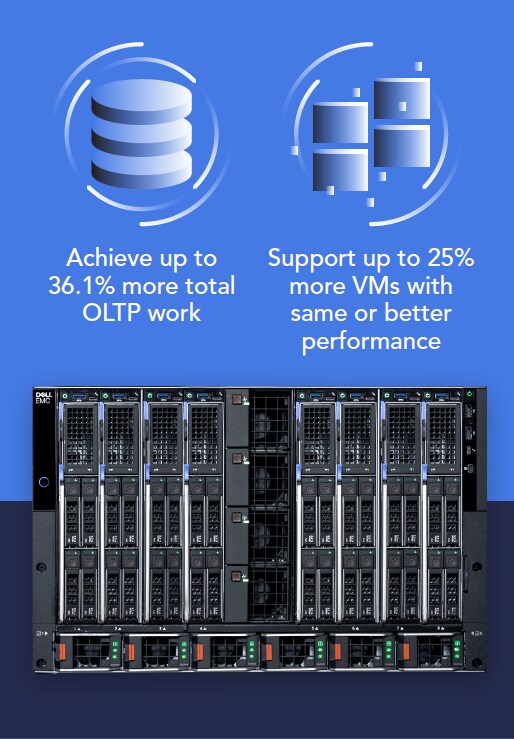
These new servers achieved up to 36.1 percent more OLTP database work than current-generation Dell EMC PowerEdge MX servers, while also lowering application response time
 When you need more computing power from your data center, upgrading to hardware with new processor technologies, architecture, and storage can be a great way to improve performance and get the most from precious space.
Our hands-on testing explored the amount of Microsoft SQL Server transaction-processing work that two VMware® vSAN™ workload clusters could achieve within the same MX7000 chassis. One workload cluster comprised current-generation 14G Dell EMC PowerEdge MX740c servers, and the other had new PowerEdge MX750c servers powered by 3rd Generation Intel® Xeon® Scalable Processors. The next-generation cluster achieved 36.1 percent more SQL Server transaction- processing work in terms of database orders per minute (OPM). At the same time, the current- generation cluster also reduced application response time by 8 percent compared to the previous-generation PowerEdge MX740c cluster.
These results indicate that by selecting next- generation servers in the same chassis, you could scale SQL Server performance within the same data center footprint.
Upgrade to achieve a greater OLTP transaction rate
About new-generation Dell EMC PowerEdge MX servers
 Dell EMC calls the new PowerEdge MX a “modular, 7U integrated solution designed for enterprise data center density with easy deployment, management, and maximum longevity” and says its no midplane design and scalable fabric architecture allow it to support new processor technologies, storage types, and connectivity options.1 Learn more at www.delltechnologies.com/en- us/servers/modular-infrastructure/poweredge-mx/.
1 Dell EMC PowerEdge MX, accessed March 22, 2021, https://www.delltechnologies.com/en-us/servers/modular-infrastructure/poweredge-mx/.
What our test results showed
In the initial phase of our testing, we ran four virtual machines on each server in our three-node workload clusters, for a total of 12 VMs per cluster. Figure 1 shows the results: the next-generation servers delivered 180,462 OPM, which is 18.7 percent more than the 151,923 OPM the current-generation cluster achieved.

During the first phase of testing, the next-generation cluster also achieved an average DVD Store 3 response time that was 18.4 percent less than that of the current-generation cluster.
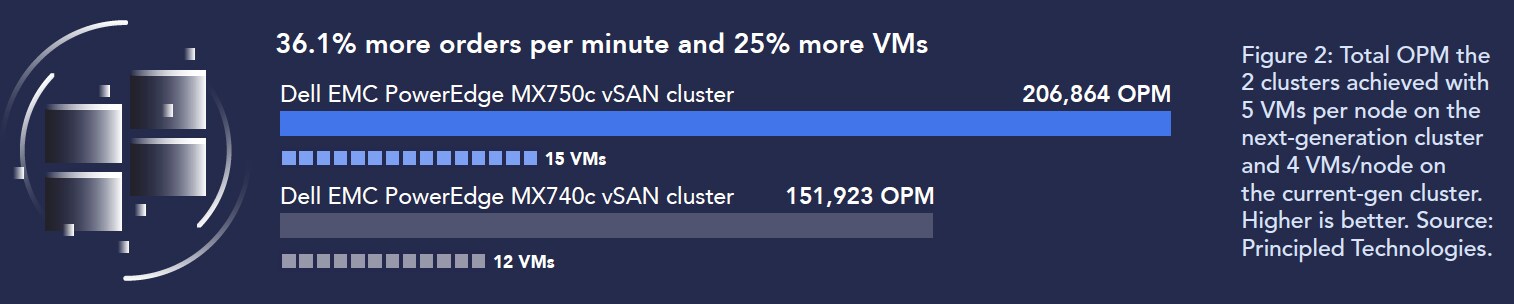
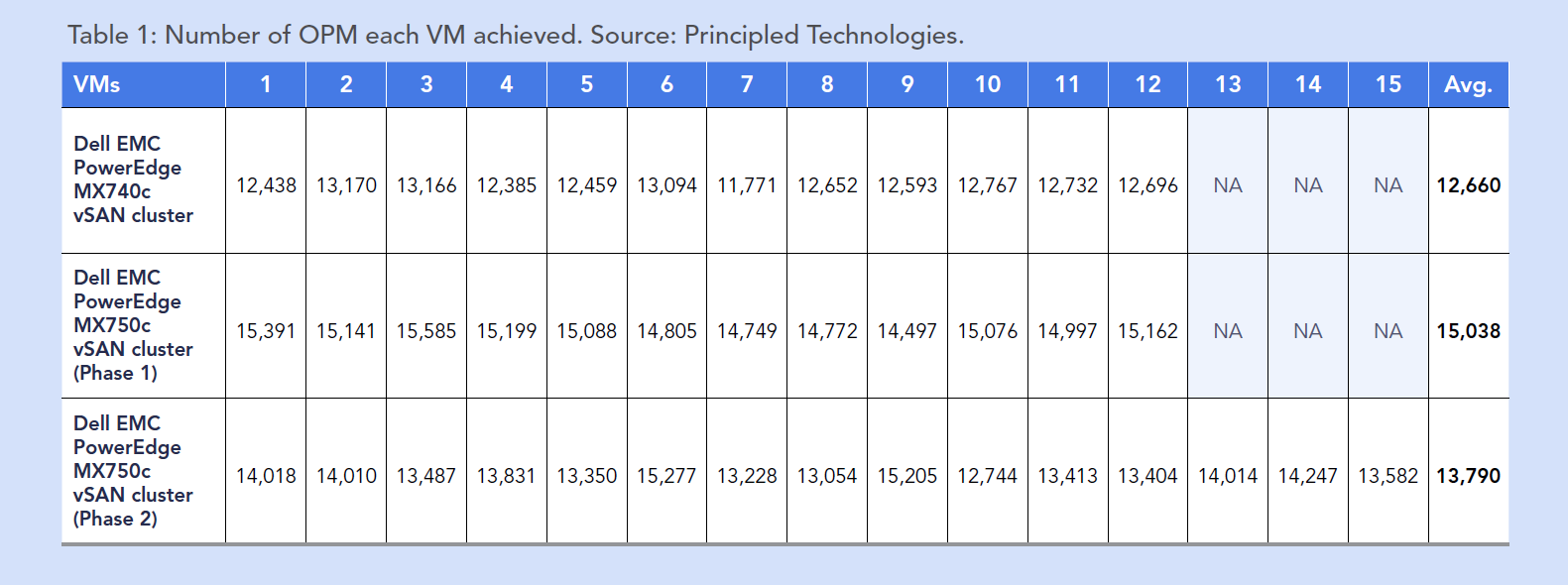
During our first phase of testing, we pushed the current-generation servers to their peak performance, fully utilizing the processors. We observed that the same VM configuration on the next-generation cluster still had processor resources available. In our second phase of testing, we deployed one more virtual machine per host on the next-generation cluster, boosting VM density per node. This meant the next-generation cluster ran 15 VMs, a 25 percent increase over the 12 VMs on the legacy cluster. As Figure 2 shows, these additional VMs allowed the next-generation cluster to deliver 206,864 OPM, an increase of 36.1 percent over the current- generation cluster’s 151,923 OPM.
What about deployment?
Conclusion
When the demands of business require more computing power from your data center, it can be tempting to stick with the server models to which you’ve become accustomed. Choosing the right newer models, however, can deliver advantages in both transaction rate and response time.
In our hands-on testing, a VMware vSAN cluster of next-generation Dell EMC PowerEdge MX servers not only boosted total OLTP performance by more than a third over a cluster of current-generation models, but it also reduced application response time by 8.5 percent.
Investing in these new servers could provide the high-density environment you need to handle your current and future business demands.
 This project was commissioned by Dell Technologies.
Read the science behind this report at http://facts.pt/eLCYZsD.