Dell OpenManage Rack Scale makes each new generation of AI infrastructure simpler to run, from Silicon to Server, Rack to Data Center, and across multiple sites.
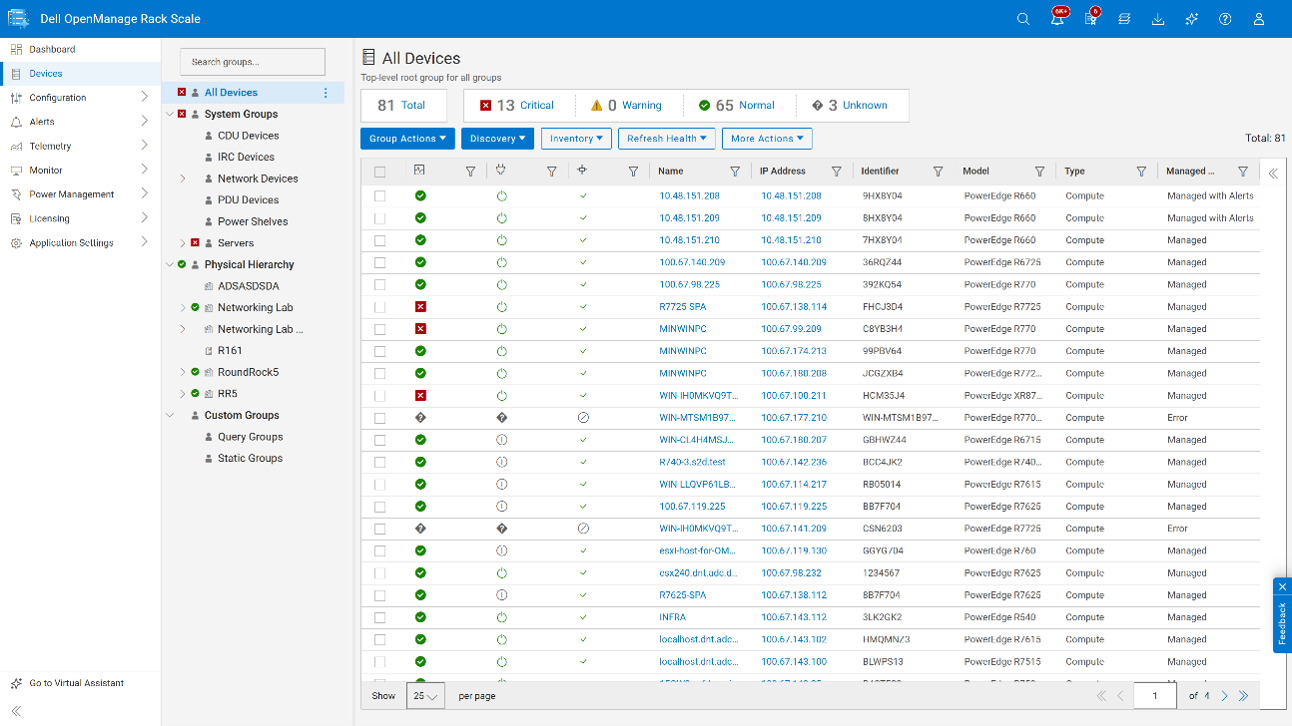
Dell OpenManage Rack Scale — All Devices Inventory View
Every generation of compute arrives with more of everything. Processors carry more cores, accelerators deliver more performance per watt, and memory and I/O get faster. Servers are becoming modular, and direct liquid cooling has become a mainstream design choice. This is a remarkable period of hardware innovation. It also raises an important question: how do we make all this capability and innovation simple to operate?
There is a useful principle in systems design known as Tesler's Law. It says that complexity can't be eliminated, only moved. Every new hardware capability brings complexity with it. The real design decision is where that complexity ends up: with the people who run the infrastructure, or to a platform built to absorb it.
Dell OpenManage Rack Scale is our answer to that question. It is a management platform designed to take on the complexity of operating modern AI and data center infrastructure, from device to rack, and across compute, power, cooling and networking fabrics, so that the teams running it can focus on what the infrastructure is there to do.
Six Shifts Shaping the Next Era of Infrastructure Management
Six shifts are redefining what infrastructure management needs to be, and each one creates a real opportunity to improve how data centers run.
Scale from rack to multi-site fleet. Environments that once consisted of a few hundred compute nodes now span hundreds of thousands of devices across core data centers, colocation facilities and edge sites. The opportunity is to manage seamlessly from rack to fleet across single and multi-site environments, simplifying both initial deployment and day-two operations.
Accelerated, heterogeneous compute. CPUs, GPUs, DPUs, NICs and network switch chips now work side by side, often from several suppliers. The opportunity is a platform that speaks standard protocols, including Redfish, SNMP and gNMI, and presents one consistent operational model across mixed environments.
Insight that starts in the silicon. The signals that matter most now originate below the operating system: GPU memory health, interconnect stability and thermal behavior. The opportunity is telemetry that comes directly from the source silicon rather than bolt-on technologies or solutions.
Intelligent operations. Modern infrastructure produces rich streams of data. The opportunity is to turn that volume of data into clear answers about what changed, where it happened and what to do next.
Trust by design. Security starts in the factory and continues through every firmware update. The opportunity is a verifiable chain of trust anchored in silicon and carried all the way into production.
Business outcomes. Platform, security and finance leaders now make infrastructure decisions together. The opportunity is management that shows up directly in how well hardware is used, how resilient services are and how quickly new capacity reaches production, to deliver faster time to first token.
One industry finding ties these shifts together. Uptime Institute's Annual Outage Analysis 2026 found that human error is a contributing factor in nine out of ten outages, with skipped or unclear procedures remaining the primary drivers. As environments grow more automated and interdependent, failures increasingly arise from complex interactions between systems rather than isolated points of failure. Its conclusion is a practical one: managing human error is "less about eliminating mistakes and more about designing systems that anticipate and mitigate them."2
That is exactly the opportunity in front of us: to turn expert knowledge into software, so that good practice becomes the default way infrastructure runs.
Built from the Silicon Up: Architecture that Scales
Dell has engineered the management stack the way we engineer compute: in layers, each the authority on its own domain, and all of them brought together into one unified management platform.
iDRAC is the foundation. With iDRAC10 on 17th and 18th Generation PowerEdge servers, the controller resides on an OCP-compliant DC-SCM module. It runs on a quad-core, 64-bit processor with a dedicated security co-processor that isolates management from host operating system compromise. An immutable, silicon-based root of trust verifies firmware every time the server boots. Secured Component Verification (SCV) confirms that the server a customer receives matches what left the factory. iDRAC also streams agent-free telemetry across more than 20 component types, including CPUs, memory, drives, GPUs and DPUs. Every server arrives with its own source of truth built in.
The Integrated Rack Controller extends that same intelligence to the rack's power and cooling, including power shelves, coolant distribution unit (CDU) and leak detection. Future integration with Dell Fabric Manager brings the network into view, capturing topology, path health and intended configuration across multi-vendor fabrics.
Dell OpenManage Rack Scale, the next generation of OpenManage, is where these layers come together. It supports up to 100,000 devices, delivering more than 12 times the OpenManage Enterprise device scale. It is a single orchestration layer for lifecycle management, observability, governance and AI-assisted operations of your physical infrastructure.
The layered design is deliberate. It follows a principle the best distributed systems share: break complexity into well-defined pieces with clear responsibilities. Each layer runs next to the hardware it knows best. iDRAC works independently of the host operating system, the Integrated Rack Controller monitors rack-level power and cooling directly, and Dell OpenManage Rack Scale coordinates everything above them. Customers can adopt the stack at their own pace, starting with servers and adding rack and fabric management as their environment grows.
This entire system runs on-premises, including in fully air-gapped environments, on a cloud-native architecture. Teams can start with a self-contained virtual appliance or deploy onto their own Kubernetes cluster, where the platform enables high availability automatically once three or more worker nodes are present. Internal services communicate through an event-driven backbone secured with mutual TLS, and access is both role- and scope-based so every team can work confidently on the exact infrastructure it owns.
Managing at Every Scale: Server, Rack and Fleet
Infrastructure doesn't live at one level, so management can't either. A modern AI estate requires precision at the individual node, coordination across shared rack resources, and governance across global sites. Dell OpenManage Rack Scale lets teams move smoothly between the three levels with one system.
At the server level
Teams get precise lifecycle control: configuration, firmware, inventory and health for each system, across PowerEdge and other Redfish-compliant servers. Dell OpenManage Rack Scale gives customers a consistent, standards-based operational baseline across their mixed server estate.
At the rack level
Teams manage systems that are designed to work as one. Rack-scale AI systems are the clearest example, with shared power, shared cooling and GPU domains that span many trays. The system models where every device sits and how its power, cooling and connectivity relate. Racks can be imported from factory-defined layouts, health rolls up to one clear status, and rack-wide operations run in the right order.
At the fleet level
Teams operate everything they own across sites and teams. Role-based policies, groups and access scopes let each team work on exactly the infrastructure it is responsible for, while leadership sees the whole estate. The rack is one important level of scale in this picture.
The real advance is that one platform, one data model and one set of practices now cover all three levels, so a team can begin with a single PowerEdge server and grow that to racks and to large, multi-site environments without changing how it operates.
Intent is the source of truth. A Device Profile Template describes how a system should be configured, and it remains the reference point after deployment. The same versioned template drives deployment, compliance checks, drift detection and remediation, so deployment and audit always measure against the same standard. When something drifts, the Make Compliant workflow shows exactly which settings changed, restores them within the team's scope and maintenance window, and confirms the result automatically. It is the reconciliation pattern that made modern cloud platforms dependable, applied to BIOS settings, boot order, and security posture, with people approving each change.
Procedures become software. Firmware baselines draw on Dell's update catalogs or a local mirror. Updates run in dependency order, keep reboots to a minimum and are verified by reading each new version back from the device. Power operations follow factory-defined sequences that match each system's design. This is how the platform puts Uptime Institute's lesson into practice: the right procedure is built into the platform, so following it is the easiest path.
Every signal speaks one language. Telemetry arrives in many protocols and formats. The platform converts all of it into a single OpenTelemetry model, with each data point carrying its location and context. That data then flows into the tools teams already use, including Kafka and Grafana. Related alerts are grouped into one clear event, so operators can focus on what matters.
Intelligence explains itself. GPU anomaly detection looks at temperature, utilization, memory and power together, revealing patterns that single thresholds miss. An ensemble of different statistical models learns each GPU's normal behavior. The platform then identifies the subsystem most likely involved: cooling, power, compute or memory. We chose interpretable models on purpose. They give operators a reason for every insight, and they run entirely on site.
AI is grounded and governed. The built-in Virtual Assistant answers from product documentation and live platform data, a technique called retrieval-augmented generation. It can answer questions such as "Which servers need a firmware update?" or "What changed in this environment in the last hour?" Customers connect a large language model of their choice, and their data stays where they decide. The assistant speeds up investigation and troubleshooting, while people stay in control of every action. This matches what leading AI operations teams have found in practice: trust grows when investigation comes first and the evidence is clear.
Open by Design: Northbound Integration Across Dell and Partner Ecosystems
Dell OpenManage Rack Scale is modular by design and open at every boundary. On the device side, it uses standard protocols (Redfish, SNMP and gNMI) to manage PowerEdge servers alongside other Redfish based servers, power and cooling infrastructure, and integrations planned with Dell Fabric Manager for multi-vendor switches.
For the applications and platforms above it, it offers a clear northbound integration layer:
a REST API programmatic lifecycle and rack automation
a Model Context Protocol (MCP) connector for AI agents
OpenTelemetry-based streaming to Kafka and Grafana.
Through these, its trusted view of the infrastructure flows into the tools teams already rely on. That openness is what lifts the platform from managing devices to delivering outcomes. Dell solutions can draw on the platform's knowledge of racks, power, and topology to orchestrate workloads across on-premises, hybrid and multi-cloud environments. Partner ecosystems can build on the same foundation.
The result is a single, trusted source of infrastructure data that supports many use cases, from AI factory operations to private cloud and the edge, without creating another silo.
Building towards Agentic and Autonomous Infrastructure
The direction ahead for data center operations is clear and exciting. Infrastructure management is moving step by step toward operations that sense, understand, recommend, and then act within the boundaries people set.
Each step builds on the one before it:
A trusted data model makes accurate insight possible.
Accurate insight makes good recommendations possible.
Good recommendations, combined with strong governance, make safe automation possible.
Dell OpenManage Rack Scale lays that foundation today. It builds trust from the silicon up, describes infrastructure as intended state, normalizes every signal, explains its insights and keeps people in command.
Innovation in compute will keep accelerating. Our commitment is that each new generation will be as simple to operate as it is powerful to run. Complexity will keep arriving, and Dell OpenManage Rack Scale is built to absorb it, so the teams running the infrastructure can spend their time on what it makes possible.
Next Steps
To see how Dell OpenManage Rack Scale can simplify your data center operations, contact your Dell Technologies account team to schedule a briefing or request a hands-on demonstration.