PowerProtect Data Domain Data Invulnerability Architecture
This white paper focuses on the four key elements of the PowerProtect Data Domain Data Invulnerability Architecture, which, in combination, provide the industry’s highest levels of data integrity and recoverability.
Despite all their added value, specialized storage systems are built on software and general-purpose computing components that can fail. Some failures have an immediate visible impact, such as the total failure of a disk drive. Other failures are subtle and hidden, such as a software issue that causes latent file system corruption that is only discovered at read time.
To ensure data integrity in the face of such failures, most storage systems include various data integrity checks and are generally optimized for performance and system availability, not data invulnerability. In the final analysis, they assume that backups get done, and they make design tradeoffs that favor speed over guaranteed data recoverability. For example, no widely used primary storage file system reads data back from disk to ensure that it was stored correctly; to do so would compromise performance.
But data cannot be considered invulnerable if it is not stored correctly in the first place. With purpose-built backup appliances, the priority must be data invulnerability over performance and even availability. Unless the focus is on data integrity, backup and archive data are at risk. If data is at risk, then recovery is at risk when the primary copy of the data is lost. Most purpose-built backup appliances are just primary storage systems built out of cheaper disks. As such, they inherit the design philosophy of their primary storage predecessors. Though labeled as purpose-built backup appliances, their designs emphasize performance at the expense of data invulnerability.
This white paper focuses on the four key elements of the Dell PowerProtect Data Domain Data Invulnerability Architecture, which, in combination, provide the industry’s highest levels of data integrity and recoverability.
Audience
This white paper is intended for Dell customers, partners, and prospects who are interested in learning more about the PowerProtect Data Domain Data Invulnerability Architecture.
Revisions
Date
Part number/ revision
Description
August 2017
H19544
Initial release
March 2023
H19544.1
Branding updates; part number assignment
May 2025
H19544.2
Added more details on DIA and updated productbranding
Introduction to PowerProtect Data Domain architecture
PowerProtect Data Domain deduplication storage systems represent a clean break from conventional storage system design thinking, introducing data integrity and recoverability as the most important goals. If we imagine a tapeless IT department, we have to imagine extremely resilient and protective disk storage. Data Domain systems have been designed to be the storage of last resort. The Data Domain operating system, DDOS, is purpose-built for data invulnerability, with these critical areas of focus:
End-to-end verification
Fault avoidance and containment
Continuous fault detection and healing
File system recoverability
DDOS is only as good as the data it receives. DDOS can do an end-to-end test of the data it receives within its system boundaries, but it cannot know whether that data has been protected along the network on the way to the system. If there is an error in the network that causes data corruption, or if the data is corrupted in place in primary storage, DDOS cannot repair it. It remains prudent to test recovery to the application level on a periodic basis.
End-to-end verification
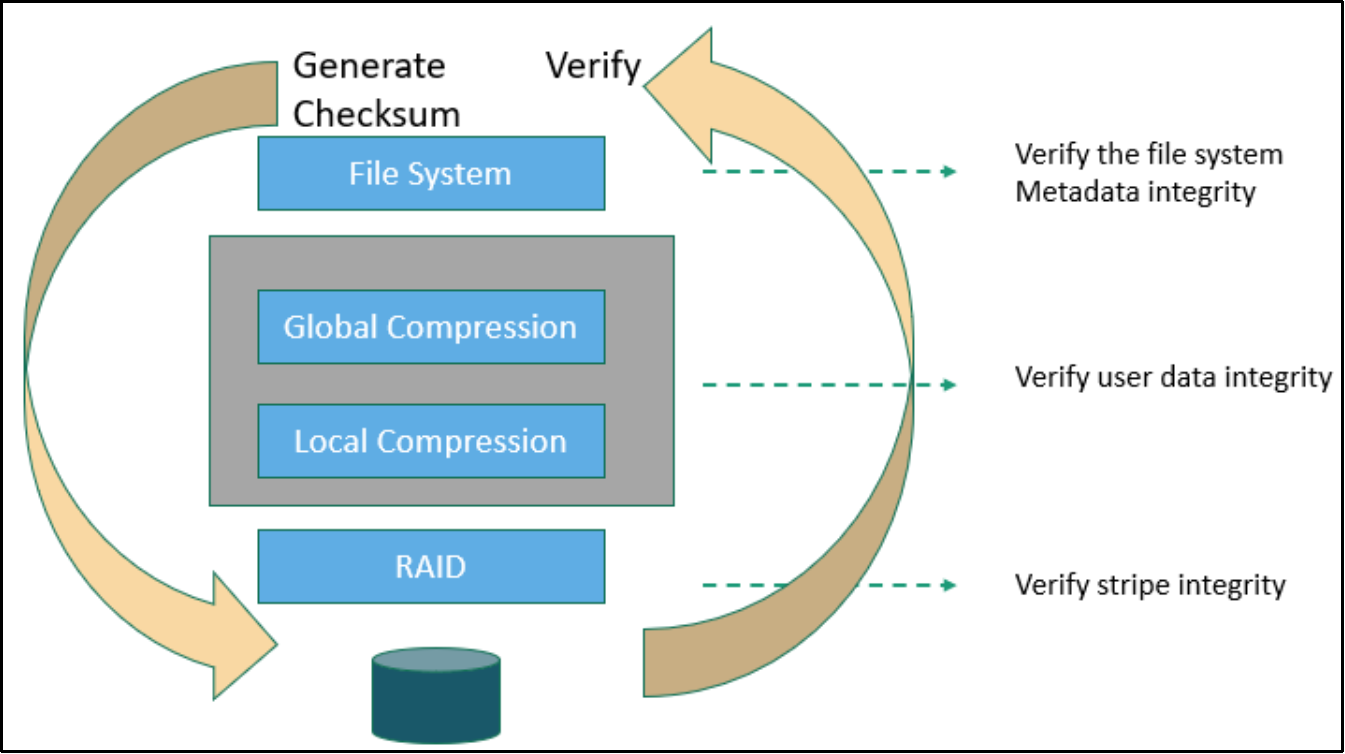
Because every component of a storage system can introduce errors, an end-to-end test is the simplest path to ensure data integrity. End-to-end verification means reading data after it is written and comparing it to what was sent to disk, proving that it is reachable through the file system to disk and that the data has not been corrupted. When DDOS receives a write request from backup or archive software, it computes a checksum for the data. The system then stores unique data to disk and reads it back to validate the data, immediately correcting I/O errors. Because data is validated after writing to disk and before being released from memory (NVRAM), correcting I/O errors does not require restarting the backup job.
End-to-end verification confirms that the data is correct and recoverable from every level of the system. If there are problems anywhere along the way—for example, if a bit has flipped on a disk drive—it will be caught. Errors can also be corrected through self-healing, as described in Fault avoidance and containment. Conventional, primary storage systems cannot afford such rigorous verifications; however, purpose-built backup appliances require them. The tremendous data reduction achieved by Data Domain global compression reduces the amount of data that needs to be verified and makes such verification possible.
Figure 1.The end-to-end check verifying all file system data and metadata
Fault avoidance and containment
The next step in protecting the data is to ensure that the data, which was verified to be correct, stay correct. Ironically, the biggest risk to file system integrity is file system software errors that occur when new data is written. Only new writes can accidentally write on existing data, and only new updates to file system metadata can mangle existing structures.
Because the Data Domain file system was built to protect data as its primary goal, its design protects against even its own software errors that could put existing data at risk. It accomplishes this through a combination of design simplicity, which reduces the chance of software issues in the first place, and several fault containment features, which make it difficult for potential software errors to corrupt existing data. PowerProtect Data Domain systems are equipped with a specialized log-structured file system that has four important benefits:
New data never puts old data at risk.
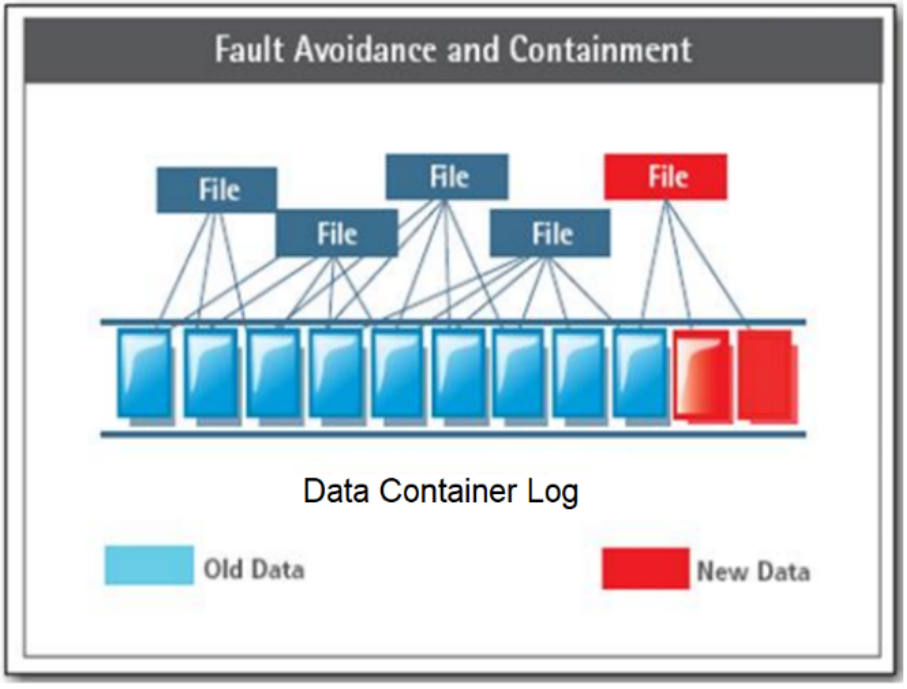
The data container log never overwrites or updates existing data.
New data is always written in new containers (in red in the following figure).
The old containers and references remain in place and are safe even in the face of software issues or hardware faults that might occur when new backups are stored.
Figure 2.PowerProtect Data Domain log-structured file system
New data never overwrites good data
Unlike traditional file systems, which often overwrite blocks when data changes, PowerProtect Data Domain systems only write to new blocks. This isolates any incorrect overwrite (a software issue) to only the newest backup and archive data. Older versions remain safe.
Fewer complex data structures
A traditional file system has many data structures (free block bit maps and reference counts, for example) that support very fast block updates. In a backup application, the workload is primarily simpler sequential writes of new data, meaning fewer data structures are required to support it. As long as the system can keep track of the head of the log, new writes do not touch old data. This design simplicity greatly reduces the chances of software errors that could lead to data corruption.
NVRAM for fast, safe restart
The Data Domain file system includes a nonvolatile RAM (NVRAM) write buffer into which it puts all data not yet safely on disk. The file system leverages the security of this write buffer to implement a fast, safe restart capability.
The file system uses many internal logic and data structure integrity checks. If one of these checks finds any problem, the file system restarts itself. The checks and restarts provide early detection and recovery from data corruption errors. As it restarts, the Data Domain file system verifies the integrity of the data in the NVRAM buffer before applying it to the file system, ensuring that no data is lost due to the restart. Because the NVRAM is a separate hardware device, it protects the data from errors that can corrupt data in RAM. Because the RAM is nonvolatile, it also protects against power failures. Though the NVRAM is important for ensuring the success of new backups, the file system guarantees the integrity of old backups even if the NVRAM itself fails.
Persistent RAM protection
In some smaller Data Domain systems, the entire system is protected from a power loss by a battery backup. For these systems, a persistent RAM implementation protects data in RAM. Data Domain systems move data from RAM to disk in a process called vaulting. If a power failure occurs, a battery powers the entire Data Domain system while data is vaulted from RAM to disk. If a system crashes, the system reboots into a special vaulting mode where it vaults data from RAM to disk and then reboots to normal DDOS.
This persistent RAM feature maintains power and control to the system RAM through a crash so that the contents of RAM are preserved across the crash. Persistent RAM implementations protect data during an AC power loss, a system reboot and shutdown, and a DDOS or kernel crash. The data vaulted to disk is RAID-protected, just like the Data Domain file system.
No partial stripe writes
Traditional primary storage disk arrays, whether RAID 1, RAID 3, RAID 4, RAID 5, or RAID 6, can lose old data if, during a write, a power failure causes a disk to fail. This data loss occurs because disk reconstruction depends on all the blocks in a RAID stripe being consistent. During a block write, there is a transition window where the stripe is inconsistent, so reconstruction of the stripe fails, and the old data on the failed disk is lost.
Enterprise storage systems protect against this data loss with NVRAM or uninterruptible power supplies. However, if these protections fail because of an extended power outage, the old data could be lost, and a recovery attempt could fail. For this reason, Data Domain systems never update just one block in a stripe. Following the no-overwrite policy, all new writes go to new RAID stripes, and those new RAID stripes are written in their entirety. The verification after write ensures that the new stripe is consistent. New writes do not put existing data at risk. Data Domain systems are designed to minimize the number of standard storage system errors. If more challenging faults happen, less time is needed to find them, correct them, and notify the operator.
Continuous fault detection and healing
Regardless of the software safeguards in place, it is the nature of computing hardware to have occasional faults. Most visibly in a storage system, disk drives can fail, but other more localized or transient faults also occur. An individual disk block might be unreadable, or a bit flip error could occur on the storage interconnect or internal system bus. For this reason, DDOS builds in extra levels of data protection to immediately detect faults and recover from them to ensure successful data restore operations.
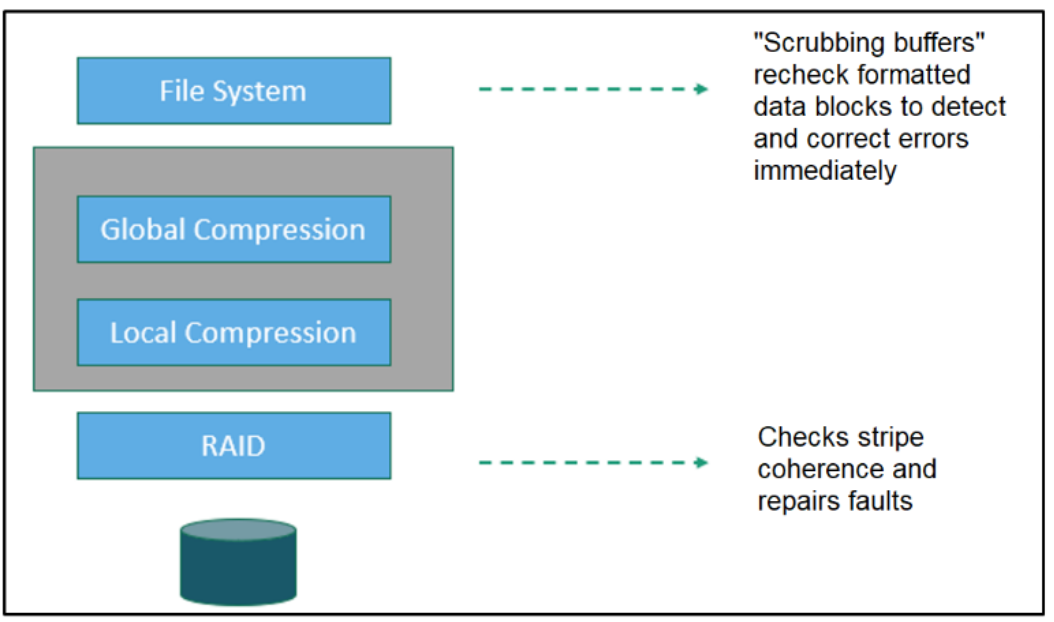
The following figure illustrates how the system protects against storage system faults. It periodically rechecks the integrity of the RAID stripes and the container log, and uses the redundancy of the RAID system to heal any faults. During every read, data integrity is reverified, and any errors are immediately healed.
Figure 3.Continuous fault detection and healing
RAID 6: Double disk failure protection, read error protection
RAID 6 is the foundation for PowerProtect Data Domain continuous fault detection and healing. Its powerful dual-parity architecture offers significant advantages over conventional architectures including RAID 1 (mirroring), RAID 3, RAID 4, or RAID 5 single-parity approaches. RAID 6:
Protects against two disk failures
Protects against disk read errors during reconstruction
Protects against the operator pulling the wrong disk
Guarantees RAID stripe consistency, even during power failure, without reliance on NVRAM or UPS
Verifies data integrity and stripe coherency after writes
Each storage shelf includes a global spare drive, which automatically replaces a failed drive anywhere in the Data Domain system. When the hot swappable failed drive is replaced by Dell, it becomes a new global spare. By comparison, once a single disk is down in the other RAID approaches, any further simultaneous disk error will cause data loss.
Any storage system of last resort must include the extra level of protection that RAID 6 provides.
“On-the-fly” error detection and correction
To ensure that all data returned to the user during a restore is correct, the PowerProtect Data Domain file system stores all its on-disk data structures in formatted data blocks. These data blocks are self-identifying and verified by a strong checksum. On every read from disk, the system first verifies that the block read from disk is the block expected. It then uses the checksum to verify the integrity of the data. If any issue is found, the system prompts RAID 6 to use its extra level of redundancy to correct the data error. Because the RAID stripes are never partially updated, their consistency is ensured, as is the ability to heal an error when it is discovered.
Scrubbing to ensure ongoing data integrity
“On-the-fly” error detection works well for data that is being read, but it does not address issues with data that might be unread for weeks or months before it is needed for a recovery. For this reason, PowerProtect Data Domain systems actively reverify the integrity of all data through an ongoing background process. This scrubbing process intelligently finds and repairs defects on the disk before they can become a problem. Through the combination of RAID 6, “on-the-fly” error detection and correction for data being read, and ongoing data scrubbing, most computing-system and disk-drive-generated faults can be isolated and overcome with no data risk or impact on system operation.
File system recoverability
Though every effort is made to ensure that no file system issues occur, the PowerProtect Data Domain Data Invulnerability Architecture anticipates that some system might have a problem at some time. Therefore, the architecture includes features to reconstruct lost or corrupted file system metadata and file system check tools that can bring an ailing system back online safely and quickly.
Self-describing data format to ensure metadata recoverability
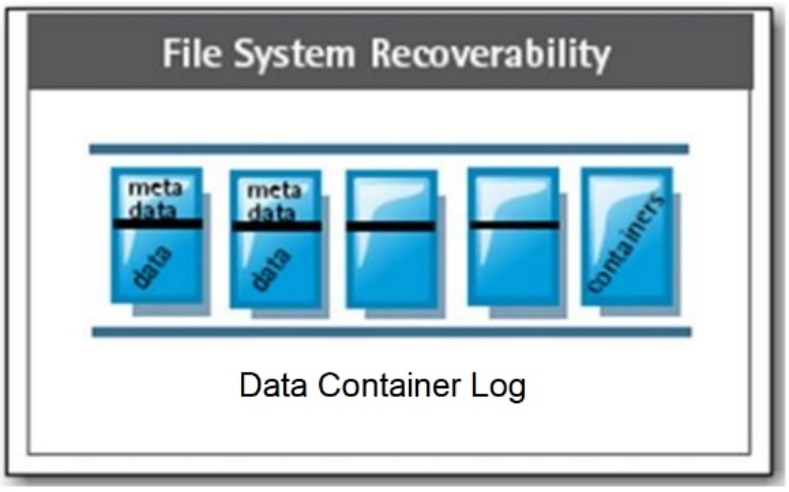
Metadata structures, such as indexes that accelerate access, are rebuildable from the data on disk. All data is stored with metadata that describes it. If a metadata structure is somehow corrupted, two levels of recoverability exist. First, a snapshot is taken of the file system metadata every several hours; recoverability can rely on this point-in-time copy. Second, the data can be scanned on disk and the metadata structure can be rebuilt. These capabilities enable recoverability even if a corruption of the file system or its metadata occurs.
Figure 4.Self-describing data format
File system check, if needed, is fast
In a traditional file system, consistency is not checked inline at all. PowerProtect Data Domain systems perform an initial inline verification to ensure consistency for all new writes. The usable size of a traditional file system is often limited by the time it would take to recover the file system after some sort of corruption. Imagine running fsck on a traditional file system with more than 80 TB of data. The reason the checking process can take so long is that the file system needs to sort out where the free blocks are so that new writes do not accidentally overwrite existing data. Typically, this process entails checking all references to rebuild free block maps and reference counts. The more data in the system, the longer the process takes.
In contrast, the Data Domain file system never overwrites old data and does not have block maps and reference counts to rebuild. It only has to verify the location of the head of the log to safely bring the system back online to restore critical data.
Object Existence Check (OEC)
Enhancing Data Invulnerability in Cloud Archival.
Data Domain cloud tier solution is a "Long Term Data Retention" solution. Any data loss on this Long Term Retention tier is unacceptable.
A key feature of the Data Invulnerability Architecture (DIA) in PowerProtect Data Domain is the Object Existence Check (OEC), designed to safeguard the integrity of cloud-resident data. In environments leveraging Long-Term Retention (LTR) to archive files to the cloud, there are potential risks of object loss or corruption—often undetectable until data access is attempted.
The OEC utility addresses this challenge by verifying the presence of objects stored in the cloud, particularly in scenarios where files have been tiered off from on-premises storage. It operates offline, independent of the Data Domain File System , enabling administrators to detect missing or corrupted cloud objects even when the primary file system is inactive. This proactive verification capability strengthens the resilience of cloud archival workflows by identifying integrity issues that may have originated from the cloud provider—issues that would otherwise remain unnoticed until recovery time. Offline tool oec can be run to check if there are any objects in the cloud that are missing. This feature is made as in-line check in the file system where this tool is automatically run at a periodic interval and generates the alert for customers and support to take action respectively. Alert generated in this case is EVT-CM-00004: Filesystem has detected missing cloud data.
Conclusion
Conclusion
No single mechanism is sufficient to ensure data integrity in a storage system. Data recoverability can be assured only through the cooperation of a multitude of mechanisms that establish successive lines of defense against all sources of errors.
Unlike a traditional storage system that has been repurposed from primary storage to data protection, PowerProtect Data Domain systems have been designed explicitly as the data store of last resort. The innovative Data Invulnerability Architecture offers the industry’s best defense against data integrity issues. Advanced verification ensures that new backup and archive data is stored correctly. The no-overwrite, log-structured architecture of the Data Domain file system, together with the insistence on full-stripe writes, ensures that old data is always safe even in the face of software errors from new data. Meanwhile, a simple and robust implementation reduces the chance of software errors in the first place.
All these mechanisms protect against problems during the storage of backup and archive data, but faults in the storage itself also threaten data recoverability. For this reason, the Data Invulnerability Architecture includes a proprietary implementation of RAID 6. It protects against up to two disks failures, can rebuild a failed disk even if there is a data read error, and immediately corrects errors during read. The architecture also includes a background scrub process that actively seeks out and repairs latent faults before they become a problem.
The recoverability features of the Data Domain file system provide the final line of defense. The self-describing data format enables the reconstruction of file data even if various metadata structures are corrupted or lost. With the fast file system check and repair, even a system holding dozens of terabytes of data will not be offline for long if a problem occurs. Data Domain systems are the only solution built with this relentless attention to data integrity, giving you ultimate confidence in recoverability.