PowerScale OneFS 9.15 Release
Dell PowerScale is kicking off the summer with the release of OneFS 9.15, introduced on August 11, 2026 and marking a significant evolution of its scale-out NAS platform. This release brings broad innovation across platform capabilities, performance, security, serviceability, and ease of use, delivering meaningful value for a wide range of enterprise workloads.
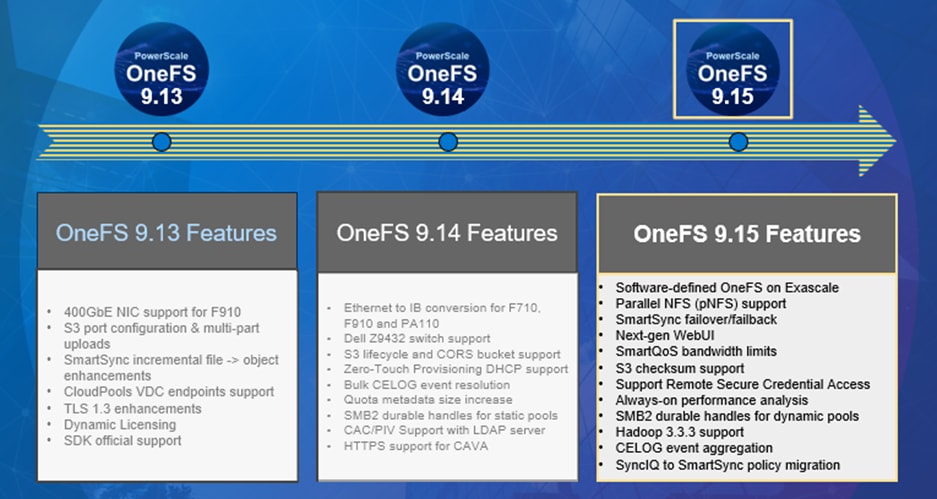
As the latest version of PowerScale’s unified software platform for both on-premises and cloud deployments, OneFS 9.15 is well suited for traditional file services and vertical industry use cases such as media and entertainment, healthcare, life sciences, and financial services, as well as modern workloads including generative AI, machine learning, deep learning, and analytics.
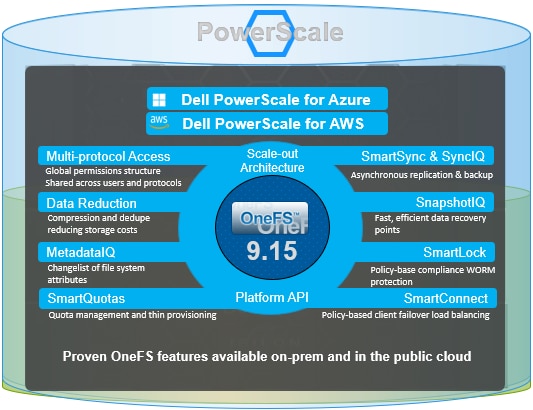
PowerScale continues to provide flexible deployment options across core, edge, and cloud environments, whether on-site, in colocation facilities, or through customer-managed deployments in AWS and Microsoft Azure. Its scale-out architecture ensures the performance and agility required to support increasingly complex unstructured data workflows. In today’s environment in which data security, threat detection, and operational visibility are more critical than ever, OneFS 9.15 introduces a plethora of new capabilities and enhancements designed to strengthen performance, resiliency, and security while simplifying operations.
Performance enhancements are a central highlight of OneFS 9.15, including the general availability of pNFS which enables parallel client data access and significantly improves throughput for AI and high-performance computing workloads.
OneFS 9.15 also introduces Exascale, the first software-defined PowerScale platform. Based on the Dell PowerEdge R7725xd, Exascale marks two firsts for the PowerScale product line as both the first software-defined deployment model in which hardware and OneFS software are ordered and delivered independently rather than as a pre-integrated appliance and the first AMD-based PowerScale node. Dual AMD EPYC SP5 9455 processors provide 96 cores and 768 GB of DDR5-6400 memory per node, built on a PCIe Gen5 platform throughout. Storage density is equally striking: 24 PCIe Gen5 NVMe drive bays support drive options from 7.68 TB TLC through to 122 TB QLC, delivering up to 2.93 petabytes of raw NVMe capacity in a single 2RU chassis. The write journal is backed by 64 GB of Software-Defined Persistent Memory—double the capacity of prior PowerScale generations and the first SDPM implementation on AMD silicon.
Networking on the R7725xd is designed for the bandwidth demands of exascale AI workloads. Both the client-facing front-end and the inter-node back-end run at 400 gigabit Ethernet using NVIDIA ConnectX-8 adapters in PCIe Gen5 x16 slots, with NVIDIA Spectrum-SN5610 switches providing the required 400GbE switching fabric. This quadruples the back-end bandwidth of the F910 generation. The R7725xd uses a subscription-based licensing model—Tier 45, priced per terabyte of raw capacity—replacing the perpetual node-tied licenses of prior generations. R7725xd nodes join and coexist in the same cluster as existing F210, F710, F910, and H700 appliances; the minimum software requirement is OneFS 9.15 with NFP 14.1. Because the hardware platform is shared with ObjectScale and planned future workloads, nodes can be repurposed between storage software stacks without new hardware, a strategic advantage for organizations building large-scale AI infrastructure.
OneFS 9.15 also delivers predictable, linear scaling across clusters ranging from 3 to 32 nodes, allowing organizations to grow efficiently without overprovisioning. SmartQoS has been enhanced with support for both bandwidth- and IOPS-based limits, separation of read and write workload classes, improved latency observability, and the ability to define system pools that isolate performance-sensitive nodes, providing administrators with granular control over resource allocation.
Security and compliance have also been strengthened through validation of cryptographic entropy sources for FIPS 140-3 compliance and updates to the secure development lifecycle, including the removal of outdated software components and adoption of current packages to maintain a strong security posture. Reliability improvements are deeply embedded across the platform, with enhancements to the non-disruptive upgrade framework that improve stability, introduce retry mechanisms, and streamline upgrade operations. Additional resiliency gains include better service startup handling, continuous performance data collection through Always-On Performance Analysis, and optimizations for large file workflows and deduplication consistency.
Serviceability and observability see major gains with automated CELOG event aggregation, which correlates and enriches events to provide clearer insights and reduce troubleshooting time. Administrators also benefit from API-driven configuration management that eliminates the need for root access when adjusting advanced settings, along with automated diagnostic tools that generate actionable reports and proactive alerts for job failures or cancellations.
Finally, data mobility and user experience are further enhanced through the transition from SyncIQ to SmartSync, enabling more modern and flexible disaster recovery strategies while preserving existing investments. A new SmartSync web interface simplifies management, while improvements to SMB2 failover durability and expanded SmartQoS visibility enhance both resilience and operational clarity.
|
Theme |
Key Features |
|
Unlock Platform Power for Gen AI |
|
|
File/Object Handling Enhancements |
|
|
Performance Improvements |
|
|
Reliability |
|
|
Serviceability |
|
|
Data Mobility and Data Recovery |
|
|
Useability |
|
|
Security |
|
Overall, OneFS 9.15 reinforces Dell PowerScale’s position as a leading platform for unstructured data, delivering powerful advancements in scalability, performance, security, and operational efficiency, and equipping organizations to meet the growing demands of modern data-driven environments.
We’ll be taking a deeper look at the new OneFS 9.14 features and functionality in blog articles over the course of the next few weeks. Meanwhile, the new OneFS 9.15 code is available on the Dell Support site as both an upgrade and reimage file, allowing both installation and upgrade of this new release.
For existing clusters running a prior OneFS release, the recommendation is to open a Service Request to schedule an upgrade. To provide a consistent and positive upgrade experience, Dell Technologies is offering assisted upgrades to OneFS 9.15 at no cost to customers with a valid support contract. Please refer to this Knowledge Base article for additional information on how to initiate the upgrade process.
Author: Nick Trimbee