PowerScale OneFS 9.8
It’s launch season here at Dell Technologies, and PowerScale is already scaling up spring with the innovative OneFS 9.8 release which shipped today, 9th April 2024. This new 9.8 release has something for everyone, introducing PowerScale innovations in cloud, performance, serviceability, and ease of use.
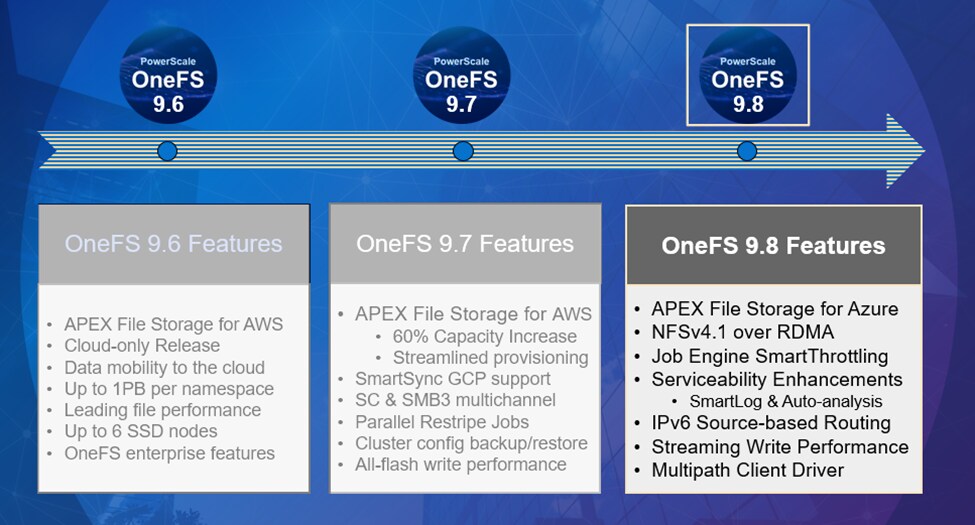 Figure 1. OneFS 9.8 release features
APEX File Storage for Azure
After the debut of APEX File Storage for AWS last year, OneFS 9.8 amplifies PowerScale’s presence in the public cloud by introducing APEX File Storage for Azure.
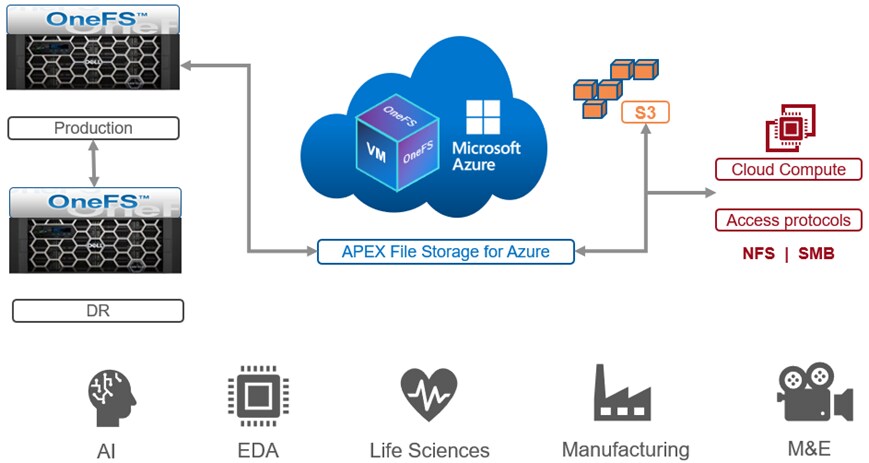 Figure 2. OneFS 9.8 APEX File Storage for Azure
In addition to providing the same OneFS software platform on-prem and in the cloud as well as customer-managed for full control, APEX File Storage for Azure in OneFS 9.8 provides linear capacity and performance scaling from four to eighteen SSD nodes and up to 3PB per cluster, making it a solid fit for AI, ML, and analytics applications, as well as traditional file shares and home directories and vertical workloads like M&E, healthcare, life sciences, and financial services.
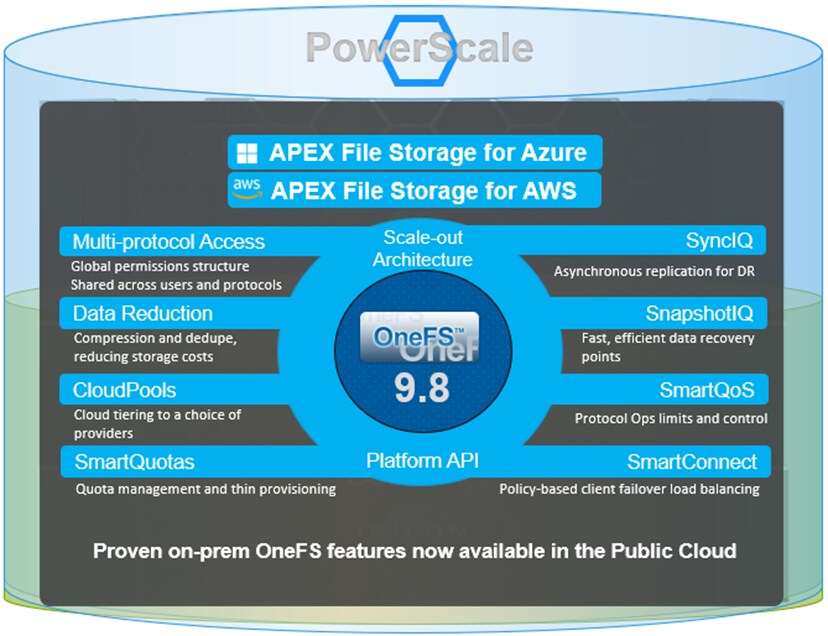 Figure 3. Dell PowerScale scale-out architecture
PowerScale’s scale-out architecture can be deployed on customer-managed AWS and Azure infrastructure, providing the capacity and performance needed to run a variety of unstructured workflows in the public cloud.
Once in the cloud, existing PowerScale investments can be further leveraged by accessing and orchestrating your data through the platform's multi-protocol access and APIs.
This includes the common OneFS control plane (CLI, WebUI, and platform API) and the same enterprise features, such as Multi-protocol, SnapshotIQ, SmartQuotas, Identity management, and so on.
Simplicity and efficiency
OneFS 9.8 SmartThrottling is an automated impact control mechanism for the job engine, allowing the cluster to automatically throttle job resource consumption if it exceeds pre-defined thresholds in order to prioritize client workloads.
OneFS 9.8 also delivers automatic on-cluster core file analysis, and SmartLog provides an efficient, granular log file gathering and transmission framework. Both of these new features help dramatically accelerate the ease and time to resolution of cluster issues.
Performance
OneFS 9.8 also adds support for Remote Direct Memory Access (RDMA) over NFS 4.1 support for applications and clients. This allows for substantially higher throughput performance – especially in the case of single-connection and read-intensive workloads such as machine learning and generative AI model training – while also reducing both cluster and client CPU utilization and provides the foundation for interoperability with NVIDIA’s GPUDirect.
RDMA over NFSv4.1 in OneFS 9.8 leverages the ROCEv2 network protocol. OneFS CLI and WebUI configuration options include global enablement and IP pool configuration, filtering, and verification of RoCEv2 capable network interfaces. NFS over RDMA is available on all PowerScale platforms containing Mellanox ConnectX network adapters on the front end and with a choice of 25, 40, or 100 Gigabit Ethernet connectivity. The OneFS user interface helps easily identify which of a cluster’s NICs support RDMA.
Under the hood, OneFS 9.8 introduces efficiencies such as lock sharding and parallel thread handling, delivering a substantial performance boost for streaming write-heavy workloads such as generative AI inferencing and model training. Performance scales linearly as compute is increased, keeping GPUs busy and allowing PowerScale to easily support AI and ML workflows both small and large. OneFS 9.8 also includes infrastructure support for future node hardware platform generations.
Multipath Client Driver
The addition of a new Multipath Client Driver helps expand PowerScale’s role in Dell Technologies’ strategic collaboration with NVIDIA, delivering the first and only end-to-end large scale AI system. This is based on the PowerScale F710 platform in conjunction with PowerEdge XE9680 GPU servers and NVIDIA’s Spectrum-X Ethernet switching platform to optimize performance and throughput at scale.
In summary, OneFS 9.8 brings the following new features to the Dell PowerScale ecosystem:
|
Feature |
Info |
|
Cloud |
|
|
Simplicity |
|
|
Performance |
|
|
Serviceability |
|
We’ll be taking a deeper look at this new functionality in blog articles over the course of the next few weeks.
Meanwhile, the new OneFS 9.8 code is available on the Dell Online Support site, both as an upgrade and reimage file, allowing installation and upgrade of this new release.
Author: Nick Trimbee