Revolutionizing Data Centers with a Linear Pluggable Optic (LPO) Solution
One of the most groundbreaking network innovations driving transformations of data centers in 2025 is Linear Pluggable Optics (LPO)—a Digital Signal Processor (DSP)-free optical solution designed to optimize power, cost, and latency.
At Dell Technologies, we are excited to offer fully supported server-to-switch LPO solutions with our Dell PowerSwitch line of Ethernet switches. These offerings are designed to work alongside the Broadcom 57608 Thor 2 Network Interface Card (NIC), setting new benchmarks for high-performance networking.
The Dell LPO Solution
Dell has taken charge with this revolutionary technology, providing multiple LPO solutions for customers to choose from. Users will be able to experience the superior performance of end-to-end LPO solutions like the one below being demonstrated at Dell Tech World 2025!
LPO to LPO
This new end-to-end LPO framework will deliver performance and cost savings at both ends of the fiber.
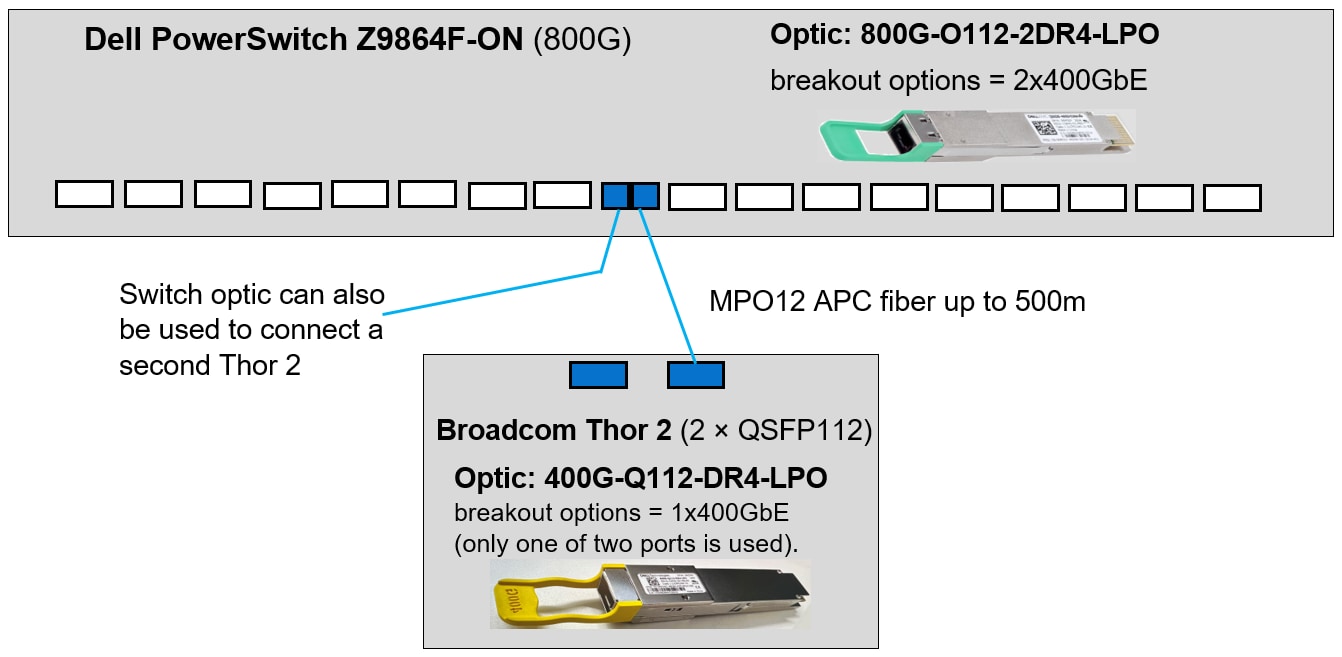
800GbE: LPO on Z9864F to LPO on server NICs
During Dell Tech World 2025, we are demonstrating this new single mode fiber solution that uses 800G-O112-2DR4-LPO optics in the Dell PowerSwitch Z9864F-ON to interoperate with 400G-Q112-DR4-LPO optics in the Broadcom Thor 2 NIC.
LPO to DSPLPO
Customers can also take advantage of these performance improvements incrementally with LPO-to-DSPLPO solutions to gradually build their LPO environment at a pace that best suits their schedule or budget. This gives new LPO consumers even greater flexibility.
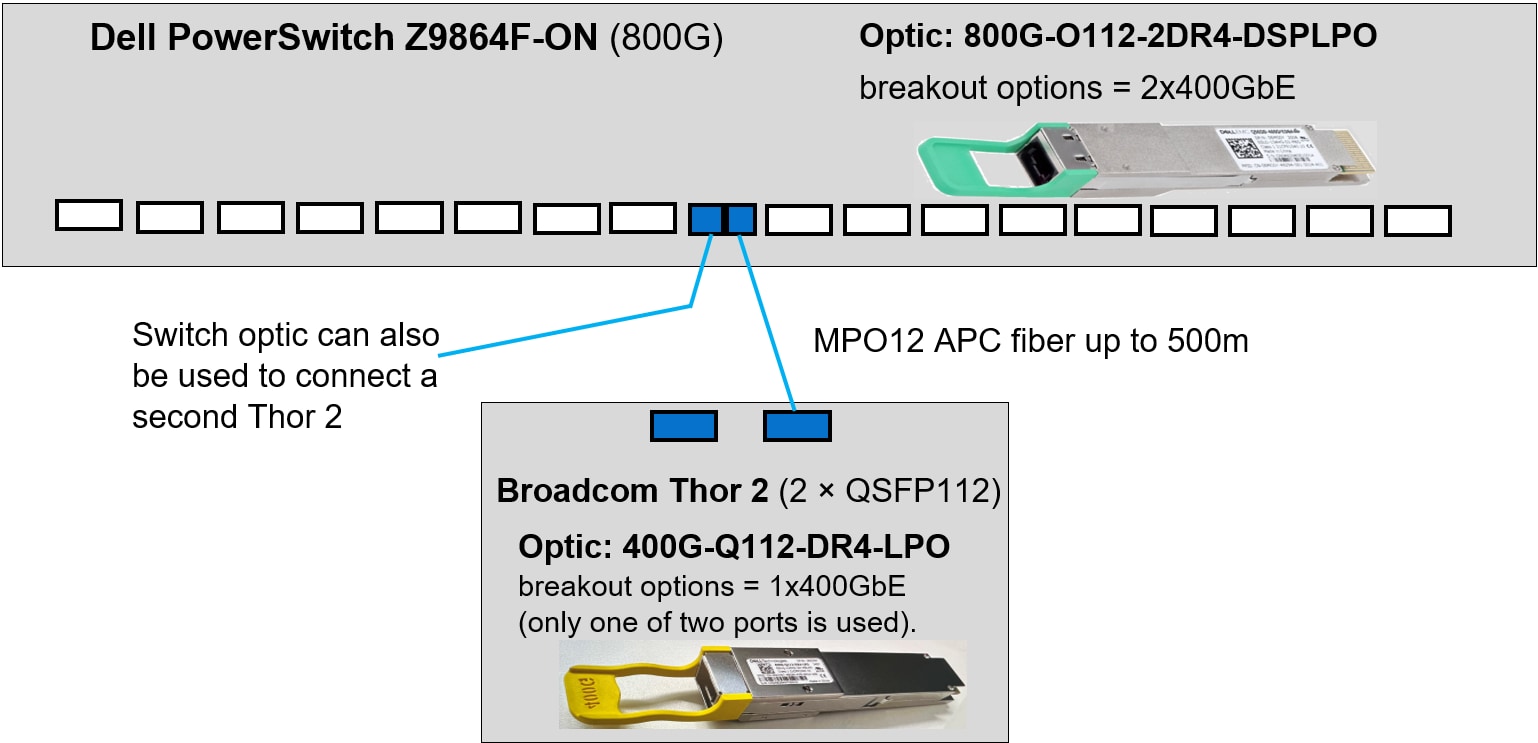
800GbE: DSPLPO on 800GbE Z9864F to LPO on server NICs
In this single mode fiber scenario, the 800G-O112-2DR4-DSPLPO optic in the Dell PowerSwitch Z9864F-ON interoperates with the 400G-Q112-DR4-LPO optic in Broadcom Thor 2 NICs.
400GbE: DSPLPO on 400GbE Z9664F and Z9432F to LPO on server NICs
In this single mode fiber scenario, the 400G-Q56DD-EDR4-DSPLPO optic in the Dell PowerSwitch Z9664F-ON and Z9432F-ON interoperates with the 400G-Q112-DR4-LPO optic in Broadcom Thor 2 NICs.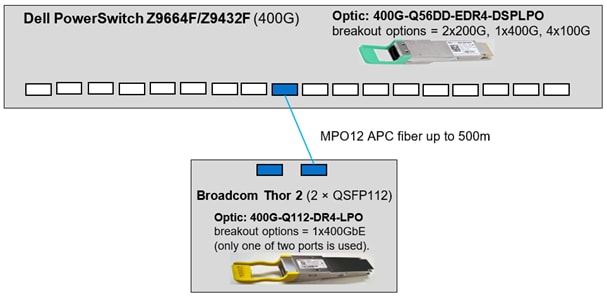
Note: When an 800G-O112-2DR4 or 400G-Q56DD-EDR4 optic has been certified to connect to a remote LPO at the other end of the fiber, it is given the qualifier suffix DSPLPO.
Dell continues to be a key player in LPO development in the second half of 2025. Customers can expect rolling launches of multi-mode fiber LPO, and expanded NIC and switch support.
The Genesis of LPO Technology
The evolution of LPO technology marks a significant leap in the field of optical transceivers. As the industry moves towards generative AI (GenAI) and continues to innovate to support higher speeds and increased data traffic, LPOs are poised to become a critical component of modern data centers. But what exactly makes these optics so groundbreaking?
LPO technology is a transceiver packaging innovation. Unlike traditional pluggable optics that rely on a DSP chip, the Dell LPO solution has no DSP chip and relies on the host platform’s DSP instead. The removal of the optic’s DSP offers the following key advantages:
- Lower Power Consumption. One of the most compelling benefits of LPO technology is its significantly reduced power consumption. A single traditional DSP-driven 400GbE transceiver, for example, can consume 7-9 watts, whereas the 400GbE LPO transceiver generally requires only 2-4 watts. This drastic reduction is critical for data centers aiming to minimize their energy footprint and reduce operational costs. There is also less power required by switch and server fans, providing even more savings.
- Cost-Effective Solutions. The DSP chip is the most expensive component of an optic. By removing the chip, the LPO can lead to substantial savings. This will be especially desirable for customers looking to deploy large volumes of optics for GenAI use cases. The number of early adopters and onboard LPO suppliers are also contributing to more robust competition and supply chains.
- Reduced Latency. LPOs can provide up to 90% less latency for better performance in AI applications. Latency is a crucial factor in any high-performance computing environment. The absence of the DSP in LPO transceivers removes a processing step, thereby reducing data transmission latency. This improvement is especially valuable for applications requiring real-time data processing and low-latency communication.
Key Takeaways
Dell has launched support for pure LPO connectivity between the switch and the server, using 400GbE LPO optics on Broadcom Thor 2 NICs, connecting to 800GbE LPO optics on Dell PowerSwitch Ethernet switches. Additionally, consumers are given a choice of using supported DSPLPO 800GbE and 400GbE optics on the Dell PowerSwitch.
LPOs are revolutionizing the optical communications industry with low power consumption, cost effectiveness, and reduced latency benefits. Dell’s goal is to continually introduce new LPO solutions to help customers take further advantage of these efficiencies.
In summary, while this technology is still very new, its potential is undeniable. For network engineers, data center managers, and customers, understanding and adopting LPO technology could be the key to staying ahead in a rapidly progressing field.
Additional information
These links provide more information on how the LPO solution is supported in common AI Ethernet fabrics to ensure effective GPU communications.
- Optimizing Connectivity Server to NIC Using LPO (Dell Tech World 2025) - Video from DTW announcing the industry’s first switch-to-NIC LPO solution.
- LPO Customer Demo (Dell Tech World 2025) - Recorded demo of Siemon's MTP Pro Fiber with Dell PowerSwitch Z-Series using LPO.
- Linear optics for AI fabric scale-out and scale-up - Video from the OCP Global Summit that provides an introduction to LPO solutions.
- Dell Cables and Optics for the AI Ethernet Fabrics - Reference guide that helps identify supported LPOs and other cables and optics required for the most common Ethernet Scale Out fabrics.