NetWorker Virtual Edition: Upgrade or Install Failure Log Locations and Collection
Summary: This KB provides a general log location for NetWorker Virtual Edition (NVE) upgrade or install failures.
This article applies to
This article does not apply to
This article is not tied to any specific product.
Not all product versions are identified in this article.
Instructions
This article can be broken up into the following sections:
- Networker Installation Manager troubleshooting: This is specific to the NVE web UI used to manage NetWorker and system packaging. See this section when the Web UI is not accessible or behaving abnormally.
- NetWorker Upgrades and Installation: Logs specific to NVE initial deployment, configuration, and NetWorker software upgrades.
- OsRollup: Logs specific to applying the NVE OS security rollup packaging.
- General OS and NetWorker logging: System level and NetWorker service logging.
- Log Bundling: to be used when engaging with NetWorker support on a NVE upgrade or rollup issue.
Expand each of the below sections for detailed instructions on each area of troubleshooting:
NetWorker Installation Manager (Avinstaller) Web UI Logs
avinstaller is the NetWorker Installation Manager web-UI, accessed through: https://NVE_ADDRESS:7543
The following logs pertain to the
avinstaller web user interface used to deploy and manage the NVE software packages. The following logs should be reviewed if issues are observed when attempting to access the avinstaller web-UI during NVE deployment/upgrades. These logs may also be reviewed when the web UI is accessible but a deployment/initial configuration of the NVE fails:
-
/space/avamar/var/avi/server_log/avinstaller.log./space/avamar/var/avi/server_log/aviserver.log./space/avamar/var/avi/server_log/avitask.log.0/usr/local/avamar/lib/jetty/logs/jetty.log
The avinstaller service has the following command options:
nve:~ # avinstaller.pl
Usage: avinstaller.pl [options]
avinstaller.pl performs AvInstaller tasks. For internal use only.
options:
--help                    Display this help message
--start                   Start AvInstaller
--stop                    Stop AvInstaller
--restart                 Restart AvInstaller
--test                    Test the AvInstaller status
--debug                   Launch AvInstaller in debug mode
--testconfigured          Test if AvInstller is configured
--update_passcode         Update the support passcode
--reset_passcode          Reset the support passcode to default value
--version                 Display version information
NetWorker Upgrade and NVE Installation Logs
During NVE upgrades, a temporary folder is created using the name of the upgrade package being installed. You can see the temp upgrade directory by running: NetWorker Upgrade and NVE Installation Logs
ls -l /data01/avamar/repo/temp/
This folder is removed post upgrade and may be deleted if the upgrade fails and the workflow is closed. To collect these logs, initiate the upgrade and before closing out the failure collect the logs.
-
/data01/avamar/repo/temp/*/tmp/workflow.log/data01/avamar/repo/temp/*/tmp/err.log
NOTE: The workflow.log and err.log is in the ../temp/tmp folder under the NVE upgrade package name. There is only one package folder for an active installation or upgrade.
Once an upgrade has been completed, you can find the workflow.log and err.log in the upgrade package directory under:
/usr/local/avamar/var/avi/server_data/package_data/
Or:
/space/debugging/usr/local/avamar/var/avi/server_data/package_data
Each upgrade applied to the NVE has a corresponding folder, indicating the installation date, and containing files specific to the completed upgrade jobs.
For example:
nve:~ # ls -ltr /usr/local/avamar/var/avi/server_data/package_data/
total 4
drwxr-xr-x 2 avi avi  335 May 31 21:55 NveInstall-19.11.0-12.avp_1717206867725
drwxr-xr-x 3 avi avi 4096 Jun 28 17:16 NveConfig-19.11.0-12.avp_1719608972274
drwxr-xr-x 2 avi avi  328 Aug 14 09:58 NvePlatformOsRollup_2024-R2-v3.avp_1723643818123

nve:~ # ls -ltr /usr/local/avamar/var/avi/server_data/package_data/NvePlatformOsRollup_2024-R2-v3.avp_1723643818123
total 368
-rw-r--r-- 1 avi avi   1243 Jul 15 07:24 pkgdef.xml
-rw-r--r-- 1 avi avi    282 Jul 15 07:24 callabledef.xml
-rw-r--r-- 1 avi avi  27043 Jul 15 07:24 process.jpdl.xml
-rw-r--r-- 1 avi avi   1034 Jul 15 07:24 process.flowchart.txt
-rw-r--r-- 1 avi avi    541 Jul 15 07:28 userinput.xml
-rw-r--r-- 1 avi avi    541 Jul 15 07:28 ui_library.xml
-rw-r--r-- 1 avi avi   1305 Aug 14 09:57 inventory.log
-rw-r--r-- 1 avi avi      0 Aug 14 09:57 err.log
-rw-r--r-- 1 avi avi      5 Aug 14 09:57 port-cache.txt
-rw-r--r-- 1 avi avi    784 Aug 14 09:58 workflow_xml_val.xml
-rw-r--r-- 1 avi avi    312 Aug 14 09:58 main-cache.yaml
-rw-r--r-- 1 avi avi    588 Aug 14 10:00 workflow-reports.yaml
-rw-r--r-- 1 avi avi    311 Aug 14 10:00 internal_config.xml
-rw-r--r-- 1 avi avi 300053 Aug 14 10:00 workflow.log
Security OsRollup Logs
Security OsRollup Logs
The current rollup version can be identified using: avosrollup -V
admin@nve:~> sudo su -
nve:~ # avosrollup -V
Avamar Platform OS Security Rollup:
OS[SLES12.5] Version[2025-R4-v3] Installation Time[2026-02-06-16-13-19]
nve:~ #
When installing an NVE OsRollup package, the sec_install_os_errata_sles.pl process creates a temporary log /tmp/sec_install_os_errata_sles.pl.log. This file will be deleted after a system reboot.
The OS rollup creates post_errata_installation XML files after completion. The XML files detail OS packages that were updated in the rollup. These files are in the following location: /usr/local/avamar/var/
nve:/space/home/labadmin # grep package-survey /usr/local/avamar/var/*post_errata_installation*.xml
/usr/local/avamar/var/package-survey-SLES12.5-post_errata_installation-2025-08-06-16-33-34.xml:<package-survey version="2025-R2-v3"/>
/usr/local/avamar/var/package-survey-SLES12.5-post_errata_installation-2025-08-06-16-33-34.xml:<package-survey>
/usr/local/avamar/var/package-survey-SLES12.5-post_errata_installation-2025-08-06-16-33-34.xml:</package-survey>
/usr/local/avamar/var/package-survey-SLES12.5-post_errata_installation-2025-11-11-17-39-30.xml:<package-survey version="2025-R3-v3"/>
/usr/local/avamar/var/package-survey-SLES12.5-post_errata_installation-2025-11-11-17-39-30.xml:<package-survey>
/usr/local/avamar/var/package-survey-SLES12.5-post_errata_installation-2025-11-11-17-39-30.xml:</package-survey>
/usr/local/avamar/var/package-survey-SLES12.5-post_errata_installation-2026-02-06-16-13-19.xml:<package-survey version="2025-R4-v3"/>
/usr/local/avamar/var/package-survey-SLES12.5-post_errata_installation-2026-02-06-16-13-19.xml:<package-survey>
/usr/local/avamar/var/package-survey-SLES12.5-post_errata_installation-2026-02-06-16-13-19.xml:</package-survey>
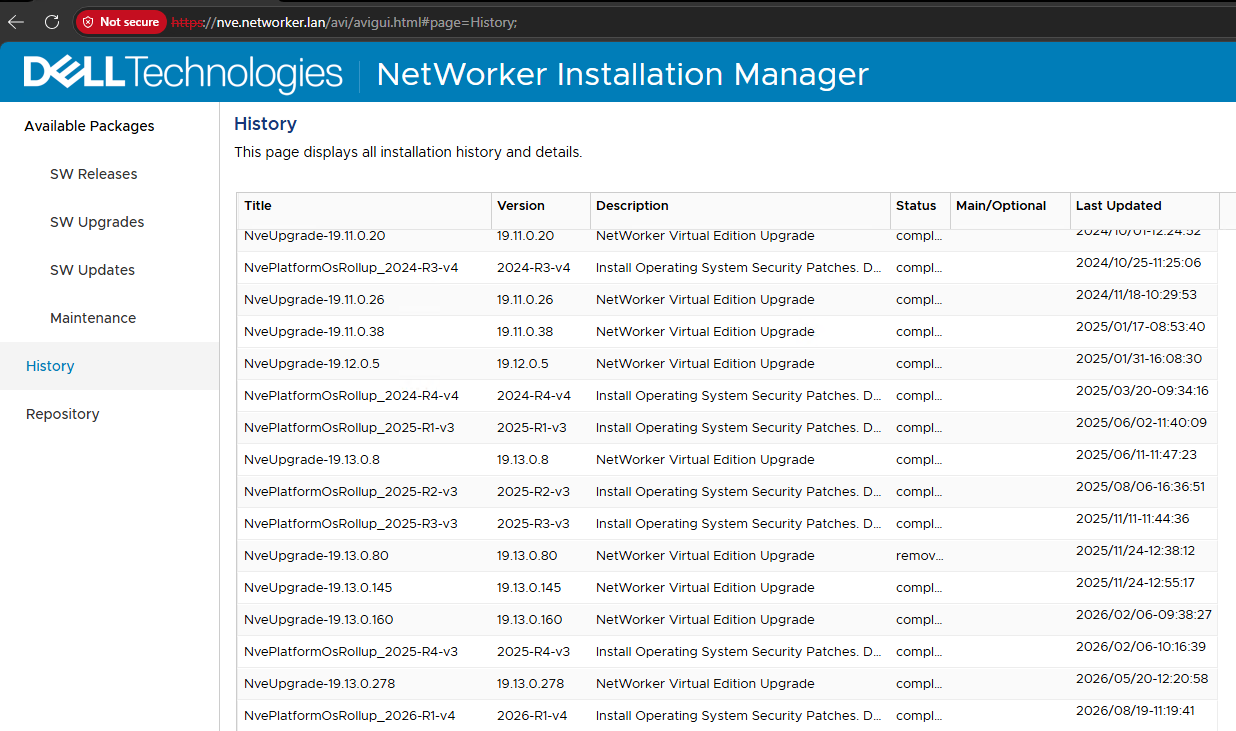
Upgrade History Details
Command Line:
- Get output showing install and upgrade history:
avi-cli --verbose localhost --password ROOT-PASSWORD --listhistory
- List packages available in the repository:
avi-cli --verbose localhost --password ROOT-PASSWORD --listrepository
NetWorker Installation Manager:
- From a web browser, go to
https://NVE-HOSTNAME-OR-IP - Log in as root.
- Go to the History tab:
General OS and NetWorker Service Logs
General OS and NetWorker Service Logs
| Log Location | Purpose |
/var/log/messages |
Logs various system messages, including information about system events, errors, startups, shutdowns, and changes in the configuration. |
/var/log/zypp/history |
Logs important events related to package management on systems using the ZYpp package manager. |
/var/log/zypper.log |
Logs Zypper command-line package manager. |
/var/log/warn |
Logs system warnings and errors. |
NetWorker service logs are detailed in: NetWorker: Log Files and Locations
Log Collection - Support Engagement:
There are two methods for log collection:
NVEgetTool (Preferred):- Interactive executable run from Windows host with SSH access to NVE.
- Collects upgrade logs including upgrade history.
- Collects system configuration files, overview, and logs.
- (Optional) Collects NetWorker configuration details and logs.
- Remotely creates bundle and downloads it to the same system from which the
nveget.exewas run. - No/Minimal Linux skills required.
- Manual bundle creation:
- Connect to the NVE over SSH session
- Run
tarcommand to create a log bundle (less thorough than nveget) - Manually copy bundle off of NVE using an SCP agent.
Expand the below sections for specific log collection instructions.
Option One: NVEget Tool (Preferred)
NVEget is a Windows-based diagnostic utility for collecting logs and configuration data from Dell NetWorker Virtual Edition (NVE) appliances. Designed for use with Dell NetWorker support cases.
Requirements:
- Windows system with network access to the target NVE appliance (SSH/SFTP, port 22)
- Valid credentials for the NVE `
admin` account; in some scenarios (sudorelated issues, therootpassword may be required)
Getting Started:
- Download the nveget.zip from the Networker-Tools site (you must sign-in with your Dell support account); alternatively, Dell support can provide this tool to you through SR attachment or MFT site.
Windows Defender Notice
NOTE: Some systems may flag the `
.exe` as a threat. This is expected; the executable is unsigned because it was built in-house by NetWorker Support. It is safe to use if downloaded directly from the Networker-Tools site or provided directly from Dell support.
If needed, add an exclusion:
-
- Open Windows Security.
- Go to Virus & threat protection.
- Under Virus & threat protection settings, click Manage settings.
- Scroll to Exclusions → Add or remove exclusions.
- Add a File or Folder exclusion for the executable.
Run the Tool:
Run `nveget.exe` (double-click the .exe) and follow the interactive prompts:
- Enter NVE hostname/IP — the target NVE appliance
- (Optional) Specify local output directory — press Enter to use the current directory, or provide a full path inside " ".
- Enter the NVE admin password (hidden) — used for both SSH and
sudoelevation.
The tool automatically:
- Attempts SSH key authentication first (checks common key locations)
- Falls back to password authentication if keys fail or aren't available
- Verifies
sudoelevation using the provided password - Collects system information, logs, and configuration
- Prompts for optional NetWorker log collection
- Collects system configuration (
cron,udev,YaST) - Creates and downloads the diagnostic bundle
- Packages everything into the final ZIP file
nveget-HOSTNAME_YYYYMMDD_TIMESTAMP_complete.zip
Example Run:
┌────────────────────────────────────────────────────────────────────────┐
│           NveGet v1.5.0 │ - NVE Diagnostic Log Collector               │
│   Sept 2026 -- @ https://central.dell.com/solutions/Networker-Tools    │
│   Contact Dell NetWorker Support for any assistance / enhancements     │
|                   Tool Runtime: 2026-09-24 16:30:00                    │
└────────────────────────────────────────────────────────────────────────┘

  Log file: C:\Users\Administrator\Downloads\nveget_20260924_163000.log

  NVE hostname / IP     : nve.networker.lan
  Local output dir [.]  :

============================================================
  Connecting to nve.networker.lan:22 as 'admin'
============================================================
[*] Attempting password authentication...
[+] Password authentication successful.
[*] Verifying sudo elevation...
[+] Sudo credentials verified (running as root).
[+] Hostname: nve

[*] Checking free space on /space …
    Sufficient space available on /space.

[*] Checking NSRDB at /data01/nsr/res/nsrdb …
    Found NSRDB at /data01/nsr/res/nsrdb
    NVE is deployed on: VMware

[*] Do you want to collect NetWorker (NSR) logs and database
    This is only required when troubleshooting NetWorker issues
    it is optional when troubleshooting system install/upgrade issues.

    Collect NetWorker logs? [y/N]: n
    NetWorker log collection: skipped

[*] Remote work directory: /space/nveget_diag_20260924_163000

[*] Collecting system information …
    date                 → collected
    df -T -B1            → collected
    env                  → collected
    fdisk -l             → collected
    ip a                 → collected
    hostnamectl          → collected
    lsof                 → collected
    lsmod                → collected
    mount                → collected
    netstat -apno        → collected
    cat /etc/os-release  → collected
    ps aux               → collected
    rpm -qa --last       → collected
    ss -a                → collected
    systemctl            → collected
    sysctl -p            → collected
    timedatectl          → collected
    ulimit -a            → collected
    uname -a             → collected
    uptime               → collected
    vmstat               → collected
    meminfo + free -mh   → collected
    avosrollup -V        → collected

[*] Collecting config and /proc files …
    /proc/cpuinfo                      → copied
    /proc/meminfo                      → copied
    /etc/hosts                         → copied
    /etc/resolv.conf                  → copied
    /etc/ssh/sshd_config              → copied
    /space/avamar/var/probe.xml       → copied
    /usr/local/avamar/var/change-passwords.log → copied

[*] Checking for active upgrade/installation …
    No active upgrade detected

[*] Collecting avinstaller logs …
    avinstaller.pl --test → collected
    /space/avamar/var/avi/server_log → copied
    /usr/local/avamar/var/avi/webserv_log → copied
    /usr/local/avamar/lib/sql → copied

[*] Collecting upgrade history …
    /space/avamar/var/avi/server_data/package_data → copied
    /space/debugging/usr/local/avamar/var/avi/server_data/package_data → NOT FOUND

[*] Checking for post errata logs …
    No post errata logs found under /usr/local/avamar/var

[*] Collecting system logs since 2026-08-25 (last 30 days) …
    messages*       → 5 file(s) copied
    warn*           → 1 file(s) copied

[*] Collecting system configuration files …
    /etc/crontab                   → copied
    /etc/cron.d/                   → copied
    /etc/cron.daily/               → copied
    /etc/cron.hourly/              → copied
    /etc/cron.monthly/             → copied
    /etc/cron.weekly/              → copied
    /etc/udev/rules.d/             → copied
    /run/udev/rules.d/             → copied
    /var/lib/YaST2/                → copied

[*] Creating bundle: nveget-nve_20260924_163000.tgz
    Bundle created (45.2MB).

[*] Downloading to C:\Users\Administrator\Downloads\nveget-nve_20260924_163000.tgz …
    [████████████████████████████████████████] 100.0% (45.2/45.2 MB) completed in 2.3s
[+] Saved: C:\Users\Administrator\Downloads\nveget-nve_20260924_163000.tgz  (47,432,192 bytes)

[*] Cleaning up remote temporary files …
    Done.

[+] Disconnected from NVE.

============================================================
  Collection complete.
  Log saved to: C:\Users\Administrator\Downloads\nveget_20260924_163000.log
============================================================

[*] Compressing final deliverable: nveget-nve_20260924_163000_complete.zip …
[+] Final zip created: C:\Users\Administrator\Downloads\nveget-nve_20260924_163000_complete.zip  (47.5 MB)
[+] Bundle checksum: a1b2c3d4e5f6g7h8i9j0k1l2m3n4o5p6q7r8s9t0u1v2w3x4y5z6...
[+] Log checksum: b2c3d4e5f6g7h8i9j0k1l2m3n4o5p6q7r8s9t0u1v2w3x4y5z6a1b2c3...
Option Two: Linux tar command:
The logs can be collected and zipped using the Linux
tar command:
- Access the NVE over SSH session and log in as
admin. - Confirm there are no space issues on the NVE:
df -Th - Create the log bundle in the
/spacedirectory using the following command (run as is, no changes needed):
sudo tar cvzfP /space/$(hostname)_$(date -I).tgz \
--ignore-failed-read \
/space/avamar/var/avi/server_log \
/space/avamar/var/avi/webserv_log \
/space/avamar/var/avi/server_data/package_data \
/space/debugging/usr/local/avamar/var/avi/server_data/package_data \
/data01/avamar/repo/temp/*/tmp \
/tmp/sec_install_os_errata_sles.pl.log \
/usr/local/avamar/var/*post_errata_installation* \
/var/log/zypp/history \
$(find /var/log -maxdepth 1 -type f -name 'messages*' -newermt "$(date -d '30 days ago' +%Y-%m-%d)") \
$(find /var/log -maxdepth 1 -type f -name 'warn*' -newermt "$(date -d '30 days ago' +%Y-%m-%d)") \
&& sudo chmod 777 /space/$(hostname)_$(date -I).tgz \
&& sudo ls -lh /space/$(hostname)_$(date -I).tgz
NOTE: This command can be run as-is. It creates a
.tgz bundle with the NVE's hostname and date on which the bundle was generated under the /space directory. You can specify another location; however, /space typically has the most disk space available. Copy the command into a plain‑text editor such as Notepad++, then copy it from the editor into the NVE shell. Depending on the issue faced, some of the directories listed may not exist and reports an error when zipping. This is expected behavior and in such scenarios the skipped directories can be ignored.
- Using an SCP agent, collect the
nsrget tar.gzfrom the/space/nsrgetdirectory on the NVE.
For additional info on retrieving files from a Linux server, see: NetWorker (Linux): How to Copy Files to or from a Linux NetWorker Server
Additional Information
- Dell Avamar and NetWorker Operating System (OS) Rollup Security Update Cadence
- NetWorker Virtual Edition (NVE): How to Install the Platform Security Rollup
- NetWorker Virtual Edition: How To Upgrade NetWorker Software and NVE System
- NetWorker Virtual Edition: How to increase /data01 partition size (XFS)
- NVE: How to Allow root SSH Access On a NetWorker Virtual Edition
Affected Products
NetWorker Family, NetWorkerArticle Properties
Article Number: 000156134
Article Type: How To
Last Modified: 25 Sep 2026
Version: 29
Find answers to your questions from other Dell users
Support Services
Check if your device is covered by Support Services.