
The Token Economy Is a Data Problem
How Dell AI Data Platform drove a 76% token reduction, while raising answer accuracy, in an internal benchmark study.
Key takeaways:
7 min read- In internal testing, Dell AI Data Platform (AIDP) cut total LLM token consumption by up to 76%1 and input tokens by up to 79%,2 while raising answer accuracy from 60% to 94% on information-retrieval tasks.1
- The savings come from moving work server side: AIDP's engines search, filter, resolve schema and run machine learning computation before the LLM ever sees a prompt.
- Even against a realistic RAG baseline, not just a worst-case starting point, the full AIDP stack still delivered a further 50% token reduction and an 18-point accuracy gain.3
- Token efficiency is not about spending fewer tokens for their own sake. It is about spending tokens on reasoning instead of on searching, guessing and correcting.
Every enterprise wants more from AI: more use cases, more agents, more automation, more decisions made in real time. But as AI moves from pilots to production, a harder question keeps surfacing: how do you make every token count?
That question usually starts with model selection, GPU utilization or inference tuning. Those levers matter, but they are not the whole story. We ran a benchmark to find out how much of the token bill is actually a data problem, and the answer was more than we expected.
The hidden cost of an unprepared context
A large language model reasons only over the context it receives. When that context is incomplete, stale, or full of near-duplicate documents, the model has to work harder and so does everything around it. It may search again. It may retrieve more documents than it needs. An agent may call another tool or retry the workflow. The prompt grows, the workflow lengthens and the token meter keeps running.
The most efficient token is often the one a system never has to spend, because the right context was already there the first time.
What we measured
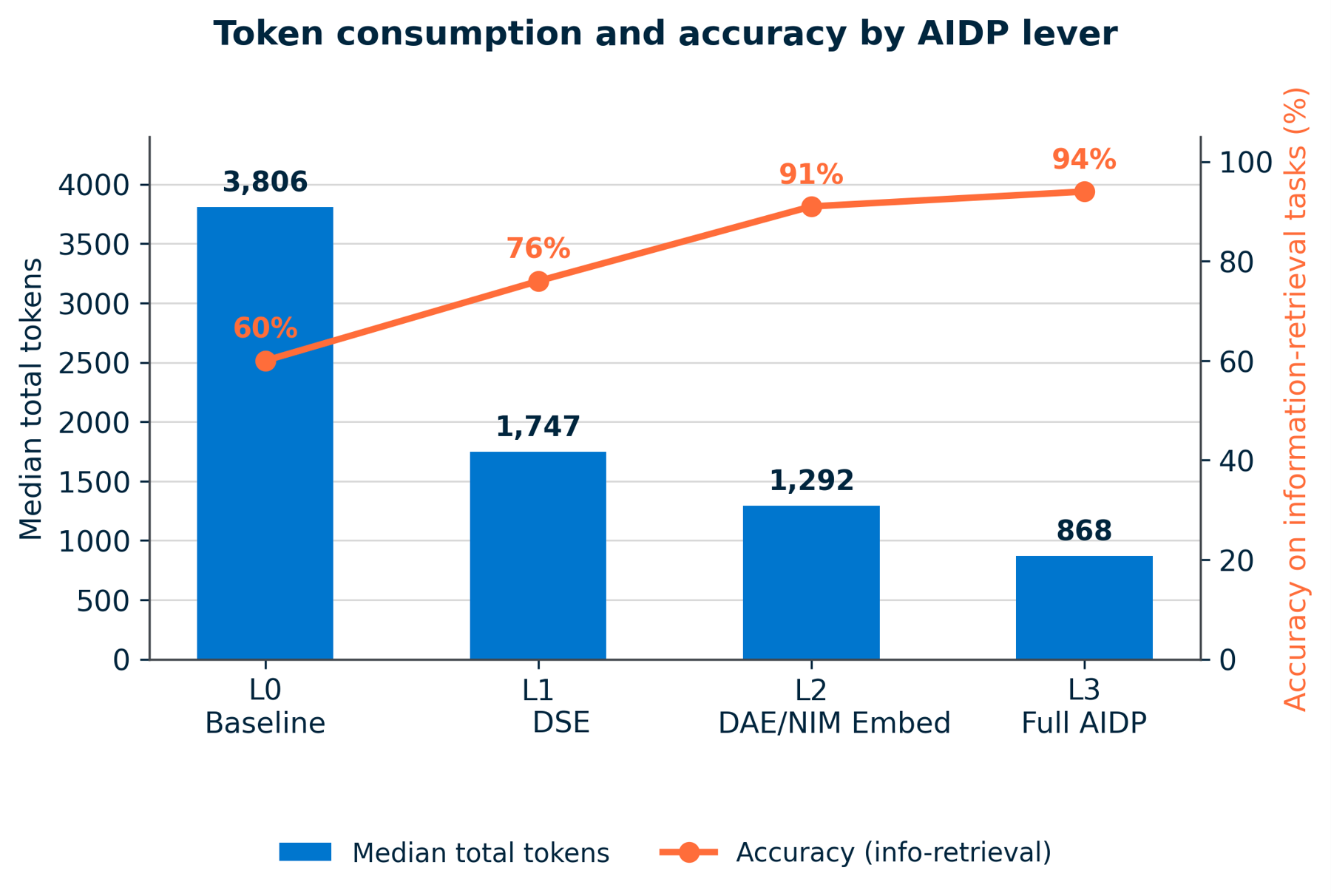
We built a benchmark of 20 questions across six workload types (document Q&A, multi-hop reasoning, data extraction, comparative analysis, SQL generation and ML prediction) and ran each one against a synthetic toll-plaza operations corpus at four configuration levels, from a bare unstructured baseline up to the full AIDP stack. The same LLM, the same question and the same scoring method were used at every level; only the data-delivery pipeline changed.
The results scaled with each engine we added:
- No AIDP (unstructured baseline): 3,806 median tokens, 60% accuracy.
- AIDP search only (DSE keyword search): 1,747 median tokens, 76% accuracy.
- Adding schema and semantic search (DAE + NIM Embed): 1,292 median tokens, 91% accuracy.
- Full AIDP stack (DSE + DAE + DPE + NIM): 868 median tokens, 94% accuracy.
Even starting from a standard, already-reasonable RAG setup rather than the worst-case baseline, adding the rest of AIDP's stack still cut tokens by half and lifted accuracy by 18 points.3 Response latency fell in step with token count, dropping 53% from the unstructured baseline to the full stack.4
How the reduction happens
The savings are not a prompting trick. They come from three purpose-built engines inside Dell AI Data Platform doing work the LLM would otherwise have to attempt inside its own context window:
- The Data Search Engine (DSE), powered by Elasticsearch, handles retrieval: keyword search, semantic search, metadata filtering and nearest-neighbor matching, so the model sees fewer, better-matched documents instead of a large pile of loosely relevant ones.
- The Data Analytics Engine (DAE), powered by Starburst, supplies live schema: exact table and column definitions pulled from the federated SQL layer, so the model stops guessing table names when it needs to write a query.
- The Data Processing Engine (DPE), powered by Apache Spark, runs the analytical computation up front: ML predictions, trend analysis and anomaly detection that the LLM could not derive from raw documents no matter how it was prompted.5
An orchestration layer, the Data Orchestration Engine, coordinates ingestion, indexing and retrieval across these engines, and NVIDIA NIM microservices serve the LLM, embedding and reranking models that sit on top of the stack. Together, they mean the model spends its context window on the business question, not on locating or computing the answer itself.
Why this matters beyond one benchmark
Token economics is often framed as a model or infrastructure problem: pick a smaller model, use GPUs more efficiently. Those levers help, but a smaller model working from a poor context still has to retrieve more, retry more or hand off to a human more often. AI-ready data is what makes the other efficiency levers pay off, rather than competing with them.
That is the idea behind treating data preparation as a repeatable capability, an AI Data Factory, rather than a one-time project per use case. Dell AI Data Platform brings storage engines (PowerScale, ObjectScale, Lightning File System), data engines (DSE, DAE, DPE) and orchestration together in an open, modular architecture, so organizations can build that repeatable path once and reuse it across many models and agents as their AI footprint grows.
The bottom line
In this benchmark, moving retrieval, schema resolution and computation out of the prompt and into the data platform cut total token consumption by 76% and raised information-retrieval accuracy from 60% to 94%.1 The full methodology, the per-engine breakdown and the complete benchmark question set are documented in the companion white paper, Reducing LLM Token Consumption with Dell AI Data Platform: A Benchmark Study, for readers who want the technical detail behind these numbers.
The future of enterprise AI will not be won by whoever generates the most tokens. It will be won by whoever turns the right tokens into the most value.
Want to see what AI-ready data can do for your own token economics?
Read more details in the whitepaper: Reducing LLM Token Consumption with Dell AI Data Platform | Dell Technologies Info Hub
Then, visit Dell AI Data Platform on Dell.com to explore the full AIDP architecture, engines and partner integrations or connect with your Dell account team to map this benchmark methodology to your own workloads.
And to see these engines in action alongside NVIDIA, join us at the Dell AI Data Platform Event on October 6–7 for a deeper look at how AI-ready data turns infrastructure spend into AI outcomes.
Frequently Asked Questions
What is "tokenomics," and why does it matter for enterprise AI?
Tokenomics is how efficiently an AI system uses LLM tokens — the units consumed for every prompt, retrieval and response — to reach an accurate answer. This benchmark shows that unprepared data forces a model to spend extra tokens searching, retrying, and correcting instead of reasoning, which drives up both cost and latency as AI moves from pilot to production.
What results did AIDP actually achieve in this benchmark?
Compared to an unstructured baseline, the full AIDP stack cut total token consumption by up to 76% and input tokens by up to 79%, while raising answer accuracy from 60% to 94% on information-retrieval tasks.1,2
Does the benefit disappear if I already have a RAG pipeline in place?
No. Starting from a realistic, already-reasonable RAG configuration rather than a worst-case baseline, the full AIDP stack still delivered a further 50% token reduction and an 18-point accuracy gain, along with a 53% drop in end-to-end response latency.3,4 AI-ready data compounds with existing RAG investments rather than competing with them.
Which AIDP engines are responsible for the savings, and did accuracy improve for specific workload types?
The Data Search Engine (DSE), Data Analytics Engine (DAE) and Data Processing Engine (DPE) each contributed. In testing, DSE and DAE improved SQL-generation accuracy from 65% to 100% and document Q&A accuracy from 83% to 100% by supplying live schema and server-side search instead of relying on the LLM alone.6 DPE let the model answer ML-derived prediction questions that scored 0% without it, and the full stack delivered up to 2.9x faster response times for document Q&A and ML-prediction workloads.5,7
Where can I find the full benchmark methodology?
The companion white paper, Reducing LLM Token Consumption with Dell AI Data Platform: A Benchmark Study, documents the full methodology, per-engine breakdown and complete benchmark question set behind these results.
1Based on Dell internal testing, September 2026, using a synthetic toll-plaza operations corpus and the benchmark configuration described in the AIDP Tokenomics benchmark study (20 questions, 6 workload types; NVIDIA Nemotron-3-Super-120B-A12B via NVIDIA NIM). Token counts are from the LLM API usage field. Actual results will vary based on workload, data characteristics, model selection and system configuration. (CLM-017501)
2Based on Dell internal testing, September 2026, using a synthetic toll-plaza operations corpus and the benchmark configuration described in the AIDP Tokenomics benchmark study (20 questions, 6 workload types; NVIDIA Nemotron-3-Super-120B-A12B via NVIDIA NIM). Token counts are from the LLM API usage field. Actual results will vary based on workload, data characteristics, model selection and system configuration. (CLM-017500)
3Based on Dell internal testing, September 2026, using a synthetic toll-plaza operations corpus and the benchmark configuration described in the AIDP Tokenomics benchmark study (20 questions, 6 workload types; NVIDIA Nemotron-3-Super-120B-A12B via NVIDIA NIM). Token counts are from the LLM API usage field. Actual results will vary based on workload, data characteristics, model selection and system configuration. (CLM-017503)
4Based on Dell internal testing, September 2026, using a synthetic toll-plaza operations corpus and the benchmark configuration described in the AIDP Tokenomics benchmark study (20 questions, 6 workload types; NVIDIA Nemotron-3-Super-120B-A12B via NVIDIA NIM). Token counts are from the LLM API usage field. Actual results will vary based on workload, data characteristics, model selection and system configuration. (CLM-017504)
5Based on Dell internal testing, September 2026, using a synthetic toll-plaza operations corpus and the benchmark configuration described in the AIDP Tokenomics benchmark study (20 questions, 6 workload types; NVIDIA Nemotron-3-Super-120B-A12B via NVIDIA NIM). Token counts are from the LLM API usage field. Actual results will vary based on workload, data characteristics, model selection and system configuration. (CLM-017502)
6Based on Dell internal testing, September 2026, using a synthetic toll-plaza operations corpus and the benchmark configuration described in the AIDP Tokenomics benchmark study (20 questions, 6 workload types; NVIDIA Nemotron-3-Super-120B-A12B via NVIDIA NIM). Token counts are from the LLM API usage field. Actual results will vary based on workload, data characteristics, model selection and system configuration. (CLM-017506)
7Based on Dell internal testing, September 2026, using a synthetic toll-plaza operations corpus and the benchmark configuration described in the AIDP Tokenomics benchmark study (20 questions, 6 workload types; NVIDIA Nemotron-3-Super-120B-A12B via NVIDIA NIM). Token counts are from the LLM API usage field. Actual results will vary based on workload, data characteristics, model selection and system configuration. (CLM-017505)
No geographic restrictions apply to claims 1–7 above. Legal IDs CLM-017500 through CLM-017506 are net-new claims sourced from this blog post; per the AIDP legal claims tracker, they are cleared for use here but require Legal ID confirmation and disclosure sign-off before reuse in other assets (e.g., the Enterprise-Wide Context Layer content).

About the Author: Kirankumar Bhusanurmath