Breaking Down Data Silos
Breaking Down Data Silos
Unified Metadata as the Key to Unlocking Your Multi-Engine Data Platform
Modern AI Data Platforms (AIDPs) deploy multiple specialized engines (analytical engines for SQL queries, process engines for complex data processing, and search engines for unstructured data). Each of these engines is optimized for specific workloads. However, this engine diversity creates a critical challenge: metadata fragmentation.
Teams discover assets engine by engine, lineage stops at engine boundaries, governance policies remain inconsistent, and data quality issues surface only after they have caused production failures. This blog explores how implementing a unified metadata layer transforms fragmented data operations into a cohesive, observable, and governed AI data ecosystem.
The Hidden Cost of Metadata Fragmentation
Modern data platforms are multi-engine by design. You pick the right tool for the right job, but each engine maintains its own catalog, its own lineage, and its own governance model. The result is an invisible tax on every team that touches data.
Consider a straightforward scenario. Raw data ingests through Spark, gets curated in Iceberg tables, is queried using analytics engine, and feeds into dashboards and AI models, leading to metadata across the ingestion and analytics layers with a lack of unified visibility.
This metadata fragmentation creates complexity that compounds over time.
Invisible Cross-Engine Lineage
A data quality issue in a source Kafka stream propagates through Spark transformations, persists in Iceberg tables, gets queried by analytics engine, and ultimately corrupts an ML model's predictions. When the model fails, data engineers must manually trace backward through four different systems—Spark logs, Iceberg transaction history, Trino query logs, and feature store metadata—just to find the root cause.
The impact is severe. Incident resolution stretches to 6 to 14 hours instead of minutes. Impact analysis becomes guesswork. Teams cannot confidently answer a simple question: “Which downstream models and dashboards will break if we change this table?”
Inconsistent Governance Policies
Governance requirements are universal: PII must be tagged; sensitive data requires access controls; compliance audits demand lineage documentation. Implementation is fragmented, however. The Spark catalog has one PII tagging system; Iceberg has another; Analytics engine uses different access controls; the search engine has its own security model.
Imagine a GDPR compliance audit. The compliance team must manually check Spark table properties, Iceberg schema metadata, analytics engine table definitions, search index mappings, and application access—logs—one system at a time. Inevitably, inconsistencies surface. For example, customer email addresses are tagged as PII in Spark but not in the search index, creating immediate compliance exposure.
The stakes are very high. Compliance violations risk fines exceeding $100 million. Security teams cannot enforce consistent policies. Data governance becomes a full-time job for multiple people instead of an automated system.
Reactive Data Quality Management
Without unified metadata, data quality monitoring happens in silos. Spark has row count checks. Iceberg tables track schema evolution. SQL analytics engine logs with query errors. But there is no holistic view of data health. Quality issues surface only when there are visible failures and AI models making wrong predictions, or customers complaining about incorrect information.
The financial drain is staggering. Data downtime costs upwards of $150,000 per hour, yet issues go undetected for 4 to 8 hours on average. Teams operate reactively, discovering problems after they cause a business impact instead of preventing them proactively. Trust in data teams erodes as business users encounter frequent errors.
The Solution: A Unified Metadata Layer
This solution requires connecting the data engines through a shared metadata fabric that acts as a single orchestration layer—unifying metadata across all data engines while preserving each engine's specialized capabilities.
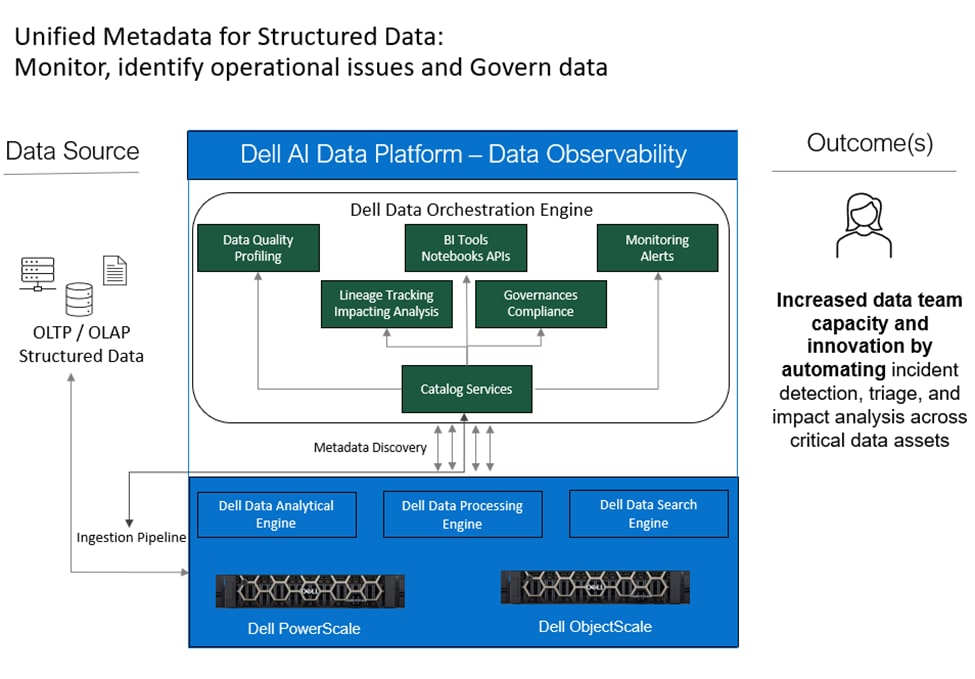 Bringing Observability, Governance, and Metadata into One Platform
Three-Layer Architecture
The architecture consists of three integrated layers that work in concert.
|
Layer |
Component |
Purpose |
|
Collection |
Engine Connectors |
Continuously synchronize metadata from Spark, Iceberg, Data Analytics Engine (Trino), Airflow, storage, and search engines |
|
Intelligence |
Unified Metadata Repository |
Single source of truth for schemas, lineage graphs, quality metrics, and governance policies |
|
Presentation |
Enhanced Orchestration UI |
Single pane of glass for search, lineage visualization, quality dashboards, and governance controls |
Layer 1: Engine Connectors—Continuous Metadata Extraction
Specialized connectors tap into each AIDP engine and continuously synchronize metadata to the central repository.
- Analytical Engine Connector (AEC) crawls the Iceberg metadata files (manifests, snapshots, partition specs), and Dell Data Analytics Engine system tables. AEC extracts schemas, statistics, table properties, and partition information. Critical tables sync in real time; everything else syncs incrementally every 15 minutes.
- Processing Engine Connector (PEC) connects to Dell Data Processing Engine and Apache Airflow's metadata and dbt project manifests for runtime lineage from transformation jobs. PEC captures DAG definitions, task dependencies, execution history, data quality check results, and transformation lineage in real time using Airflow event webhooks, supplemented by hourly full syncs.
- Search Engine Connector (SEC) integrates with Elasticsearch APIs, vector database metadata, and graph database schemas. SEC extracts index mappings, document schemas, query patterns, and embedding dimensions on a daily full scan plus on-demand syncs when indexes change.
- Storage Metadata Connector (SMC) reads Dell PowerScale and ECS object storage Metadata, S3 bucket policies, and file system statistics. SMC provides storage-layer lineage showing which Iceberg tables map to which storage paths.
Layer 2: Unified Metadata Repository— The Single Source of Truth
The central repository ingests metadata from all connectors and enriches it with cross-engine intelligence:
- Schemas and catalogs: Every table, column, view, and index across Spark, Iceberg, Trino, and search engines—all in one place.
- Lineage graphs: End-to-end data flow from source Kafka topics through Spark transformations, into Iceberg tables, through analytical engine views.
- Quality metrics: Freshness, volume, schema evolution, and profile statistics tracked consistently across all engines.
- Governance policies: PII tags, access controls, and compliance rules applied uniformly, regardless of which engine hosts the data.
- Operational metadata: Query performance, resource utilization, and job execution history aggregated for holistic monitoring.
Layer 3: Enhanced Orchestration UI—A Single Pane of Glass
The existing Dell Data Orchestration Engine (DDOE) is enhanced with structured data capabilities, creating a unified experience:
- Unified Search: A single search bar finds assets across structured data (tables, columns).
- Integrated Governance: Applies PII tags and access controls to structured data tables
- Observability Dashboards: Real-time health monitoring across all AIDP engines in a single view.
How It Works: End-to-End Flow
To see the architecture in action, trace a real data pipeline from ingestion to insight.
Step 1—Metadata Extraction. Connectors continuously pull metadata. The Spark Connector detects a new streaming job and extracts its input (Kafka topic) and output (Iceberg table) metadata. The Iceberg Connector crawls new table metadata files and extracts the schema, partition spec, and snapshot history. The Trino Connector discovers a new view querying the Iceberg table. All metadata syncs to the repository every 15 minutes, with critical tables syncing in real time.
Step 2—Automated Lineage Construction. The repository analyzes metadata relationships and builds an end-to-end lineage graph: Kafka topic → Spark job → Iceberg table → analytic engine view, a single lineage graph spanning across systems, viewable in one UI.
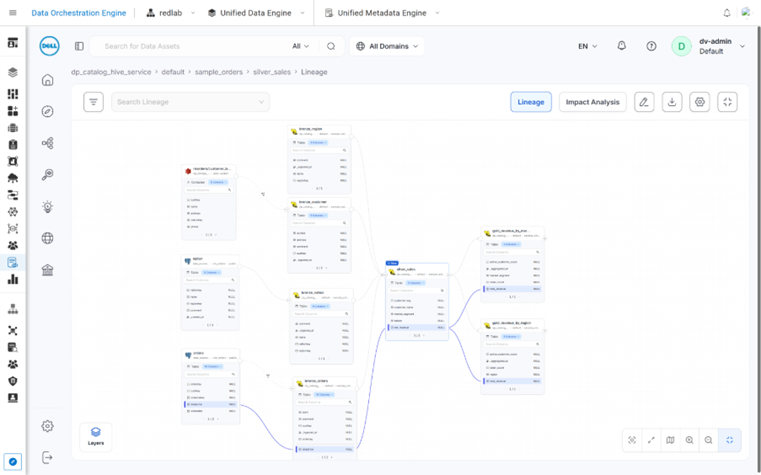 Interactive Data Lineage Graph for Impact Analysis and Traceability
Step 3—Intelligent Quality and Governance Enrichment. The system applies cross-engine intelligence automatically. An ML model scans the Iceberg table and identifies a sensor location column as PII. That PII tag propagates automatically to the downstream Trino view. Statistical profiling runs across the pipeline. Freshness SLOs are set and tracked end to end. Access control policies extend consistently from the catalog to every query endpoint.
Step 4—Unified Presentation. Engineers and scientists interact through a single interface. If you type "sensor temperature," the search returns the Iceberg table and the Trino view in one result set. Click any asset to see its full upstream and downstream lineage. View real-time quality dashboards showing freshness, volume, and schema health across every pipeline stage. Check governance status, PII tags, and access controls in one place.
Transformative Results
Implementing unified metadata delivers measurable benefits across every dimension of data operations:
- Incident resolution drops from hours to minutes. When an issue occurs, engineers see the full cross-engine lineage instantly. There is no more manual analysis and no more guesswork about downstream impact.
- Compliance audits shrink from weeks to hours. PII tags, access controls, and lineage documentation is consistent and quarriable from a single interface. Auditors get what they need without a scavenger hunt.
- Data quality shifts from reactive to proactive. Freshness SLOs, volume anomalies, and schema drift are monitored continuously across all engines. Issues surface before they cause business impact, not afterwards.
- Data engineers reclaim their time. With 60% of their time freed from firefighting, teams shift to building new capabilities, the high-value work that drives competitive advantage.
Take the Next Step
Use the Dell AI Data Platform consisting of ingestion, processing, analytics and observability layers to stop metadata fragmentation across your data estate. The unified metadata layer in Dell AI Data Platform audits your current metadata landscape. It identifies where schemas, lineage, and governance policies live today, and identifies the gaps—the places where a data quality issue in one layer silently propagates through other layers before anyone notices. This shared metadata fabric unlocks the full potential of your data infrastructure.