In the world of AI agents, short-term memory is cheap, but true long-term understanding has felt notoriously out of reach. For a long time, the industry relied on standard Retrieval-Augmented Generation (RAG) to patch the gap.
However, traditional RAG behaves like a crude document fetcher. It shoves raw text chunks into a context window and hopes for the best. It remembers what was said in a specific document, but it doesn’t actually learn from experiences. To build truly autonomous digital workforces, we must transition from simple information retrieval to Agentic Memory.
What is Agentic Memory?
Agentic Memory is a structured, dynamic, and evolving cognitive layer designed for autonomous AI agents. Instead of treating memory as a flat text log or a collection of static files, an agentic memory architecture treats data as an active substrate for reasoning.
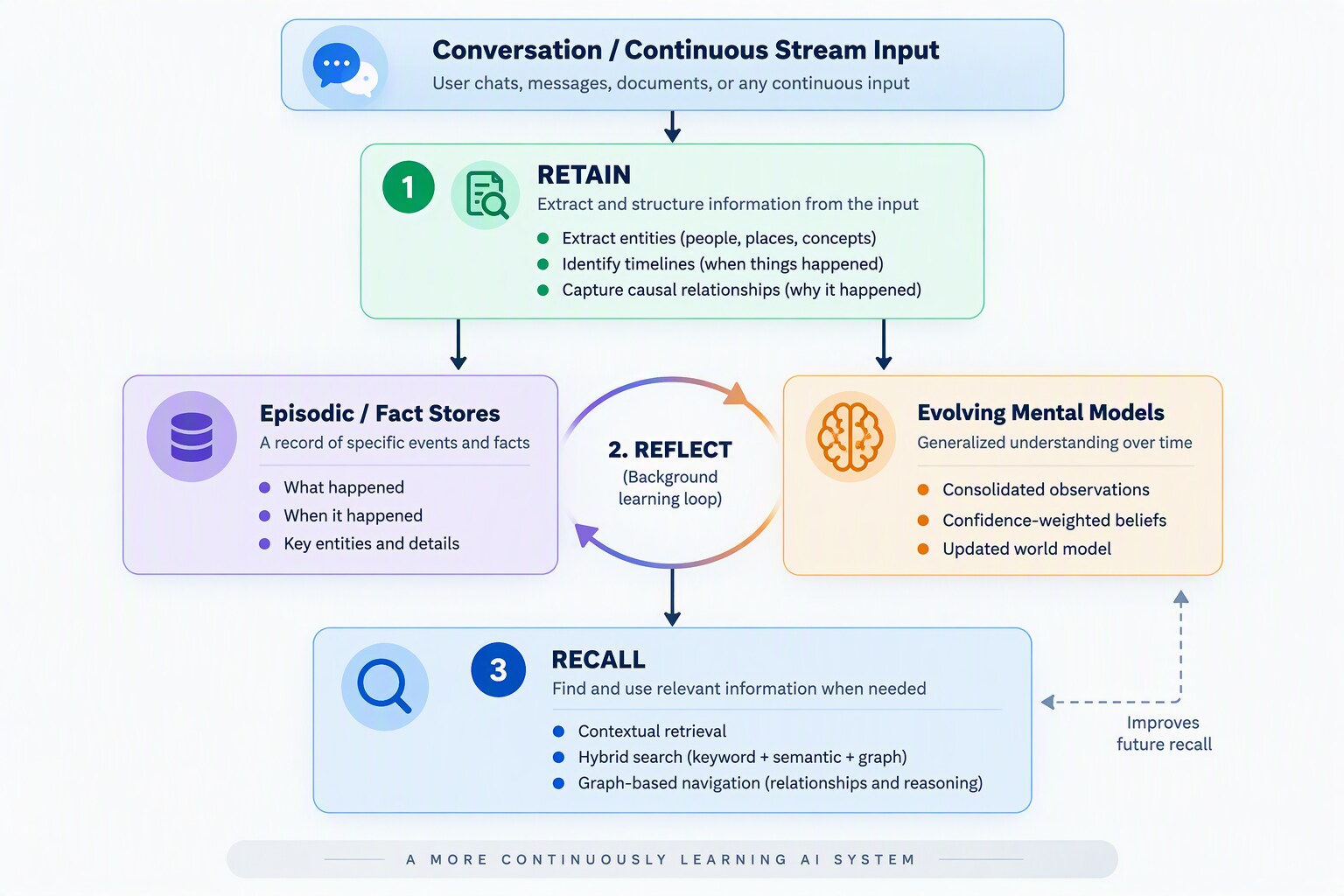
A comprehensive agentic memory system relies on three core operational pillars:
Agentic Memory Core Operational Pillars
Retain (Structured Ingestion)
The memory engine doesn't just chunk text based on character counts. It parses incoming interactions to extract facts, timelines, and relationships (who, what, when, and why), anchoring them tightly to a causal history.
Reflect (Self-Consolidation)
Memory isn't static. An agentic system runs background processes to review past events, merge duplicates, identify overarching patterns, and update its standing beliefs or mental models over time.
Recall (Contextual Retrieval)
When an agent encounters a new problem, the engine uses hybrid search methods (combining text matching, vector similarity, and graph-traversal) to inject the most relevant, highly synthesized history straight into the agent's context window.
The Power of Team-Based, Cross-Framework Collaboration
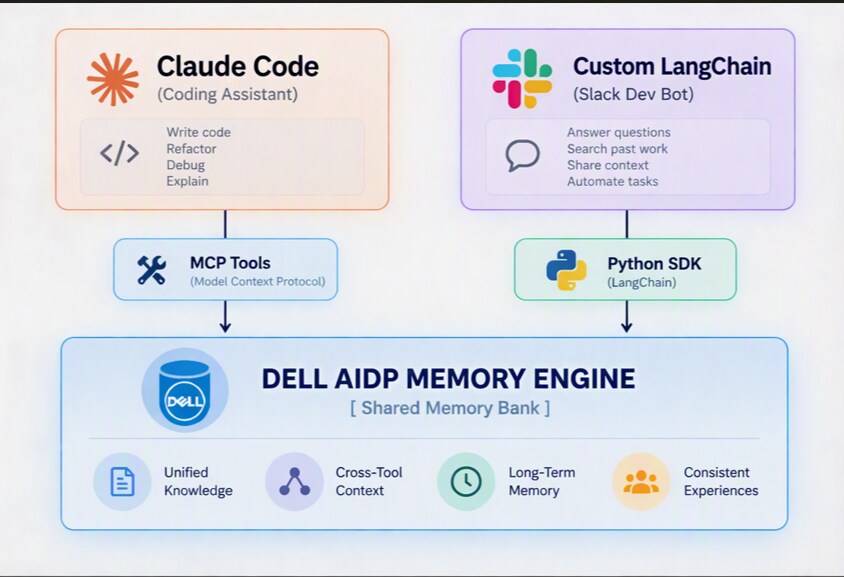
The ultimate realization of agentic memory is Shared Context. Traditionally, if you deployed a coding assistant in an IDE and a customer support agent in Slack, they lived in siloed worlds. If Agent A solved a crucial database bug, Agent B remained completely oblivious.
A centralized agentic memory tier untethers memory from any single AI tool or execution framework. By establishing a shared cognitive backend, completely different agent platforms (such as LangChain, AutoGen, or native Model Context Protocol tools) can tap into the same exact memory graph.
When Agent A learns something new, it updates the central memory tier. When Agent B queries that same memory bank hours later, it immediately benefits from Agent A's experience—creating a collaborative, cross-platform workforce.
What Dell’s AIDP Memory Engine Brings to the Table
While the blueprint for agentic memory sounds ideal, building it from scratch is incredibly difficult. This is exactly where a Memory Engine in Dell AI Data Platform comes into play.
Dell’s AIDP Memory Engine turns the theory of agentic memory into a plug-and-play architectural reality, dominating long-horizon memory benchmarks like LongMemEval with an unprecedented 91.4% accuracy.
Here is exactly what Dell’s AIDP Memory Engine introduces to execute the agentic memory paradigm:
Dell AIDP Memory Engine replaces basic vector tables with an advanced, four-tier structure modeled after human memory:
World Facts
Objective, unchangeable truths.
Experience Facts
Episodic, specific events tied directly to past execution history.
Observations
Evidence-backed beliefs derived over time.
Opinions/Mental Models
Evolving, confidence-weighted conclusions that adapt as new data emerges.
2. The TEMPR Pipeline for Ingestion
For the Retain phase, Dell AIDP Memory Engine uses TEMPR (Temporal Entity Memory Priming Retrieval). This pipeline leverages LLMs to break down conversational text into highly normalized, chronologically anchored narrative facts, eliminating noisy or irrelevant context.
3. Rank-Fused Hybrid Retrieval
For the Recall phase, Dell AIDP Memory Engine runs a parallel, four-way search strategy. It merges semantic similarity, keyword matching (BM25), graph traversal, and temporal filtering. Results are rank-fused and cross-encoder re-ranked, ensuring the agent gets high-density insights that safely fit into its token budget.
4. Native Multi-Framework Interoperability
Dell AIDP Memory Engine provides native integrations across the entire AI ecosystem, allowing you to connect diverse agentic platforms to a single memory bank:
Model Context Protocol (MCP)
Out-of-the-box MCP server support allows terminal-based tools like Claude Code to seamlessly bind to your central memory bank.
Vercel AI SDK
Web-facing applications built in TypeScript can leverage native SDK wrappers to expose memory actions as structured LLM tools.
Python Frameworks
Python developers working in LangChain, AutoGen, or CrewAI can use Dell AIDP Memory Engine’s native Python SDK to pass unified corporate context directly into custom workflows.
Conclusion: The Self-Evolving Workforce
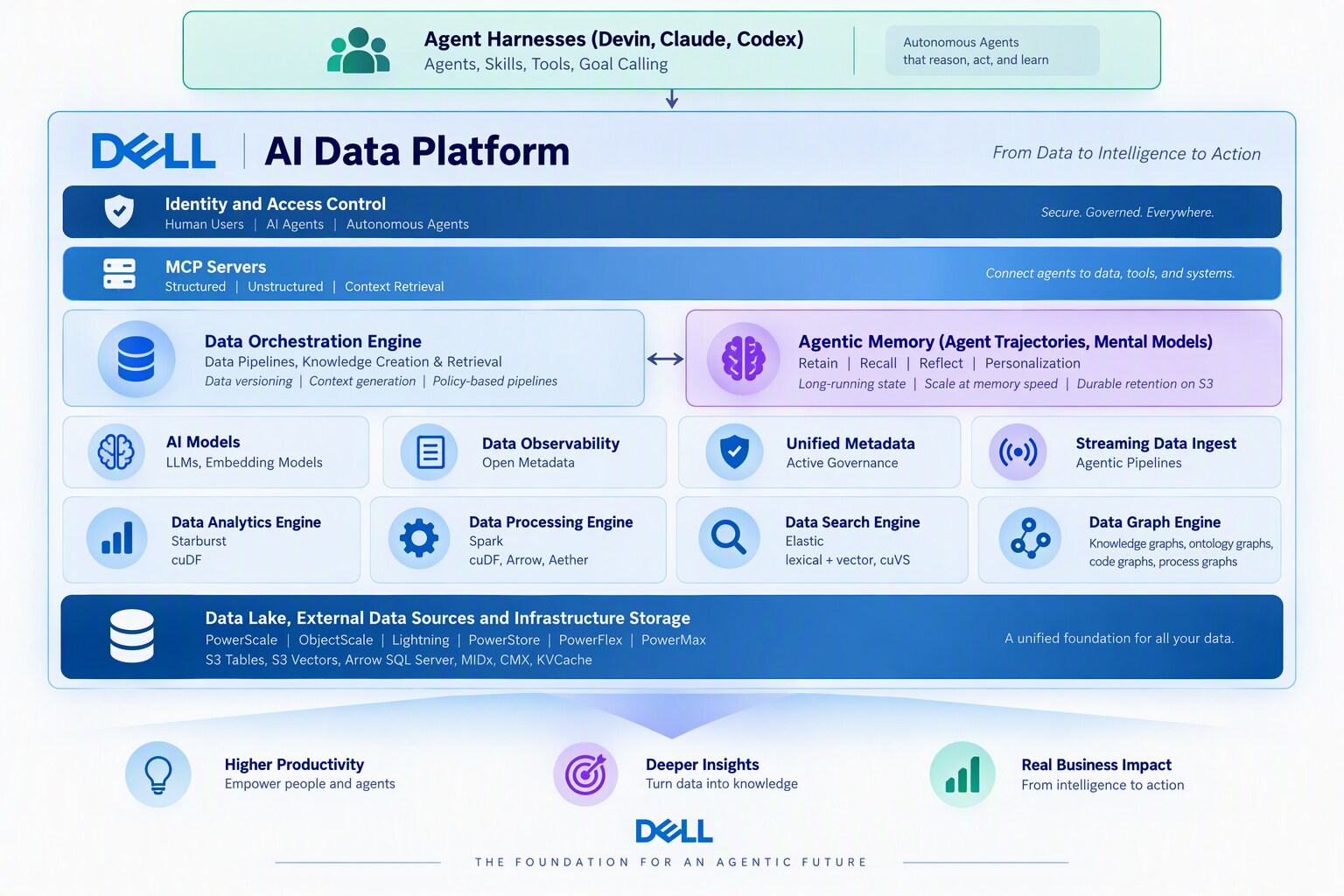
Dell AI Data Platform with Agentic Memory Layer
By detaching memory from individual execution frameworks and turning it into an active, self-reflecting layer, agentic memory transforms stateless script-executors into a cohesive digital workforce. Powered by the Dell AI Data Platform, this architecture provides the secure, high-performance data infrastructure needed to anchor central memory engines. With tools like Dell AIDP Memory Engine providing the structural heavy-lifting on top of Dell's enterprise-grade data foundation, your organization's collective intelligence can grow seamlessly as a single, unified asset—no matter which AI platforms you choose to build on.