Solution Briefs
Meeting Today’s Hybrid Infrastructure Challenge
Meeting Today’s Hybrid Infrastructure Challenge
Meeting Today’s Hybrid Infrastructure Challenge
Running SUSE Rancher and Rancher Kubernetes Engine (RKE2) on Dell VxRail
Running SUSE Rancher and Rancher Kubernetes Engine (RKE2) on Dell VxRail
Running SUSE Rancher and RKE2 on Dell VxRail
Introduction
SUSE Rancher and Rancher Kubernetes Engine 2 (RKE2) were deployed on Dell VxRail hyperconverged infrastructure (HCI) within the Dell Technologies Customer Solution Center. SUSE Rancher allows customers to operate CNCF-Certified Kubernetes clusters from core to cloud to edge.
The Dell Technologies Customer Solutions Center has successfully deployed SUSE Rancher and RKE2 on Dell VxRail, which delivers a personalized engagement experience to showcase the Dell Technologies end-to-end solutions portfolio. These experiences are designed to help customers solve their business challenges and optimize innovation within their organizations. Customers can work with Dell Technologies experts in our dedicated labs, or remotely from any location with the latest Dell technology offerings.
SUSE Rancher overview
Rancher is a complete software stack for teams that are adopting containers. It addresses the operational and security challenges of managing multiple Kubernetes clusters across any infrastructure while providing DevOps teams with integrated tools for running containerized workloads. Rancher is able to:
- Deploy production-grade Kubernetes clusters from data center to cloud to the edge
- Unite clusters with centralized authentication, access control, and observability

- SUSE Rancher container management platform
The Rancher deployment was completed using the installation instructions documented on the RKE2.io website. The installation instructions detail a quick and easy implementation of the Rancher solution onto vSphere-based infrastructures.

- Dell EMC VxRail
Running SUSE Rancher on Dell VxRail
VxRail is the only fully integrated, pre-configured, and tested HCI system optimized with VMware vSphere, making it ideal for customers who want to leverage SUSE Rancher through vSphere to create and operate Kubernetes clusters on-premises.
Running SUSE Rancher on VxRail delivers a seamless and automated operations experience across cloud-native and traditional workloads. The intelligent lifecycle management of VxRail automates non-disruptive upgrades and patches, while keeping the infrastructure in a continuously validated state to ensure workloads are running and clusters are optimized. Together, VxRail and SUSE Rancher make it easy to standardize both IT and developer operations, on-premises and in the public cloud.
SUSE Rancher is built on open-source software, which allows for the deployment of Kubernetes clusters to accelerate digital transformation. SUSE Rancher provides an installable software package for creating and operating on-premises downstream Kubernetes clusters, or any Cloud Native Computing Foundation (CNCF)-certified Kubernetes cluster.
SUSE Rancher also helps to simplify the creation and operation of on-premises Kubernetes clusters while automating cluster management so organizations can reduce support costs and avoid the maintenance overhead of integrating redundant open-source and third-party tools. In addition, DevOps teams can leverage the SUSE Rancher console to view all their Kubernetes clusters, including SUSE Rancher clusters, running anywhere.
Note: SUSE Rancher is available for free download from the SUSE Rancher website (see Install SUSE Rancher in the Resource section).
RKE2 overview
RKE2, also known as RKE Government, is a fully conformant certified Kubernetes distribution focused on security and compliance. RKE2 leverages the best components of RKE and K3s distributions to bring government-grade security capabilities to the enterprise and cloud native community.
RKE2 is built to take advantage of changes across the ecosystem. It requires no dependency on the Docker container runtime and supported containers runtime is containered. The distribution supports FIPS 140-2 compliance.
In SUSE Rancher, RKE2 provisioning is being introduced as a technical preview. This new provisioning system is built on top of the community standard Cluster API specifications. Users will now be able to leverage GitOps tools to define their clusters as infrastructure as code out of the box, called fleet.
Additionally, deploying through SUSE Rancher provides support for a choice of container networking interface (CNI) plugins, SUSE Rancher provides the following CNI network providers for Kubernetes clusters:
- Canal
- Flannel
- Calico
- Weave
Canal is the default CNI network provider combined with Flannel. Businesses can choose their CNI network provider when creating a new Kubernetes cluster.
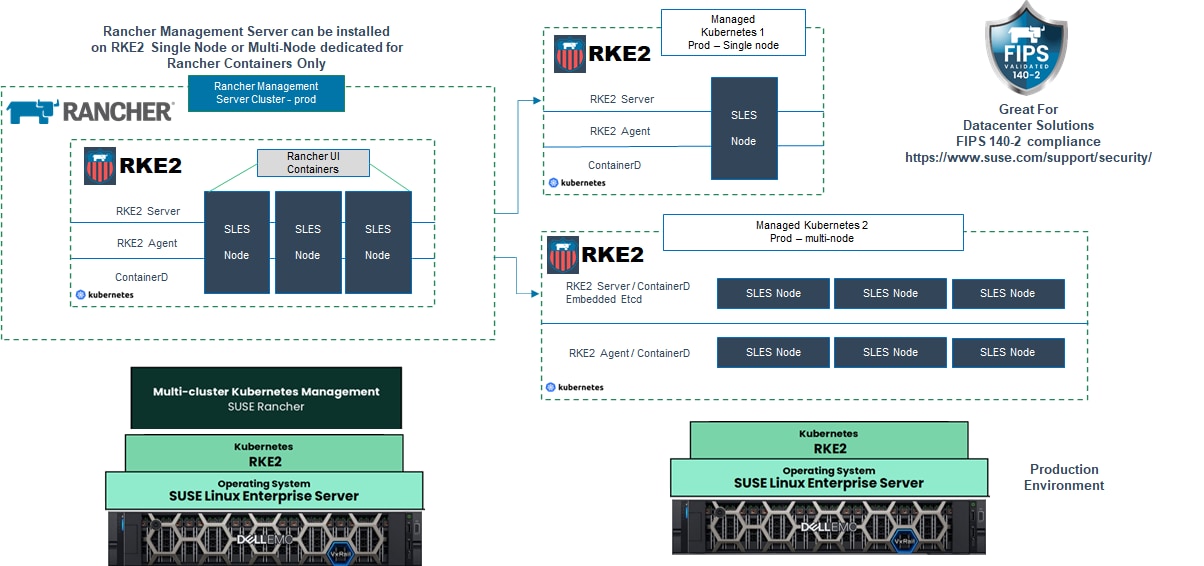
- Example of SUSE Rancher, REK2, and Dell EMC VxRail
Key integration benefits
Rancher unites Kubernetes clusters with centralized authentication and access control, enterprise security, auditing, backups, upgrades, observability, and alerts. Enterprises can deploy and secure clusters consistently in minutes, anywhere, using the Dell Technologies intuitive UI or powerful Command Line Interface (CLI).
When deploying an application that needs to retain data, businesses need to create persistent storage. Persistent storage allows them to store application data external from the pod running the application, a practice that allows them to maintain application data even if the application pod fails.
Enterprise storage capabilities can be extended to SUSE Rancher, RKE2, RKE, and K3S Kubernetes for cloud-native stateful applications with Dell Technologies Container Storage Modules (CSM).
SUSE Rancher can be freely downloaded and installed on your VxRail infrastructure, and a SUSE Rancher support subscription can be purchased through Dell Technologies.
References
Dell VxRail
- VxRail Hyperconverged Infrastructure
- VxRail System TechBook
- Running SUSE Rancher and Rancher Kubernetes Engine 2 (RKE2) on VxRail blog
Dell Customer Solutions Centers
SUSE Rancher
- SUSE Rancher Documentation
- Rancher Kubernetes Engine 2 (RKE2) Documentation
- SUSE Fleet Container management and deployment engine
- SUSE Rancher GitHub
|
Dell Technologies welcomes your feedback on the solution and the solution documentation. Contact the Dell Technologies Solutions team by email. |

|
The information in this publication is provided as is. Dell Inc. makes no representations or warranties of any kind with respect to the information in this publication, and specifically disclaims implied warranties of merchantability or fitness for a particular purpose. Use, copying, and distribution of any software described in this publication requires an applicable software license. Copyright © 2022 Dell Inc. or its subsidiaries. All Rights Reserved. Dell Technologies, Dell, EMC, Dell EMC and other trademarks are trademarks of Dell Inc. or its subsidiaries. Intel, the Intel logo, the Intel Inside logo and Xeon are trademarks of Intel Corporation in the U.S. and/or other countries. Other trademarks may be trademarks of their respective owners. Published in the USA January 2022 Solution Brief H19051. Dell Inc. believes the information in this document is accurate as of its publication date. The information is subject to change without notice. Author: Victor Dery |
|
Contact us To learn more, contact your local representative or authorized reseller. |
Running SUSE Rancher and K3s with SLE Micro on Dell VxRail
Running SUSE Rancher and K3s with SLE Micro on Dell VxRail
SUSE Rancher and K3s running on the SUSE Linux Enterprise Micro operating system were deployed on Dell VxRail hyperconverged infrastructure as part of ongoing technology validation exercises performed by a team of SUSE and Dell VxRail engineers. This joint effort was a continuation of activities resulting from the partnership between Dell Technologies and SUSE that seeks to bring validated modern products and solutions to market that enable our customers to operate CNCF-Certified Kubernetes clusters from the core to the cloud and to the edge, to support their digital businesses and harness the power of their data.
Solution Components Overview
SUSE Rancher is a complete software stack for teams that are adopting containers. It addresses the operational and security challenges of managing multiple Kubernetes (K8s) clusters, including lightweight K3s clusters, across any infrastructure, while providing DevOps teams with integrated tools for running containerized workloads. It not only deploys production-grade Kubernetes clusters from the datacenter, to the cloud, to the edge, but it also unites them with centralized authentication, access control, and observability. Included as a GitOps feature of Rancher is Fleet, a container management and deployment engine that is designed to manage up to a million clusters. Rancher is available as a free download from the SUSE Rancher GitHub.
K3s is a CNCF sandbox project that delivers a lightweight yet powerful certified Kubernetes distribution. When used with SUSE Rancher, K3s is ideal for running production workloads across resource-restrained, remote locations, or on IoT devices. K3s is packaged as a single < 40 MB binary that reduces the dependencies and steps needed to install, run, and auto-update a production Kubernetes cluster.
SUSE Linux Enterprise Micro (SLE Micro) is an ultra-reliable, lightweight operating system purpose built for containerized and virtualized workloads. It leverages the enterprise-hardened security and compliance components of SUSE Linux Enterprise and merges them with a modern, immutable, developer-friendly OS platform, making it a great fit for running K3s clusters.
VxRail is the only fully integrated, pre-configured, and tested HCI system optimized with VMware vSphere, making it ideal for customers who want to leverage SUSE Rancher, K3s, and SLE Micro through vSphere to create and operate lightweight Kubernetes clusters on-premises or at the edge. Running K3s along with SUSE Rancher on VxRail delivers a seamless and automated operations experience across cloud-native and traditional workloads.
VxRail’s intelligent lifecycle management automates non-disruptive upgrades and patches while keeping the infrastructure in a continuously validated state to ensure workloads are running and clusters are optimized. Together, VxRail, SUSE Rancher, K3s, and SLE Micro make it easy to standardize both IT and developer operations on-premises in the core, or edge, and in the public cloud.
Validation Deployment Details
In this non-production lab validation, a single VxRail cluster was deployed with the following specifications:
4 x VxRail E660F nodes running VxRail 7.0.370 version software
- 2 x Intel® Xeon® Gold 6330 CPUs
- 512 GB RAM
- Broadcom Adv. Dual 25 Gb Ethernet NIC
- 2 x vSAN Disk Groups:
- 1 x 800 GB Cache Disk
- 3 x 4 TB Capacity Disks
- vSphere/vSAN K8s CNS/CSI
After the VxRail cluster was built, a set of three virtual machines were deployed running SLE Micro 5.1. A multi-node K3s cluster running version 1.23.6 with Server and Agent services, Etcd, and a ContainerD container runtime were installed on these VMs. SUSE Rancher 2.6.3 was then installed on the K3s cluster. Also included in the K3s for Rancher installation were Fleet GitOps services, Prometheus monitoring and metrics capture services, and Grafana metrics visualization services. All of this formed our Rancher Management Server. Rancher was then used to deploy managed K3s workload clusters that were single node and multi-node in size. In this validation, two managed K3s workload clusters were deployed on the Rancher Management Server cluster. These included single node and six-node K3s clusters all running on vSphere VMs with the SLE Micro operating system installed. Note: All the installation steps used followed the SUSE documentation without any unique VxRail customization.
This validation can easily be modified to be more highly available and production ready. The following diagram depicts how to incorporate more resilience:
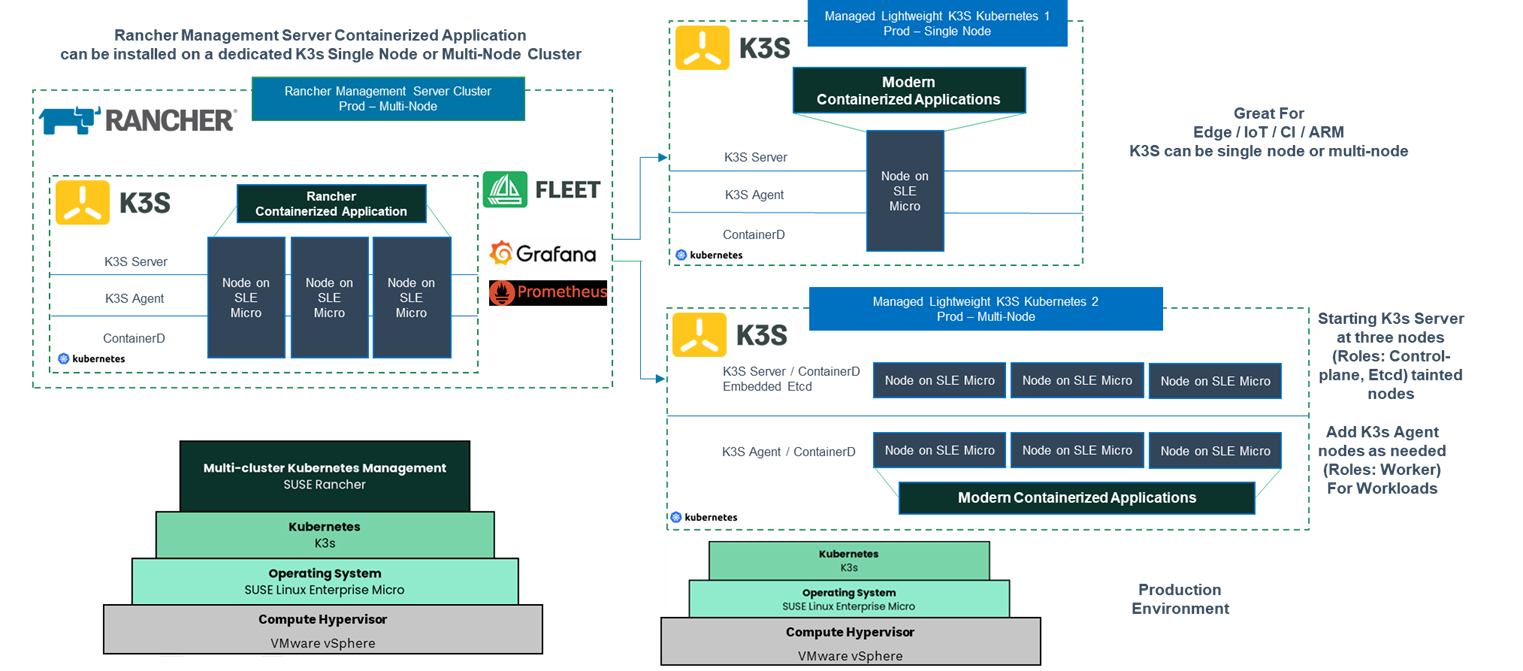
- SUSE Rancher and K3s with SLE Micro on Dell VxRail - Production Architecture
The Rancher Management Server stays the same, because it was already deployed with a highly available four-node VxRail cluster and three SLE Micro VMs running a multi-node K3s cluster. As a production best practice, managed K3s workload clusters should run on separate highly available infrastructure from the Rancher Management Server to maintain separation of management and workloads. In this case, a second four-node VxRail cluster can be deployed. For the managed K3s workload clusters, a minimum of three-node clusters should be used to provide high availability for both the Etcd services and workloads running on it. However, three nodes would not be enough to provide node separation and high availability for the Etcd services and workloads. To remedy this, customers can deploy a minimum six-node K3s cluster. This is depicted in the diagram with the K3s “Kubernetes 2 Prod” cluster.
Summary
This validation features Dell VxRail. Customers have the flexibility to deploy similar architectures using other Dell hardware platforms, such as Dell PowerEdge and Dell vSAN Ready Nodes running VMware vSphere. For more information, and to see other jointly validated reference architectures using Dell infrastructure with SUSE Rancher, K3s, and more, see the following resource pages and documentation.
Dell Resources
- Dell VxRail Hyperconverged Infrastructure
- Dell VxRail System TechBook
- Find Your Edge: Running SUSE Rancher and K3s with SLE Micro on Dell VxRail
- Reference Architecture - SUSE Rancher, K3s, and SUSE Linux Enterprise Micro for Edge Computing: Based on Dell PowerEdge XR11 and XR12 Servers