
Solution Insight: Oracle Analytics Server with Dell PowerFlex Infrastructure

Solution Insight: Oracle Analytics Server with Dell PowerFlex Infrastructure This white paper provides insight into the benefits of a powerful, agile, and flexible infrastructure for Oracle Analytics Server (OAS).

Introduction

Introduction

This document provides a solution insight architecture for the deployment of Oracle Analytics Server (OAS) on the Dell PowerFlex infrastructure. This solution demonstrates that PowerFlex is an optimal match for deploying OAS in an enterprise workload environment due to its robust performance, scalability, and availability.

Business challenge

Business challenge

Data is critical to every aspect of running a modern business. Today, data is available in several types of media, such as text, images, logs, graphs, and more. Not only does data come in different forms, but it also comes in from various sources, such as social media, edge devices, IoT, sensors, and others. It is increasingly clear that rapid growth in volume, velocity, and variety of available data is straining traditional strategies for data management and analysis.

Data analytics is the process of analyzing raw, structured, and unstructured data to identify trends and answer questions. This type of analysis allows business to interpret and communicate meaningful data patterns. Various approaches to data analytics include:

  • Descriptive
  • Diagnostic
  • Predictive
  • Prescriptive

Organizations can apply analytics to business data to describe, predict, and improve business processes and outcomes.

Organizations rely on data analytics to make better business decisions. Having the right infrastructure in place to run such workloads not only speeds up the analytics process, but it also provides a robust architecture to prevent any unplanned outages. Data analytics infrastructure needs to be powerful, highly available (HA), and flexible, as does any infrastructure designed for business-critical applications.

Solution overview

Solution overview

Oracle Analytics Server empowers business users, data engineers, and data scientists to access and process data, evaluate predictions, and make quick and accurate decisions. OAS addresses the entire analytics process, including data ingestion, preparation and enrichment, and visualization and collaboration. Machine Learning (ML) is embedded throughout the platform to help organizations go move data-driven to analytics-driven enterprises.

Dell PowerFlex is a complete infrastructure platform that combines storage, compute, and networking resources with industry-standard hardware. It empowers organizations to harness the power of software and embrace change while achieving consistently predictable outcomes for mission-critical workloads. 

PowerFlex is a modern foundation that delivers extreme flexibility, massive performance, and linear scalability while simplifying complete infrastructure management and boosting IT agility. It is the ideal foundation for organizations that are looking to modernize their mission-critical applications, consolidate heterogeneous workloads, and build agile, private, and hybrid clouds. It is also optimized and validated for a broad set of enterprise workloads including Oracle database, Microsoft SQL Server, SAP HANA, Cassandra, MongoDB, to Splunk, SAS, and Elastic Search.

Deploying OAS on Dell PowerFlex provides the following benefits:

  1. Provides a single pane of glass for the cluster management
  2. Provides bare metal nodes for the database tier for Oracle licensing compliance
  3. Provides the Hyperconverged nodes option for any of the tiers
  4. Provides the ability to serve both file and block-based shared storage
  5. Provides the ability to scale out storage and compute independently

Generic OAS architectural overview

Generic OAS architectural overview

OAS is Oracle’s on-premises analytics and business intelligence (BI) platform that provides the full range of features and capabilities as the Oracle Analytics Cloud (OAC). OAC is Oracle’s cloud-based analytics platform. OAS is the successor to Oracle Business Intelligence Enterprise Edition (OBIEE) product. OAS offers customers a seamless path to connect and move to the cloud at their own pace. Existing OBIEE customers who upgrade to OAS can benefit from adding augmented analytics and AI-powered data enrichment to their existing environment and other rich and advanced features offered by OAS over OBIEE.
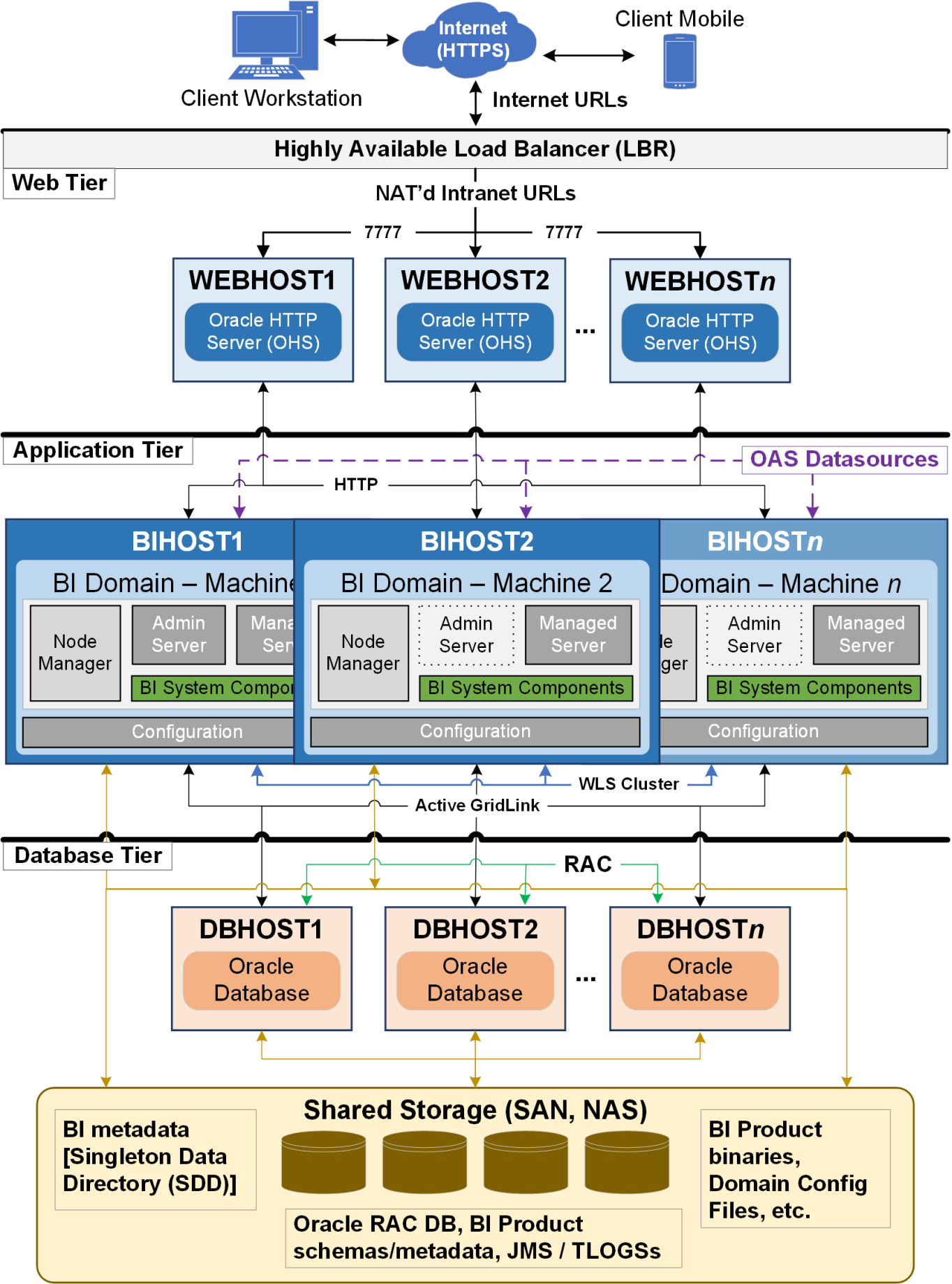
Figure 1.   Generic OAS highly available / scale-out enterprise reference topology

Figure 1 shows Oracle’s recommended enterprise reference topology for deploying OAS and its components in a high available (HA), scaled-out, and secure environment. The following sections provide a high-level overview of this Oracle’s recommended three-tier enterprise architecture which includes the web tier, the application tier, and the database tier.

Web tier (LBR and OHS)

This tier consists of a pair of load balancers (LBR) and two or more physical web servers or hosts that receive the initial request from the users.

LBR can be either hardware devices or software applications. It provides security enhancements by allowing customers to configure external facing virtual server names (URLs) that users enter to connect to OAS. LBR, in turn, will route these requests to one of the web servers (WEBHOST1, WEBHOST2, WEBHOSTn) by using a load balancing algorithm. LBR uses Network Address Translation (NAT) to map the URL requests to the appropriate internal application (OAS) URLs. LBR can also help increase performance to the architecture by terminating or off-loading the SSL requests.

Although traffic from LBR can be routed directly to the application servers (WebLogic Servers (WLS) and OAS), it is recommended to deploy web servers (Oracle HTTP Servers (OHS)) in the web-tier. Deploying servers in the web tier offers several advantages such as faster fail-over if a WLS instance fails, more security with a public DMZ, and faster delivery of static content. OHS is installed and configured on its own domain on each host. Each OHS instance is an independent unit, which makes it easier to configure and maintain.

Application tier (Middleware, WLS, and OAS)

This tier hosts the business, application, visualization, and analytics logic. It consists of one or more physical application servers where the WebLogic Server and the Oracle Fusion Middleware products, and OAS are deployed and configured.

OAS software deployment includes the installation of the following software products on each application server/host (BIHOST1, BIHOST2, BIHOSTn):

  • Oracle Fusion Middleware Infrastructure distribution software which includes Fusion Middleware binaries, Middleware Enterprise Manager (EM) binaries, WebLogic Server (WLS) binaries, and Oracle JRF software–all in one distribution.
  • Java Development Kit (JDK) software
  • Oracle Analytics Server (OAS) software which is also referenced as Business Intelligence (BI) in this architecture.

OAS configuration involves creation or extension of the WebLogic Server or BI domain. Each domain consists of Java components, Non-Java components, and a node manager:

  • Java components: These are deployed as Java EE (JEE) containers.
    • Administration Server: A JEE container that runs a dedicated Java virtual machine and contains Java components (WLS Admin Console) for administering the system.
    • Managed Server: A JEE container that runs a dedicated Java virtual machine that provides runtime environment for the Java-based services and applications (Publisher, Presentation Services, and more) within the system.
  • Non-Java components
    • System components: BI System components such as BI Server, BI Scheduler, BI Presentation Server, and others are deployed as server processes that provide the core services.
    • Other domain contents: Includes all the necessary software, configuration files, metadata, security, and connection and database configuration information that are required to run the system.
  • Node manager: This provides process management services for the Administration Server, Managed Server processes, and system components.

Scaling-out OAS with shared storage

OAS is a scalable platform. Depending on client-request load, OAS can be scaled either vertically (scale-up) or horizontally (scale-out). Scale-up involves adding more OAS components within the same host and scale-out involves adding more hosts to the environment to service additional or increased client request loads. The process of scaling-out includes the following: installing OAS software binaries on a new host, stopping and cloning the components on the first host, packing the domain and unpacking it on the new host, and starting the components on all hosts.

In a production system, it is recommended to deploy two or more instances of every component on two or more physical hosts (BIHOST1, BIHOST2, BIHOSTn). If the system components and Java components are deployed in a clustered environment, for maximum availability, the files and directories (such as product binaries, domain configuration files, BI metadata) including the global cache and shared Oracle BI Scheduler scripts should be on a shared storage device (such as a file-based NFS shared storage). Although the configuration directory and files are located on a shared storage volume for an Administration Server, the shared volume is mounted only on the host that the Administration Server is running on. For Managed Servers, to get the best performance, it is recommended to keep its configuration files on the local storage of the host that it is running on.

Database tier (Oracle Database)

 This tier provides the repository or the database to store the schemas required by the OAS or BI components and the Oracle Platform Security Services (OPSS) policy store. For maximum availability, performance, and scalability, Oracle Database Real Application Clusters (RAC) on two or more database hosts (DBHOST1, DBHOST2, DBHOSTn) is recommended. The RAC database and OAS schemas should be residing on a highly available shared SAN storage.

A data source is an abstraction that OAS components use to obtain connections to a relational database. Active GridLink data source provides connectivity between OAS/WLS and an Oracle Database (RAC) service. It is recommended to use Active GridLink while configuring data sources for the OAS components during the OAS/WLS domain creation due to the following advantages it provides - database connection HA, load balancing, and failover.

WebLogic Java Messaging System (JMS) messages and JTA Transaction Logs (TLOG) can be stored either to a file-based (NFS) persistent store or to a JDBC-enabled database. In a production environment, it is recommended to create and store them on JDBC-accessible stores in the Oracle Database.

For additional details on the OAS enterprise topology and deployment, see Enterprise Deployment Guide for Oracle Analytics Server.

Dell OAS solution insight

Dell OAS solution insight

The following figure shows the proposed Dell solution insight architecture for deploying the OAS enterprise environment on a Dell PowerFlex infrastructure.
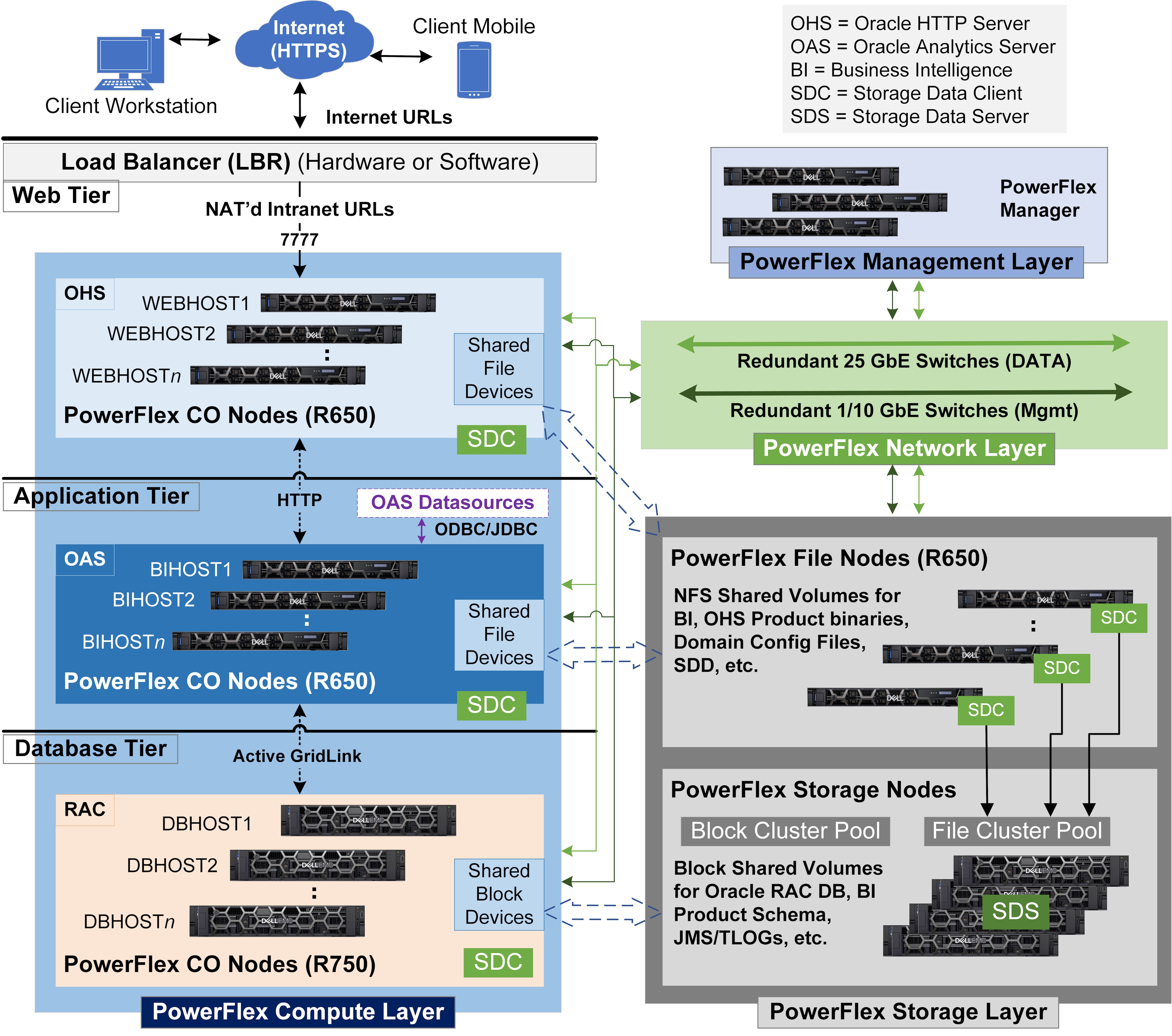
Figure 2.   OAS highly available / scale-out enterprise solution insight architecture on Dell PowerFlex infrastructure

The PowerFlex infrastructure is suitable for deploying an enterprise-level OAS platform. It can accommodate all the server and storage (both NAS and SAN) requirements for a three-tier OAS enterprise deployment. The proposed PowerFlex setup for OAS enterprise deployment is a two-layer architecture where the compute layer is separate from the storage layer. This setup provides the advantage where the OAS compute and storage nodes can scale independently of each other, providing the flexibility to start small and add nodes as you grow, at each tier and at each PowerFlex layer. The following sections briefly describes the PowerFlex infrastructure layers as it maps to the generic enterprise topology tiers in an OAS infrastructure environment:

PowerFlex compute layer

This layer provides all the physical hosts or computing requirements for all three tiers. The PowerFlex compute layer can scale independently of the PowerFlex storage layer. This type of scaling provides OAS customers the flexibility to add PowerFlex compute-only (CO) nodes to any of the tiers, at any time, as their workload demands. In the PowerFlex architecture, CO nodes are called Storage Data Clients (SDC).

Web Servers (Oracle HTTP Servers)

Two or more bare metal Linux-based-PowerFlex CO nodes can be used to run as the Oracle HTTP Servers (WEBHOST1, WEBHOST2, WEBHOSTn). PowerFlex R650 powered by Intel Xeon Scalable 3rd generation processors can provide plenty of computing, memory, and I/O capability required to run an Oracle HTTP Server.

Application servers (OAS)

Two or more bare-metal, Linux-based PowerFlex CO nodes can be used to run as the OAS application servers (BIHOST1, BIHOST2, BIHOSTn). PowerFlex R650 that is powered by Intel Xeon Scalable 3rd generation processor can provide plenty of computing, memory, and I/O capability that is needed to run OAS in a clustered environment.

Database servers (Oracle RAC)

Two or more bare-metal, Linux-based or two or more virtualized ESXi hosts set up as PowerFlex CO nodes can be used to run the two or more Oracle RAC nodes (DBHOST1, DBHOST2, DBHOSTn). PowerFlex R750 that is powered by Intel Xeon Scalable 3rd generation processor can provide plenty of computing, memory, and I/O capability that is needed to run an Oracle Database in a RAC environment.

PowerFlex storage layer

This layer serves all the shared storage needs for all three tiers in the OAS architecture.

PowerFlex storage nodes

PowerFlex storage is a software-defined storage that combines all the storage resources across multiple servers and creates a high-performance, sharable pool of block storage (Block Cluster Pool). In the PowerFlex architecture, storage nodes are called Storage Data Server (SDS). The PowerFlex Block Cluster Pool can serve as the high performance, highly available, block-based shared storage needs for the Oracle Database tier.

PowerFlex file nodes

Starting with PowerFlex 4.x, PowerFlex file nodes provide high performance, low-latency file services to applications. They provide all the features and protocols support that is expected in a modern enterprise NAS storage. File nodes are deployed as separate, dedicated nodes on top of the SDS. They provide the compute capabilities (CPU and memory) and consume storage from the PowerFlex block (SDS) storage nodes (File Cluster Pool). File nodes can scale independently of the PowerFlex storage nodes. Thus, providing OAS customers the flexibility to independently scale their file-based shared storage needs for their application and web tiers. Both the Block Cluster Pool and the File Cluster Pool on the SDS can use the same pool of hard drives underneath, thus providing great resource usage efficiency.

Note: For smaller deployments or for PowerFlex 3.6+ deployments, users can deploy separate PowerFlex SDC nodes instead of PowerFlex File Nodes. The local storage on these separate SDC nodes can serve as NFS share for storing the OHS/OAS server’s product binaries, domain configuration files, SDD, and others. However, NFS would have to be manually installed on these SDC nodes. In addition to NFS environment being pre-integrated, it is recommended to use PowerFlex File Nodes because they provide higher level of fault tolerance of NFS storage, with the ability to withstand entire storage node failures.

PowerFlex network layer

PowerFlex network layer supports multiple topologies and multiple bandwidths. The network topology showed in the Dell OAS solution insight architecture uses dual 25GbE top-of-rack switches and four 25GbE network links/ports per SDC (CO and File nodes), SDS, and management controller nodes to carry the intranet data traffic for the web, application, and database tiers. All PowerFlex nodes also use dedicated, redundant 1 GbE links/ports to connect to a dual out-of-band management switch for all management needs.

PowerFlex Management layer

One of the biggest advantages of deploying the enterprise OAS architecture on the Dell PowerFlex infrastructure is the centralized single pane of glass available to manage all the OAS platform compute and storage nodes, across all three tiers. The PowerFlex Manager deployed on the PowerFlex Controller Nodes provides IT operations and life cycle management features for the entire PowerFlex Rack and its resources. PowerFlex Manager can be used as a one-stop-shop to easily deploy and manage new and existing PowerFlex compute, storage, and networking components/nodes as proposed in the Dell OAS solution insight architecture.

For more information about the PowerFlex architecture, see Dell EMC PowerFlex Rack with PowerFlex 4.x Architecture Overview.

OAS data sources and visualization

OAS data sources and visualization

Organizations are currently flooded with information from various data sources and of multiple data types. These data sources can include on-premises or cloud applications. Sorting through this information to find what matters most to the business is a challenge. Visuals can make data analysis faster, easier, and provides stakeholders with critical information to make sound and speedy business decisions.

At the front-end, Oracle Analytics Server’s primary function is to provide powerful visualization tools for data preparation, visualization, enterprise reporting, and augmented analysis. Users should be aware of all the various types of data sources and data types that OAS supports and can connect to, to perform these visualizations and analysis when setting up and using OAS.

OAS supports many types of data sources including as Oracle Database, Oracle TimesTen, Apache Spark SQL, Impala, Google Analytics, Microsoft SQL Server, MongoDB, MySQL, etc. Complete list of supported data sources can be found here. Users can create a connection to one or more data sources, once connected users can visualize and analyze the source data either individually or by combining data from two or more data sources. If a user is using multiple data sources in the analysis, at least one match column must exist in each source.

A client query traverses the different layers of the OAS architecture once a connection is established between one or more OAS servers and one or more data sources. The request begins when the client issues the logical SQL query in the visualization tool based on the data read from the external data sources. The OAS components in the OAS/BI servers process these user requests and queries and use the metadata in the BI Repository (located in the backend Oracle database) to interpret the logical SQL queries. Using this metadata, OAS can write corresponding physical queries, transform and combine the physical results sets, perform final calculations, and more. This visualization, business, and analyses modeling occur through the three different layers in the BI repository as shown in Figure 3. As a result, the backend database (tier) that stores the metadata in the BI Repository drives most of the OAS visualization modeling and analyses performance.

Figure 3.   OAS visualization and data source metadata repositories architecture

OAS supports various number, date, and string of data types. OAS attempts to map the incoming data types with these supported data types when it reads a data source. If OAS cannot automatically convert a source data type, then the user can manually convert the data column to a supported data type by entering SQL commands. OAS notifies the user of an error if the data source contains unsupported data types. For a complete list of supported data types, see Support Data Types by Database.

Conclusion

Conclusion

A robust infrastructure for OAS is crucial for every organization. OAS is a powerful business intelligence platform that provides data engineers and data scientists a tool for processing data and evaluating predictions to make quick and accurate business decisions. This platform requires a highly flexible, highly available, and a highly performant infrastructure. 

The 2-layer configuration of Dell PowerFlex provides the required flexibility and agility for the OAS platform. With PowerFlex systems, organizations deploying OAS can scale from a few nodes to thousands of nodes. This range of scalability provides more granular sizing for the web tier, the application tier and the database tier independently.

Dell PowerFlex not only provides the best infrastructure for OAS, but it is also a cost-effective, linear solution for scalability and ease of management throughout the life cycle of the cluster.

References