Dell Unity: Recommended Maximum Sustained IOPs Per Drive Type
Summary: This article explains the maximum recommended sustained Input-Output Operations per Second (IOPs) per drive type on Unity arrays.
This article applies to
This article does not apply to
This article is not tied to any specific product.
Not all product versions are identified in this article.
Instructions
Drive IOPS and Response Time are key indicators to determine drive overload. Individual drives provide varying levels of performance based on the workload which is applied. Workload attributes such as I/O size, access patterns, queue depth can result in a drive providing more or less IOPS at acceptable response times. In general, Dell Technologies recommends the following values for determining when a drive may be approaching its maximum performance.
Recommended Maximum Sustained IOPS Per Drive
SAS Flash 2 or 3 > 20,000 IOPSSAS 15K > 350 IOPSSAS 10K > 250 IOPSNL-SAS > 150 IOPS
Newer SAS Flash drives (such as SAS Flash 3) are typically used in all‑flash pools. Earlier generations (for example, SAS Flash 2) are more commonly associated with mixed‑tier pools and FAST VP or FAST Cache configurations. See the Unity Best Practices Guide for more information.
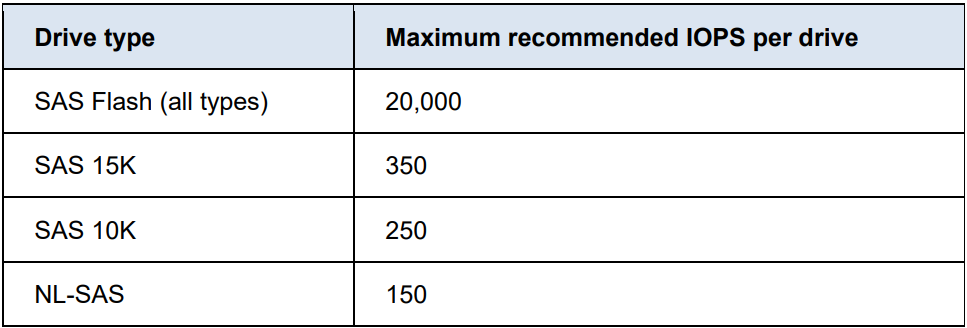
Figure 1. Maximum IOPS Recommendation Table
Additional Information
Affected Products
Dell EMC Unity, Dell EMC Unity XT 380, Dell EMC Unity XT 380F, Dell EMC Unity XT 480, Dell EMC Unity XT 480F, Dell EMC Unity XT 680, Dell EMC Unity XT 680F, Dell EMC Unity XT 880, Dell EMC Unity Family |Dell EMC Unity All Flash, Dell EMC Unity HybridProducts
Dell EMC Unity XT 880FArticle Properties
Article Number: 000022779
Article Type: How To
Last Modified: 04 سبتمبر 2026
Version: 7
Find answers to your questions from other Dell users
Support Services
Check if your device is covered by Support Services.