PowerStore: Single Node Serves I/O After Node Reboots Due to Missing MPIO Configuration on Host Side
Summary: All hosts were configured with two initiators with four iSCSI sessions (two to node B, two to node A). Before reboots, both nodes serve I/O as expected as shown in Performance Metrics. After both nodes were rebooted with no other changes, the Node B Performance Chart turns to zero bandwidth, and all I/O goes to Node A due to a missing Multipath I/O (MPIO) configuration on the Host side. ...
This article applies to
This article does not apply to
This article is not tied to any specific product.
Not all product versions are identified in this article.
Symptoms
Before node reboot, both nodes serve I/O.
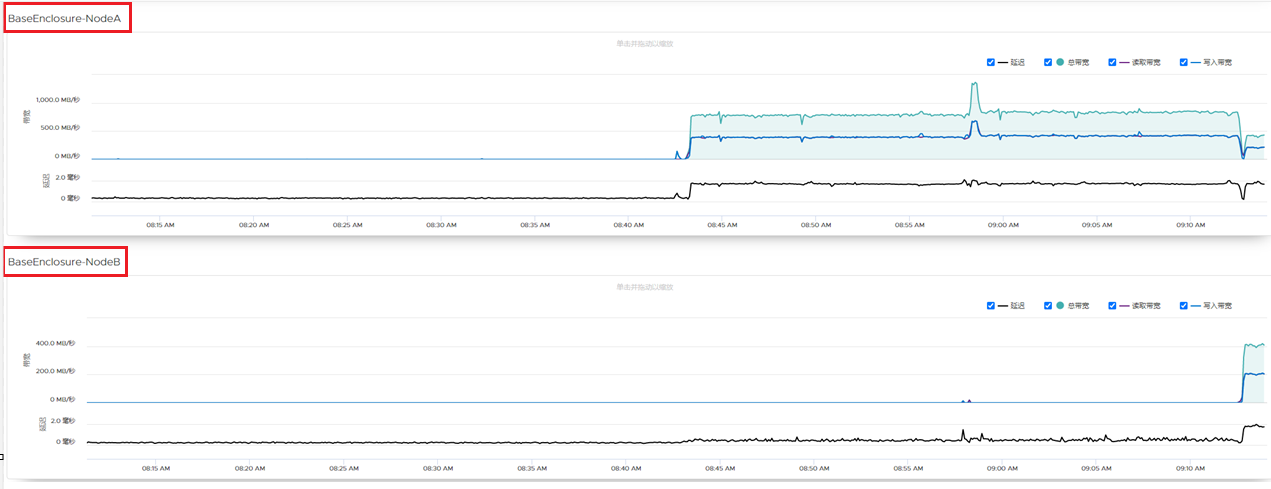
After node reboots, I/O was sent to Node A only. There is no I/O on node B iSCSI FE ports.
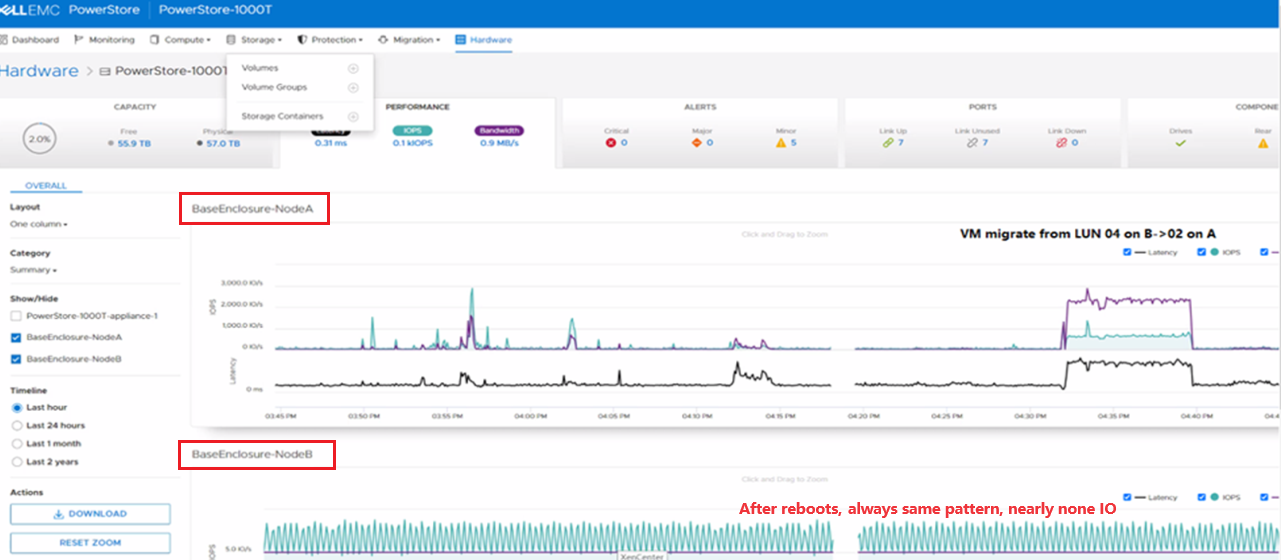
After node reboots, I/O was sent to Node A only. There is no I/O on node B iSCSI FE ports.
Cause
The user's multipath configuration for the LINUX host does not contain PowerStore information:
In the Dell Host Connectivity Guide for Linux document, it states to modify /etc/multipath.conf file as follows:
defaults {
                user_friendly_names     no
                find_multipaths                yes
                failback                 10
                no_path_retry                  10
}
blacklist {
                devnode              "^nvme.*"
                devnode "scini*"
                devnode "^rbd[0-9]*"
                devnode "^nbd[0-9]*"
}
# Leave this section in place even if empty
blacklist_exceptions {
}
devices {
                device {
                                vendor                                 "DataCore"
                                product                                "SAN*"
                                path_checker                    "tur"
                                path_grouping_policy    failover
                                failback                 30
                }
                device {
                                vendor                                 "DELL"
                                product                                "MD36xx(i|f)"
                                features                               "2 pg_init_retries 50"
                                hardware_handler          "1 rdac"
                                path_selector                    "round-robin 0"
                                path_grouping_policy    group_by_prio
                                failback                 immediate
                                rr_min_io                            100
                                path_checker                    rdac
                                prio                                        rdac
                                no_path_retry                  30
                }
                device {
                                vendor                                 "DGC"
                                product                                ".*"
                                detect_prio                        yes
                                retain_attached_hw_handler yes
                }
                device {
                                vendor                                 "EMC"
                                product                                "Invista"
                                detect_prio                        yes
                                retain_attached_hw_handler yes
                                path_grouping_policy    group_by_prio
                }
…
PowerStore was not added to /etc/multipath.conf. The configuration in /etc/multipath.conf for the Linux host should be:
defaults {
  user_friendly_names yes
  disable_changed_wwids yes
}
devices {
  device {
    vendor DellEMC
    product PowerStore
    path_selector "queue-length 0"
    path_grouping_policy group_by_prio
    path_checker tur
   detect_prio yes
   failback immediate
   no_path_retry 3
   rr_min_io_rq 1
   fast_io_fail_tmo 15
   }
In the Dell Host Connectivity Guide for Linux document, it states to modify /etc/multipath.conf file as follows:
* vendor - "DellEMC"
* product - "PowerStore"
* path_selector - "queue-length 0"
* path_grouping_policy -
* "group_by_prio"
* path_checker - "tur"
* detect_prio - "yes"
* failback - "immediate"
* no_path_retry - "3"
* rr_min_io_rq - "1"
* fast_io_fail_tmo - "15"
* max_sectors_kb - "1024"
As the PowerStore LUN was not added to Linux /etc/multipath.conf, multipath did not manage PowerStore logical unit number (LUN). During reboot events, Node A boots up one minute before Node B, then host ONLY sent I/O to node A ISCSI target ports. This is working as designed.Resolution
Advise user to modify LINUX multipath configuration. I/O is balanced between the two nodes after adding the PowerStore to the
See Dell Host Connectivity Guide for Linux on Dell Support.
/etc/multipath.conf, Node B Performance Metrics in UI recovered.
See Dell Host Connectivity Guide for Linux on Dell Support.
Affected Products
PowerStore, PowerStore 1200T, PowerStore 3000T, PowerStore 3200T, PowerStore 5000T, PowerStore 500T, PowerStore 5200T, PowerStore 7000T, PowerStore 9000T, PowerStore 9200TArticle Properties
Article Number: 000220440
Article Type: Solution
Last Modified: 19 May 2026
Version: 3
Find answers to your questions from other Dell users
Support Services
Check if your device is covered by Support Services.