Dell Pro Max
Teaching a Robot to Dance
Mitch Chaiet had never touched a robot. Eight months later, his Unitree G1 was dancing for a well-known rapper. He's sharing the open-source pipeline behind it.
Key takeaways 4 min read
Mitch Chaiet started robotics in September 2025 with zero experience. Eight months later he built G1 Moves, an open-source pipeline that turns a smartphone video of a dancer into a humanoid robot performing the same moves.
-
- A four-stage open-source pipeline, G1 Moves on Hugging Face, turns a smartphone video of a dancer into a Unitree G1 humanoid performing the same moves.
- The heavy lifting runs overnight on a Dell Pro Max with GB10, training up to 200,000 simulated robots locally instead of renting cloud compute.
- Mitch Chaiet’s Austin studio, Experiential Technologies, is exploring what’s possible at the intersection of entertainment and robotics.
- Eight months after touching his first robot, Chaiet demoed the G1 for Dell Technologies World and delivered a custom dance for a well-known rapper.
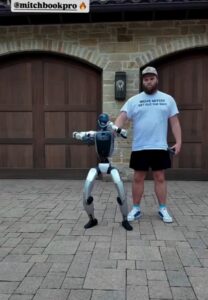
A well-known rapper and actor’s team texted Mitch Chaiet a dance video. “If you can get your robot to do this dance, we’ll post it,” they said. He was in Las Vegas for Dell Technologies World, but his Dell Pro Precision hardware was running back home in Austin. He texted the video to his AI agent remotely overnight and had a new dance the next day.
 From zero to Hugging Face
Chaiet works at the intersection of entertainment, prototyping and developing robotics projects through his Austin studio, Experiential Technologies. Eight months earlier, Chaiet had never worked with a humanoid robot. He started learning robotics in September 2025 as a Dell Pro Precision Ambassador with zero prior experience in the field. “There initially seemed to be no beginner projects for AI and robotics that didn’t involve automation,” he said. He wanted to get ahead of the curve by carving out a niche where robots met entertainment, starting with a project grounded in the arts. With two robots and a small robot lab in the garage of Austin entrepreneur Bill Perkins, he got to work. He built G1 Moves, an open-source dataset of dance and karate moves designed to teach beginners how to capture human motion in real life and play it back on the Unitree G1 humanoid robot. The open-source pipeline can turn a smartphone video of a person dancing into a humanoid robot performing the same moves.
Capture and retarget
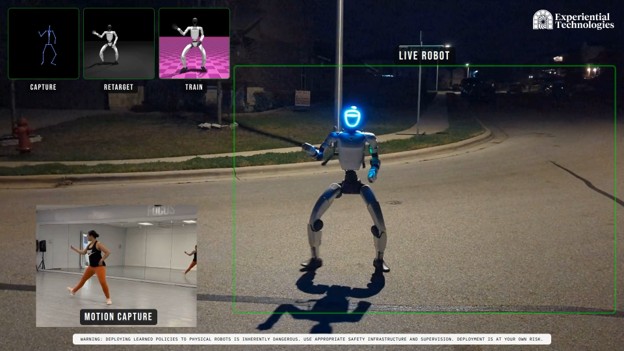
The first stage is IRL capture — all you need is a smartphone and a dancer, no motion capture suit required. “Think of a TikTok dance setup,” Chaiet said. An upgraded motion capture option uses a markerless motion capture camera from MOVIN3D, which Chaiet had access to, though he stresses it’s optional. “It was fun, challenging the technology with movements from commercial, world, technical and social styles of dance. The experience reminded me just how nuanced human movement is, and it made me excited about a future where human creativity stays at the forefront of innovation,” said Jasmine Coro, an Austin-based creative who performed the dances for G1 Moves.
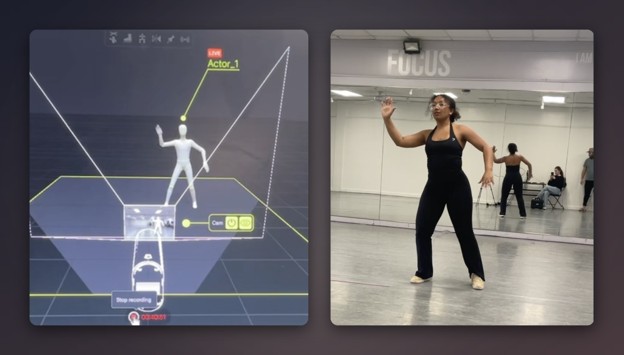
Once the motion is recorded on video, a tool called Video2Robot translates the human movement into robot joint data. This second step, known as retargeting, is familiar to anyone who understands film or game animation. For example, a director creating a computer-generated animation sequence might retarget a human performance onto a digital character, like Shrek or Lara Croft. But animations don’t need to obey gravity. A game engine doesn’t care if Shrek falls over, whereas robots are subject to the laws of physics. The retargeted data captures the motion but carries no physics, so the robot doesn’t know how to keep its balance while performing these moves.
Where the workstation earns its place
The third stage is where the need for massive local compute load lands. Using a simulation package called mjlab, Chaiet spins up upwards of 100,000 —200,000 virtual robots in a physically accurate environment. Each one attempts the dance move. Most fall over. “It’s the robot equivalent of when you’ve had a little too much and you fall over,” Chaiet said. “You get back up and dance until you nail it.” The simulation parallelizes the attempted robot dance moves onto the GPU, crunching what amounts to simulating “years” of practice. The virtual robots keep trying the dance until 99.9% of them can complete the move without toppling. The output is what roboticists call a policy. “A policy is the MP3 you load on your iPod, essentially,” Chaiet explained. “It’s the file that you put onto the robot to make it do a dance. It contains the dance data along with everything the robot learned about staying upright.” 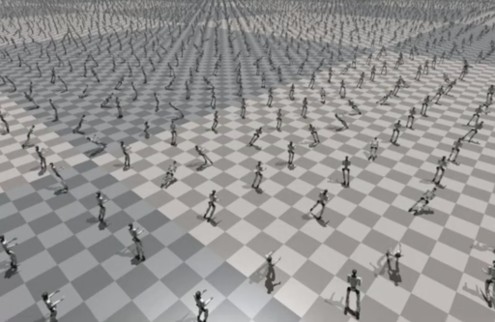 The training stage is where the Dell Pro Max with GB10 carries the show. The GB10’s unified VRAM utilizes NVIDIA’s accelerated computing to run thousands of simultaneous physics simulations overnight while Chaiet sleeps. By morning, the trained policy is ready to load onto the robot. Without a local GPU of the GB10’s scale, the simulation stage requires renting compute in the cloud. For developers building local robotics workflows, Chaiet also points to NVIDIA IsaacSim, an industry-standard tool for physics simulation, which is supercharged by the Dell Pro Max with GB10.
Getting physical
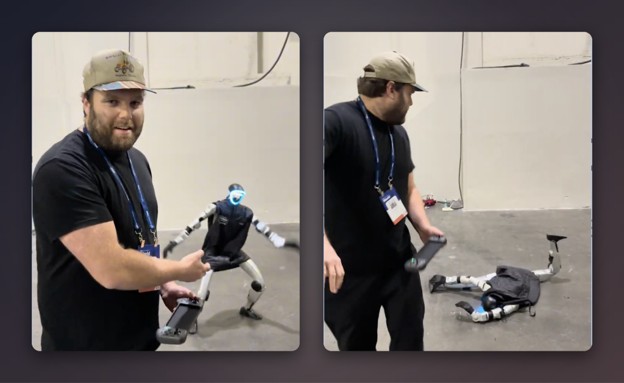
The fourth stage is deployment, where the trained policy meets the physical world for the first time. Chaiet uses a framework called RoboJudo to load the policy onto the G1. This is where things get humbling. “Even a slightly slanted driveway causes the robot to fall over,” Chaiet said. You can add terrain roughness, wind and surface variation in simulation, but the real world always has something the model didn’t anticipate. Custom policies can be dangerous to run. Polished humanoid robotics videos may suggest that humanoid balance is a solved problem; however, Chaiet pointed out that the most important use case for humanoid robots in 2026 is falling over on video for viral social media shorts.
From the garage to Dell Technologies World
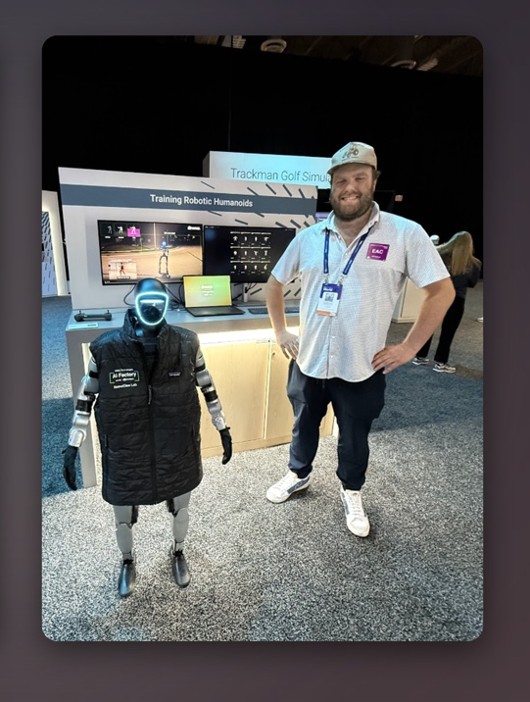 In eight months, Chaiet went from never having touched a robot to demoing the G1 for Dell Technologies World and pulling off a viral dance move overnight. It’s a testament to the untapped potential available to curious and enterprising members of the public. A handful of tools made it possible: a smartphone, Video2Robot, MJLab, RoboJudo and a Dell Pro Max with GB10 running the simulation locally. These tools are available through G1 Moves on Hugging Face, where the pipeline is documented and the dataset is hosted. Chaiet is the first to say the technology is early; however a creator working alone, with a workstation and a humanoid robot, can now do work that once required a research lab. The robots will still fall over.
