PowerStore
The Storage Efficiency Question: Why Purpose-Built Still Matters
Efficiency isn't just a ratio—it's an architecture. Here's why purpose-built beats HCI.
Key takeaways 5 min read
-
- Efficiency is architectural. HCI consumes CPU, memory, power and licensing resources to run storage services, while a disaggregated approach eliminates that architectural tax — delivering up to 65% lower costs than comparable HCI architectures.
- PowerStore’s purpose-built architecture features an optimized data path and Intel® QuickAssist Technology, enabling highly efficient data reduction without competing for application compute resources.
- In Dell internal testing, PowerStore delivered up to 98% better data reduction for compression-only workloads and up to 252% better data reduction for workloads benefiting from both compression and deduplication than a leading HCI solution.
- PowerStore backs its efficiency claims with an industry-leading 6:1 data reduction guarantee — no assessments, no signatures and no additional cost.
The biggest efficiency gains in infrastructure don’t come from data reduction ratios — they come from architectural choices.
HCI vendors promote aggressive deduplication and compression claims as proof of efficiency. But there’s a question customers should ask before being impressed by any data reduction claim:
What does the infrastructure have to consume to achieve it?
That’s where architecture matters. As organizations modernize their private clouds, many are re-evaluating tightly coupled infrastructure models and turning to disaggregated architectures instead. By separating compute and storage, each resource can scale independently and operate more efficiently. The result isn’t just better storage economics — it’s a fundamentally different approach to infrastructure efficiency.
The hidden cost of HCI
Data reduction ratios matter. But they’re only one side of the equation.
HCI architectures run storage services — including deduplication, compression, resiliency, data placement and I/O processing — on the same servers that run applications. That creates an architectural tax: CPU cycles, memory capacity, power and licensing that could support workloads are instead consumed operating the storage layer. As storage requirements grow, that tax grows as well.
HCI vendors attempt to address the issue with storage-only nodes, but the underlying design remains unchanged. Storage services still run on general-purpose server processors, and customers still purchase, power, cool and license additional infrastructure to support them. The architectural tax remains.
Dell’s disaggregated approach removes that tradeoff. Storage services run on purpose-built platforms like PowerStore, separate from application servers. Compute resources run applications. Storage systems deliver storage services. Each layer scales independently and efficiently.
The proof is in the testing
Architectural advantages only matter if they translate into measurable results. Dell testing shows they do.
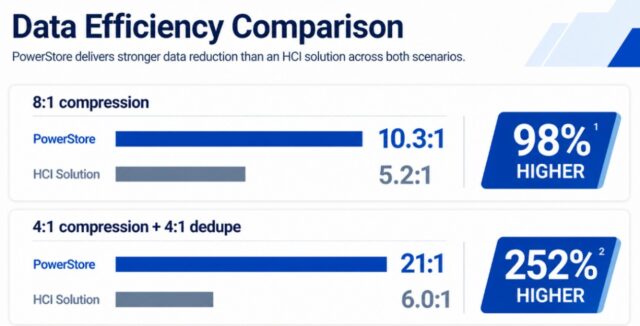
These results highlight a larger point: architectural efficiency produces storage efficiency.
PowerStore delivered nearly double the reduction of the HCI solution on a compression-focused workload. Unlike HCI platforms, PowerStore uses Intel QuickAssist Technology to offload compression processing to dedicated hardware instead of consuming application CPU resources.
The advantage becomes even more pronounced when workloads benefit from both compression and deduplication. In Dell testing, PowerStore delivered more than three times the data reduction of the HCI solution.
That’s particularly relevant for environments rich in duplicate data, including VDI, virtual machine farms, development environments, database copies and container repositories. These workloads continue to drive significant capacity growth across modern private cloud deployments — and they’re exactly where architectural efficiency compounds over time.
Efficiency you can bank on
Storage efficiency only creates value when it’s predictable.
PowerStore backs its claims with an industry-leading 6:1 data reduction guarantee — no assessments, no signatures and no additional cost. Organizations gain a predictable foundation for infrastructure planning instead of relying on estimates that may vary after deployment.
HCI vendors offer no equivalent backstop. When efficiency falls short, the burden falls on the customer through additional drives, nodes, licensing, power consumption and operational expense.
The economics of disaggregated infrastructure
In HCI environments, increasing storage capacity frequently requires adding more infrastructure than the business actually needs. Additional storage often brings additional CPU, memory, licensing, power consumption and rack space along with it.
In today’s supply-constrained environment, that architectural tax has real financial consequences. Every CPU core dedicated to storage services is a core that can’t run applications. Every gigabyte of memory consumed by the storage layer is memory that must be purchased but may provide no incremental business value. And every node added for capacity introduces components that may have nothing to do with the actual requirement.
Disaggregated infrastructure breaks that dependency. Organizations can add storage without buying unnecessary compute. Compute and storage can be refreshed independently. Resources are consumed where they create value, not where architecture requires them to exist.
That’s why Dell Private Cloud is built on a disaggregated foundation, enabling compute and storage to scale independently instead of forcing customers to buy resources they don’t need.
The impact is measurable: Dell Private Cloud with PowerStore delivers up to 65% lower costs than comparable HCI architectures,¹ proving that eliminating the architectural tax changes the economics.
Don’t assume your current architecture is as efficient as it appears.
Data reduction ratios are important, and PowerStore demonstrates a clear advantage in both testing and guaranteed outcomes. But the bigger question is how that efficiency is achieved — and what it costs to deliver it.
That’s why the most important efficiency decision isn’t the reduction number on a datasheet. It’s the architecture behind it.
Dell Technologies can help you quantify the cost of tightly coupled infrastructure, identify opportunities to reduce infrastructure spend and evaluate whether a disaggregated approach could deliver better long-term economics. Contact your Dell representative or trusted partner to learn how Dell Private Cloud with PowerStore can help reduce costs, improve efficiency and eliminate the architectural tax.
1Based on internal Dell testing comparing the three-year cost of a five-node HCI cluster to Dell Private Cloud with BYOS. Actual results may vary.