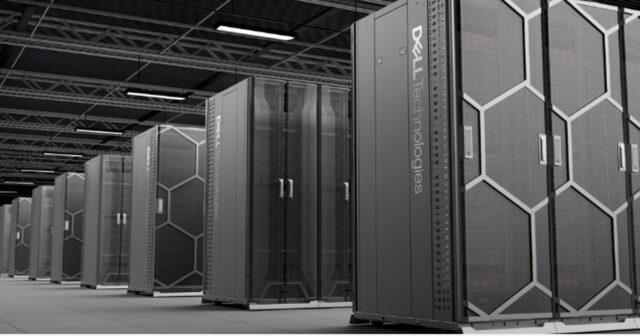
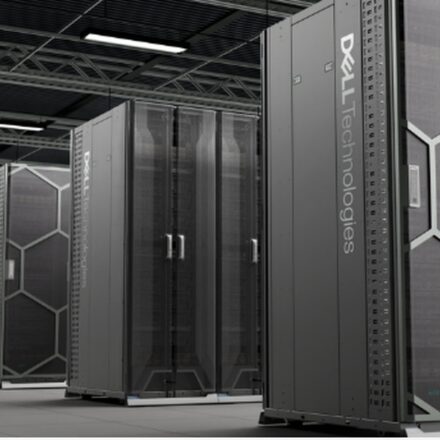
PowerRack
Dell PowerRack Transforms AI Infrastructure with Scalable Compute, Networking and Storage
Dell PowerRack transforms AI infrastructure deployment with integrated rack-scale solutions designed for speed and efficiency.
Key takeaways:
- AI advantage for CSPs and neo-cloud operators will be won at the rack level, where end-to-end infrastructure decisions beyond GPUs now determine cost, speed, and capacity over the next three years.
- Dell PowerRack delivers integrated rack-scale AI infrastructure that addresses performance, deployment speed and operational complexity challenges facing cloud service providers and AI neo-cloud operators.
- The solution combines optimized compute, networking and storage with comprehensive managed services that accelerate deployment by 84% compared to self-assembly approaches.
- PowerCool CDU C7000 provides 220kW cooling capacity in 4U form factor with higher temperature tolerance, addressing critical power and thermal management challenges at scale.
- Learn how Dell AI Factory with NVIDIA delivers a comprehensive and secure AI solution customizable for any business.
For cloud service providers (CSPs) and AI neo-cloud operators, competitive advantage in AI is being built and lost at the rack level. The bottleneck is no longer just GPUs: it is everything around them. The decisions being made right now will determine who delivers on cost, speed and capacity for the next three years.
IDC reported that global AI infrastructure spending grew 166% year-over-year in a single quarter of 2025, reaching $82 billion in three months.1 The market is not debating whether to build. It is racing to figure out how to build fast enough, and efficiently enough.
Sourcing compute, networking, storage and cooling independently and integrating them on-site introduces real performance, power and schedule risk at scale—risk that shows up as cost and delay. That approach is expensive. Most operators who have tried implementation at rack-scale have the retrofit scars to prove it.
Dell leads rack-scale infrastructure innovation
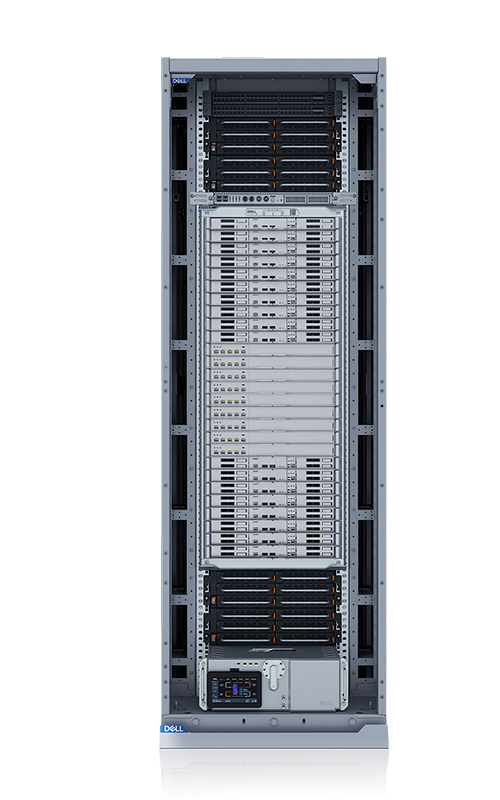
Dell is the number one provider of rack-scale infrastructure, shipping more than twice the volume of the closest competitor in 2025.2 This leadership is built on engineering the rack as a unified product rather than a collection of components. Dell integrates compute, networking, storage, power and cooling so they operate as a single system, all managed by Dell Integrated Rack Controller with OpenManage Enterprise (OME).
OME enables the entire rack to behave as a single, predictable system, with remote orchestration and unified visibility across every rack component. Each rack-scale system is fully validated through extensive end-to-end testing before it leaves the factory and arrives ready to run workloads in just over six hours.3 This reduces deployment risk and accelerates time-to-revenue for the world’s most demanding AI operators.
PowerRack Addresses Core AI Deployment Challenges
Dell announces PowerRack at Dell Technologies World 2026, now offering a complete, integrated rack-scale portfolio spanning compute, networking, and Exascale Storage. PowerRack addresses the fundamental infrastructure challenges facing large-scale AI deployments: performance at scale, rapid time-to-value, and operational simplicity.
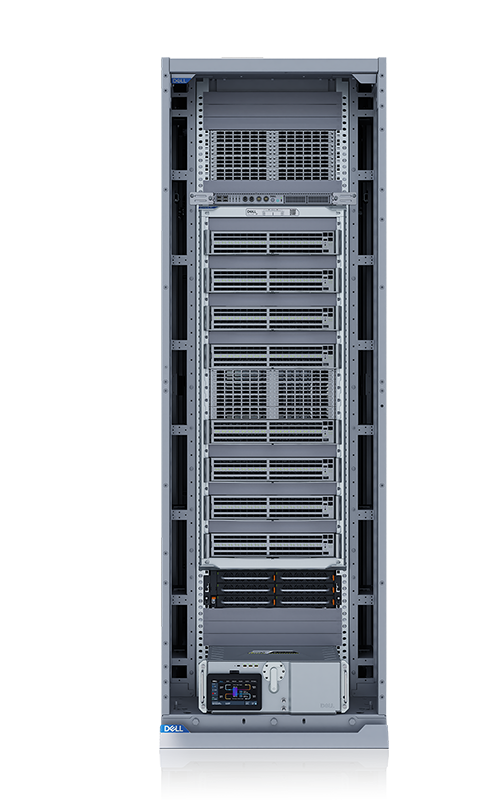
Dell PowerRack for compute delivers industry-leading GPU density and throughput across multiple GPU generations offered with direct liquid cooling designed to handle the extreme power demands of today’s and tomorrow’s accelerators. Pre-validated at the factory and managed through the Dell Integrated Rack Controller, it is built to scale with evolving GPU roadmaps without requiring infrastructure redesign—eliminating on-site integration risk and accelerating the time from delivery to live AI workloads.
Dell PowerRack for networking is designed for organizations that want to accelerate AI fabric rollouts with a turnkey, factory-integrated rack. It arrives pre-built and validated with all networking, power, cabling, and cooling engineered to work together, eliminating days or weeks of on-site assembly and wiring. Managed consistently alongside compute through the Dell Integrated Rack Controller, PowerRack for networking simplifies operations with a single-vendor experience that reduces integration complexity and keeps AI fabric performance predictable as you scale.
And PowerRack for Exascale Storage ensures data movement matches compute demand rather than creating bottlenecks, delivering predictable performance, independent scaling, and operational consistency. Built for 10+ PB environments, it is the only software‑defined, 4‑in‑1 architecture for extreme‑scale AI, HPC and demanding enterprise workloads4, offering up to 6 TB/s per rack performance.5
Comprehensive Managed Services Accelerate Deployment
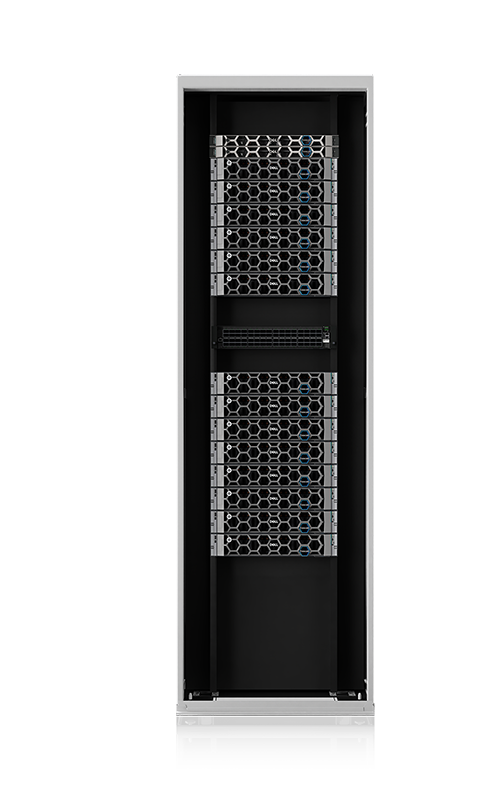
Dell provides customers with the option to choose structured end-to-end services that guide cloud service providers and large enterprises from initial workload sizing to live activation as a single managed program. With comprehensive capacity analysis up-front, infrastructure is matched to real demand before commitment. Validated reference architectures are optimized for GPU density, reducing design risk before a rack ships. Factory-level assembly and cluster-wide verification ensure the system is proven before it reaches the customer floor.
Dell AI deployment services deliver 84% faster time-to-value compared to self-assembly approaches.3 Production-ready racks can be set-up, connected, and running workloads in the customer’s data center in just over six hours.3 That’s extreme time-to-value for the most extreme densities in the industry. For operators where each day of delay represents lost revenue on committed capacity, accelerated time to value provides measurable financial impact.
Dell PowerCool Solves Critical Power Challenges
Power has evolved as a defining variable in every large-scale capacity planning conversation. Global data center electricity consumption is projected to exceed 1,000 TWh by 2026.6 Morgan Stanley forecasts a U.S. power access shortfall of approximately 49 GW by 2028.7 Wholesale electricity costs near major data center hubs have increased as much as 267% over five years.8
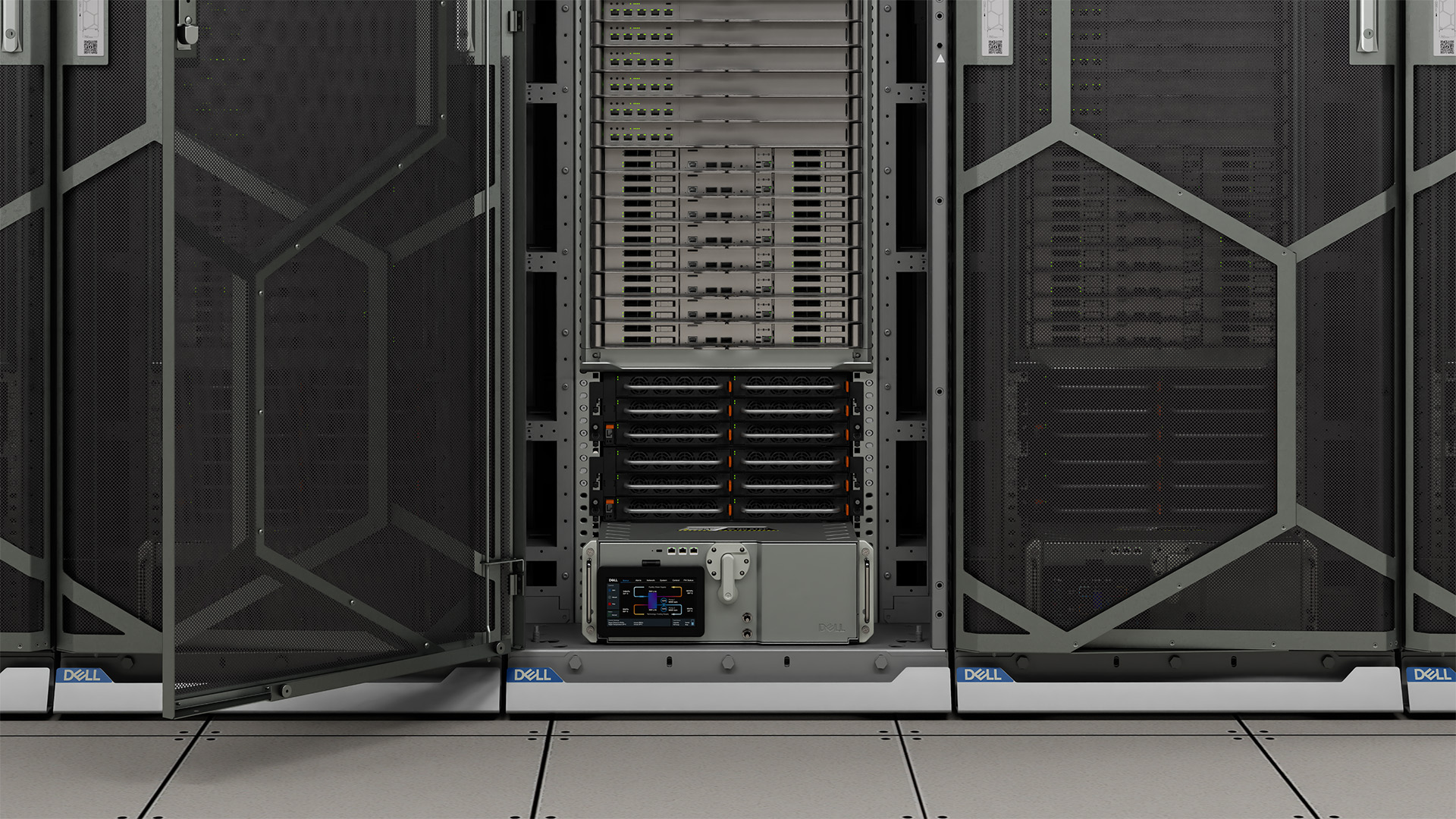
Hyperscalers and neo-cloud operators that treat power as a margin lever rather than a facilities cost are building infrastructure that will make economic sense in three years. The PowerCool CDU C7000 addresses this critical need as Dell’s compact rack-mount cooling units built for the energy-efficient NVIDIA® Vera Rubin NVL72 and beyond, including NVIDIA® Rubin HGX NVL8.
The PowerCool CDU C7000 cools more than 220 kW in a 4U form factor, supporting warmer facility water inlet temperatures up to 40 degrees Celsius.9 This lowers facility energy consumption by reducing the need for chillers and delivers cooling infrastructure that will not constrain rack performance.
Infrastructure as Strategic Product Decision
Leading operators share a common discipline: they’ve stopped treating racks as assembly projects and started approaching them as product decisions. Power efficiency, integration risk, and time-to-revenue aren’t separate workstreams. They represent the same strategic conversation. PowerRack and its delivery model address this integrated approach.
Learn more at www.Dell.com/PowerRack.
1 IDC Quarterly Server Tracker 2025
2 IDC Quarterly Server Tracker 2025 – Dell is the #1 rack‑scale infrastructure provider in CY2025, leading the industry in both units shipped and revenue share.
3 Based on a Principled Technologies study commissioned by Dell, Accelerate AI time to value with Dell Services, April 2026
4 Based on publicly available documentation from leading enterprise storage vendors as of March 2026. Comparison refers to distinct file, object and parallel‑file engines on one reusable hardware platform, excluding single‑engine multi‑protocol designs. Block availability in 1H CY2027
5 Based on internal analysis of sequential and random read I/O for Lightning File System, Feb. 2026. Actual results may vary.
6 ZestLab: AI Data Center Energy Consumption Projections 2026
7 Morgan Stanley: Energy Markets Race to Solve the AI Power Bottleneck (February 2026)
8 Medium / Rekhi: The AI Energy Crisis Is Already Here (February 2026)
9 Based on internal testing by Dell Technologies