

Artificial Intelligence
Powering Ground Truth for Agentic AI with the Dell Data Orchestration Engine
Data fuels AI. Explore how the Dell Data Orchestration Engine powers the Dell AI Data Platform to automate, govern, and scale AI.
Co-authored by Avi Yashar and Sivan Jacobs.
Key takeaways:
-
- Agentic AI is revolutionizing enterprise workflows by enabling systems to reason, retrieve, and act on data in real time.
- Traditional data platforms fall short; modern AI demands unified orchestration of datasets, pipelines, and governance.
- Dell’s Data Orchestration Engine integrates metadata, NVIDIA AI models and blueprints, and multimodal datasets for scalable, production-grade AI.
- Industries like finance, healthcare, and manufacturing are leveraging orchestration for intelligent, adaptive systems of action.
- Orchestration is the future of enterprise AI, enabling systems to learn, reason, and act on data seamlessly across environments.
Why AI data platforms must be rebuilt for a new era
Enterprise AI is entering a new phase. What began as experimentation with large language models and retrieval-augmented generation (RAG) is rapidly evolving into agentic systems capable of reasoning, retrieving, and acting across enterprise data.
These systems promise transformational outcomes, ranging from automated decision support to intelligent workflows that continuously adapt to new information. But they also expose a fundamental architectural gap that no amount of incremental upgrading can close.
Traditional data platforms were built for systems of insight: collecting data, analyzing it, and producing dashboards or predictions. Data was a product delivered downstream. Structured data dominated. Processing happened in batches. Intelligence flowed toward centralized teams, who translated data into insights for the rest of the organization.
That model worked extraordinarily well. For its time.
Agentic systems of action operate on entirely different assumptions. They reason over data continuously, autonomously trigger workflows, adapt behavior, and close the loop between data, decision, and execution in real time. The architecture required to support this isn’t an evolution of the old model. It’s a different foundation altogether.
The bolt‑on trap
In response to the AI boom, many vendors have attempted to retrofit existing platforms with AI services. Vector databases, inference endpoints, and microservices are layered onto storage or analytics platforms and collectively branded as an “AI Data Platform.”
This architecture can appear simple, but it carries a structural limitation that becomes visible at scale: it assumes data can be consolidated into a single platform to be useful. Enterprise data never works that way. It is distributed by nature, scattered across on-premises, cloud, edge, SaaS applications, and legacy repositories. No storage platform, however capacious, will ever gravitationally pull all of an organization’s data into one place. Vendors whose core competency is storage repeatedly stumble on this reality: they can optimize what lives within their walls, but AI workloads don’t respect those walls.
Metadata as control plane, datasets as logical entities
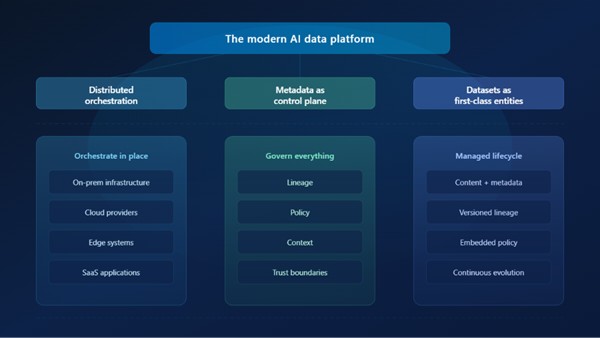
Systems of action require a platform where AI pipelines, datasets, and governance are first-class architectural components that can orchestrate across data wherever it lives.
This is where metadata shifts from a cataloging function to a control plane. In an orchestration-native architecture, metadata governs how agents access, interpret, and act on enterprise data while defining lineage, policy, context, and trust boundaries. Agents gain the context they need to reason reliably, improving governance, explainability, and auditability in production.
A parallel shift is redefining the core unit of data itself. Historically, platforms revolved around files, tables, and storage constructs, which were passive containers interpreted differently by every tool that touched them. This worked when humans mediated every interaction. It breaks down when autonomous agents need to understand not just what data contains, but where it came from, who governs it, and how it should be used.
In an orchestration-native platform, datasets emerge as the primary logical entity, combining multimodal content, metadata, lineage, policy, and contextual signals into governed structures that evolve as models are trained, feedback is incorporated, and new data arrives.
Redefining the AI data platform
Together, the shift towards distributed orchestration, metadata as a control plane and datasets as first-class entities redefines what an AI Data Platform must be. Not in degree, but in kind. Rather than storing data and attaching AI services on top, a modern platform must coordinate how datasets move across ingestion, transformation, model training, inference, and feedback loops. The defining question is no longer how efficiently the platform can store data; it’s how intelligently it can orchestrate what happens to that data across every stage of the AI lifecycle.
Enter the Dell data orchestration engine
The Dell Data Orchestration Engine was built to answer that question. Not by bolting orchestration onto an existing storage platform, but by making it the architectural foundation. The engine provides a coordination layer that manages datasets, pipelines, and AI services across the Dell AI Data Platform — connecting ingestion, dataset preparation, embedding workflows, retrieval systems, inference, and evaluation loops into a unified, governed system.
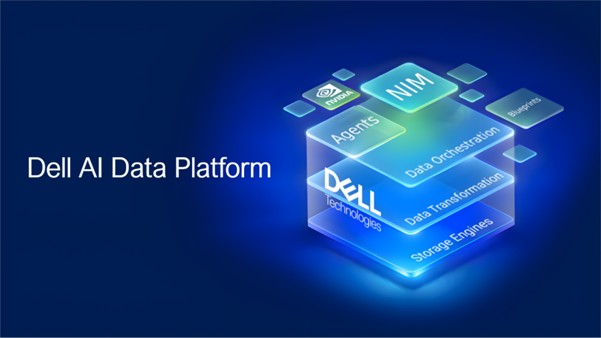
The engine builds on technology from Dataloop, founded by Avi Yashar and Nir Buschi, whose team spent years solving the hardest operational problems in enterprise AI: managing complex multimodal datasets, coordinating pipelines across heterogeneous environments, and enabling continuous iteration as models and data evolve together. By acquiring Dataloop, Dell combined deep data-centric AI expertise with best-of-breed data engines and the world’s leading storage engines to produce a modern AI Data Platform designed to operationalize AI at the scale, reliability, and governance that production demands.
Orchestration in practice
Architecture only matters if it changes what organizations can actually build and ship. The sections that follow trace that path: from the platform layer, through accelerated AI services, to the developer workflows and production systems that orchestration makes possible.
The platform layer
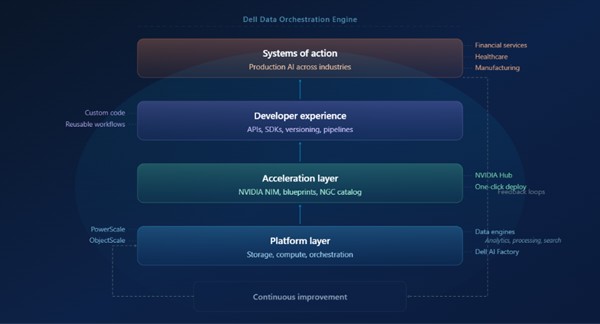
Inside the Dell AI Data Platform, the Data Orchestration Engine works alongside high-performance storage systems such as PowerScale and ObjectScale, as well as specialized data engines for analytics, search, and processing.
Rather than forcing data into a single repository, the engine coordinates pipelines close to where data resides — maintaining consistent governance, lineage, and policy enforcement across on-premises, cloud, and edge environments. Storage engines move and persist data at scale. The orchestration layer handles everything above: what happens to that data, in what order, governed by what policies, and feeding which AI systems.
Figure 1: Multimodal RAG preprocessing pipeline for financial data in the Dell Data Orchestration Engine. This pipeline prepares financial documents for retrieval by extracting, structuring, and enriching datasets with metadata — enabling downstream AI systems to consume data through continuous, governed workflows.
Figure 2: Dataset management browser within the Dell Data Orchestration Engine. This interface shows how multimodal datasets – including images, video, audio, JSON and documents – are organized, searchable, and governed with metadata, enabling AI pipelines to reliably retrieve and process diverse data types.
The acceleration layer
Production AI requires tight integration with accelerated computing. The Data Orchestration Engine includes a dedicated NVIDIA Hub, providing native access to NVIDIA NIM microservices, Blueprints, and the relevant components of the NGC catalog directly within the engine. As new models are released, they become available through automated catalog integration — no manual downloads, no environment configuration, and no fragile glue code.
Developers can deploy NIM services directly into pipelines with a few clicks — collapsing the distance between discovering a useful model and running it in a governed production pipeline.
Figure 3: NVIDIA Hub inside the Data Orchestration Engine. This interface shows the built-in hub for NVIDIA NIM microservices and AI Blueprints enabling a simple, one-click deploy experience and integration directly inside a data pipeline with no additional steps.
The developer experience
Developers and AI Engineers are central to enterprise AI, and the hardest part of their job is managing the data workflows around them: versioning datasets, coordinating pipeline dependencies, and ensuring governance without slowing iteration.
The Data Orchestration Engine is designed around this reality. It exposes flexible APIs, rich Python and JavaScript SDKs, and bring-your-own-code capabilities so teams can integrate custom logic into managed pipelines. More importantly, it removes undifferentiated work, such as dataset versioning, pipeline coordination and metadata propagation that otherwise forces developers to build and maintain bespoke infrastructure for every new AI project.
Figure 4: Bring-your-own-code in data pipelines: This interface shows a node in a pipeline capable of running and scaling any custom code using the rich Python SDK. Custom code unlocks capabilities for developers to use a pipeline in their own way, connect to data sources, parse complex data types, apply custom logic and enable code reuse.
Systems of action across industries
The shift from insight to action is already taking shape across industries, following recognizable patterns.
In financial services, teams are building document intelligence workflows that chain ingestion, embedding, retrieval, and reasoning into continuous pipelines — transforming static document repositories into systems that analysts and agents can query in real time. In healthcare and life sciences, similar patterns are emerging around multimodal research datasets, where intelligent assistants retrieve insights across scientific literature, clinical records, and experimental data while maintaining strict governance over sensitive information.
In automotive and manufacturing, the orchestration challenge centers on operational data: sensor streams, inspection records, and machine learning models that must work together to detect anomalies, automate quality workflows, and improve predictive maintenance as new data arrives continuously.
These use cases share a common architectural requirement: the ability to manage data, models, and feedback loops as a unified system, not as isolated experiments stitched together with custom code.
Looking ahead
As agentic AI continues to mature, the platforms that succeed will be those that treat orchestration as a core architectural layer, not an afterthought. The Dell Data Orchestration Engine represents this shift by deeply integrating pipeline coordination, governance, and lifecycle management of datasets into the foundation of the Dell AI Data Platform.
Work is already underway to deepen the Data Orchestration Engine’s integration with Dell AI Factory, Dell Storage, and Dell Data Engines so that organizations can manage the full AI lifecycle across Dell’s portfolio without the seams.
The era of bolting AI onto yesterday’s platforms is ending. What replaces it will be defined by those who recognized earliest that the real challenge was never storing data. It was orchestrating it.
Explore the Dell AI Data Platform today and see how it can transform your AI initiatives. Dell AI Data Platform | Dell USA
Read about using Active Learning with Data Orchestration Engine: https://infohub.delltechnologies.com/en-us/t/active-learning-pipeline-with-dell-data-orchestration-engine/
