
Launch
PowerScale OneFS 9.15 strengthens Dell AI Data Platform foundations
Feed AI pipelines faster, move data across clouds securely and simplify operations with a stronger data foundation.
Key takeaways 5 min read
-
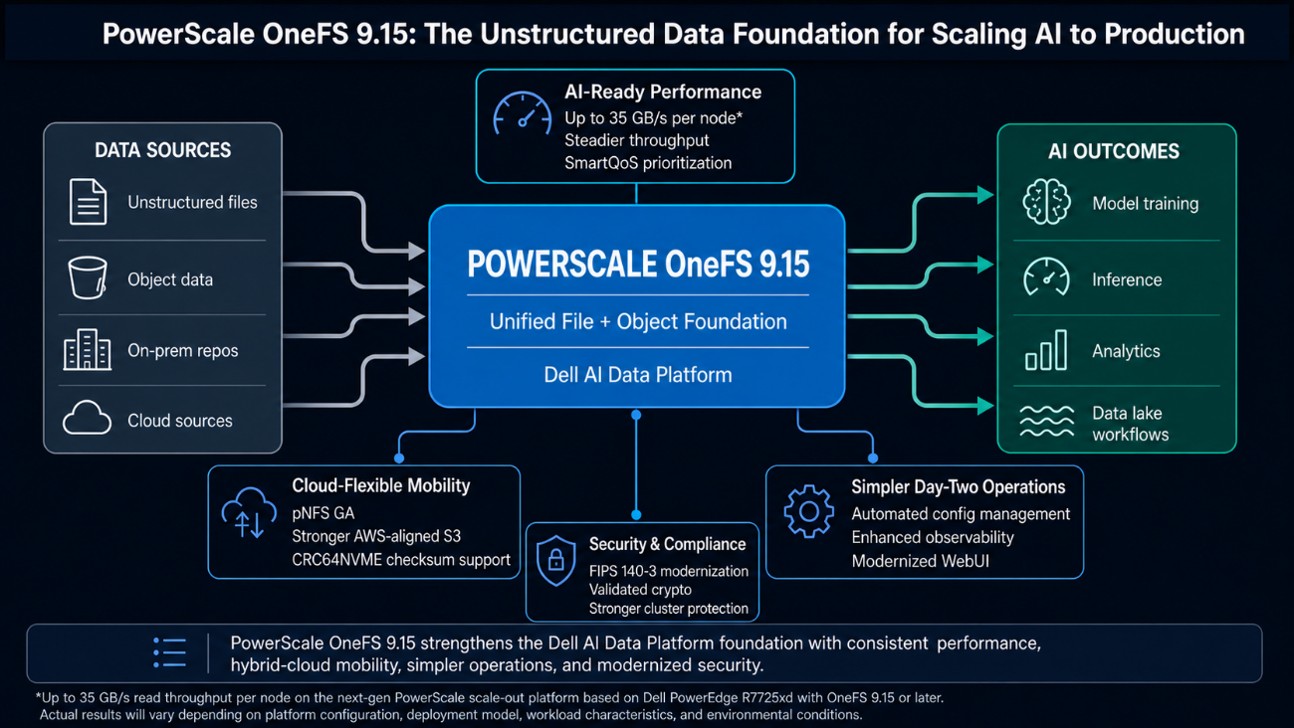
- OneFS 9.15 strengthens the data layer for enterprise AI with steadier performance, expanded QoS and up to 35 GB/s read throughput per node.¹
- It modernizes hybrid-cloud and file/object workflows with pNFS general availability, stronger AWS‑aligned S3 and easier disaster recovery.
- Day-two operations get simpler with automation, richer observability and a more resilient, security‑ready platform foundation.
- It strengthens security and compliance readiness with FIPS 140-3 modernization, stronger cluster protection and improved support for regulated environments.
Enterprise AI runs on data. As models scale and pipelines grow, organizations need unstructured data infrastructure that delivers consistent throughput, works across hybrid cloud, simplifies operations and meets rising security expectations. With OneFS 9.15, Dell PowerScale advances on all four fronts.
In Dell AI Data Platform, PowerScale provides the unified file and object foundation that helps move AI from pilot to production. This release focuses on AI‑ready performance, cloud‑flexible mobility, simpler day‑two operations and stronger security so teams can move from pilot to production with confidence.
AI‑ready performance that scales
For AI and analytics, the question is not peak speed. It is consistent performance as client counts rise and workloads mix. OneFS 9.15 introduces platform enhancements, always‑on performance analysis, file‑level visibility and large‑file optimizations. On supported configurations, customers can achieve up to 35 GB/s read throughput per node.
Expanded SmartQoS controls add finer prioritization by read, write and operation class. Bandwidth limits and enhanced latency visibility help critical jobs stay on track when AI, analytics and enterprise workloads share the same cluster.
OneFS 9.15 also aligns with next‑gen networking through CX8 200G qualification and Enterprise SONiC Distribution by Dell Technologies enablement on S5224 switches, helping prepare storage for higher‑bandwidth AI clusters.
Cloud‑flexible data mobility
Hybrid‑cloud workflows get easier with stronger S3 compatibility, including support for CRC64NVME, the default checksum algorithm used by AWS. Broader checksum validation and S3 log dump capabilities reduce friction when moving data across on‑prem and cloud.
With pNFS now generally available in OneFS 9.15, customers can scale file workflows more efficiently through parallel I/O and native protocol support. The result is fewer bottlenecks for AI, analytics and modern data lake workloads, without added client-side complexity or specialized drivers.
OneFS 9.15 also smooths the path from legacy replication to next‑generation disaster recovery. Automated SyncIQ‑to‑SmartSync policy migration, SmartSync usability improvements and cross‑domain failover and failback capabilities help preserve existing investments while modernizing mobility and resilience.
Simpler day‑two operations
Just as important as performance, OneFS 9.15 makes the platform easier to run day to day. Automated configuration management reduces drift and lowers dependence on root‑level changes for routine tasks. CELOG event aggregation, enhanced protocol diagnostics, improved alerting and broader observability help teams troubleshoot faster with clearer signals.
Lifecycle improvements increase non‑disruptive upgrade resiliency, improve failure visibility for background jobs and streamline management at scale. An enhanced WebUI dashboard and modernized user experience bring at‑a‑glance views of cluster status, hardware health, performance and jobs. SmartSync WebUI and CLI improvements make routine tasks easier to execute with consistency.
Dynamic licensing for the next‑gen PowerScale platform based on the Dell PowerEdge R7725xd and mixed node pools gives customers more flexibility to align performance and capacity growth with business needs over time.
Security and compliance, modernized
OpenSSL modernization helps align PowerScale with FIPS 140‑3 readiness and next‑gen cryptographic requirements. Cluster join rule enforcement updates, validated cryptographic entropy sources and more flexible SED/FIPS migration paths give organizations a practical way to strengthen protection without disruptive change. Remote Secure Credential access further supports auditable, secure operations for regulated environments.
What it means for customers
What matters most is how these updates come together. Teams scaling AI pipelines get steadier throughput and finer workload control, with up to 35 GB/s read throughput per node and expanded SmartQoS prioritization. Teams modernizing hybrid-cloud workflows get stronger S3 compatibility and pNFS general availability without specialized access architecture. Operations teams get fewer manual interventions through automated configuration management, richer observability and a more intuitive management experience. And teams in regulated environments get a more practical path to FIPS 140-3 readiness without forcing disruptive platform changes.
The common thread is fewer tradeoffs — performance without complexity, cloud flexibility without fragmentation, security without disruption. That is what a stronger unstructured data foundation looks like inside Dell AI Data Platform.
Explore what’s new in OneFS 9.15, review the technical overview, or talk with your Dell team about how these capabilities map to your environment.
Frequently Asked Questions
Q. What is PowerScale OneFS 9.15?
A. A major OneFS release that advances PowerScale for enterprise AI, hybrid‑cloud data mobility, simpler operations and stronger security.
Q. How does it help AI workloads?
A. It delivers more predictable performance as environments grow, supports high‑throughput file workflows and strengthens the unstructured data layer for training, inference and analytics.
Q. Why does pNFS matter?
A. pNFS enables parallel file access using native methods, which reduces bottlenecks and improves aggregate throughput without specialized client software.
Q. What hybrid‑cloud and DR updates stand out?
A. Stronger AWS‑aligned S3 with CRC64NVME support, broader checksum validation, automated SyncIQ‑to‑SmartSync policy migration and cross‑domain failover and failback.
Q. How does it simplify operations and strengthen trust?
A. Automation, richer observability, improved diagnostics and enhanced alerting reduce day‑two friction. FIPS‑aligned crypto updates and stronger controls reinforce security and compliance readiness.
Q. What about operational resiliency?
A. Improved non‑disruptive upgrade resiliency, better failure visibility for background jobs and stability gains for large, highly concurrent clusters.
1Up to 35 GB/s read throughput per node on the next-gen PowerScale scale-out platform based on Dell PowerEdge R7725xd with OneFS 9.15 or later. Actual results will vary depending on platform configuration, deployment model, workload characteristics, and environmental conditions.
