

AI Solutions
When the AI Factory Is a Franken-Stack
The important question is whether your AI solution is truly one platform or just another fragmented stack packaged to look like one.
Key takeaways 6 min read
Supermicro and VAST may market an AI factory, but customers still absorb the day-two cost in support coordination, data movement and operational complexity, while Dell reduces those handoffs with a more integrated model.
In my original “Franken-Stack” blog, I described what happens when vendors market “end-to-end” AI but still leave you stitching together components, control planes and support models on your own. For you as an ITDM, the real standard for any AI platform you choose should not be how complete it looks in a PowerPoint slide or a nice demo, but how much complexity it removes in production.
Forbes makes the same point: “for C-suite leaders, the message is clear: fragmented technology stacks are a competitive liability. Businesses need a new approach — one built on a unified platform designed to integrate AI, automation and data seamlessly.”¹
1. A unified launch story is not a unified operating model
That is the right lens for reading Supermicro and VAST’s February 2026 CNode-X announcement, which they positioned as “a highly integrated, rapidly deployable AI Data Platform.”²
It is important to dig a bit deeper. When your team is accountable for real production outcomes, the important question is whether this is truly one platform or just another fragmented stack packaged to look like one cohesive solution.
The AI Journal notes: The danger of the AI Frankenstack isn’t just inefficiency. It’s a loss of control. When systems are stitched together instead of architected as one, visibility drops, costs fragment and risk builds quietly.³
The issue is not whether the stack can be assembled. The issue is who absorbs the complexity once it is running in production.
2. When accountability crosses vendors, you pay the escalation tax
VAST is trying to move beyond storage into a broader AI OS narrative, and in market, that story increasingly shows up as part of a Supermicro + VAST AI factory. The pitch is a unifying storage software layer with your GPU server vendor of choice. The reality is a multi-vendor operating model. When something breaks, the integration overhead, ticket routing and fault isolation fall entirely on your team. That is the escalation tax.
The questions every buyer should take into the meeting are: when things go wrong, who do we call? What is the escalation path? And do these vendors have a joint support agreement in place, or does the burden fall back on my team?
3. When the stack pulls the data, you pay the data-gravity tax
A storage-led AI stack works best when the data already sits inside that environment, but most enterprise estates do not work that way. Data is spread across regulated systems, sovereign environments, application-owned platforms and sources that change continuously.
That is the data-gravity tax: when the stack has to pull, copy or re-stage data to keep GPUs fed, you pay in latency, duplicated copies, governance overhead and wasted compute. I invite you to read my blog called “Why Expensive GPUs Sit Idle.”
4. When control Planes multiply, you pay the lifecycle tax
Fragmented stacks do not just increase complexity. They make day-two operations more challenging. Industry data suggests average GPU utilization remains around 5%,⁴ which raises the cost of any added friction. Teams end up chasing data freshness, synchronizing pipelines, patching compatibility gaps and coordinating changes across separate vendors and control layers.
That is the lifecycle tax. Production AI is not a test of peak performance alone. It is a test of whether the platform can be patched, scaled, governed, secured and supported without adding new operational drag.
These are the questions you should be asking, especially once you move past the headline architecture and into day-two operations, accountability and governance:
-
- Who owns end-to-end accountability here? Is there one clear point of ownership, or are there multiple vendors and teams involved when something breaks?
- As this environment grows, can it be patched, scaled and secured without adding meaningful administrative overhead?
- How does this platform fit within my company’s change-management policies, especially in a large enterprise where patches and changes cannot be applied casually or outside formal controls?
- What regulated and sovereign data can never move into VAST’s global namespace, and what cost and complexity do you take on when you adopt an architecture that depends on centralization instead of an open model that works with data in place?
- How much GPU idle time is really being driven by data movement and integration delays rather than by compute scheduling?
The bigger point is that there is more to this discussion than raw performance or integration claims. You should press on operational ownership, patching discipline, governance constraints and the real cost of complexity before you assume the platform will scale cleanly in an enterprise environment.
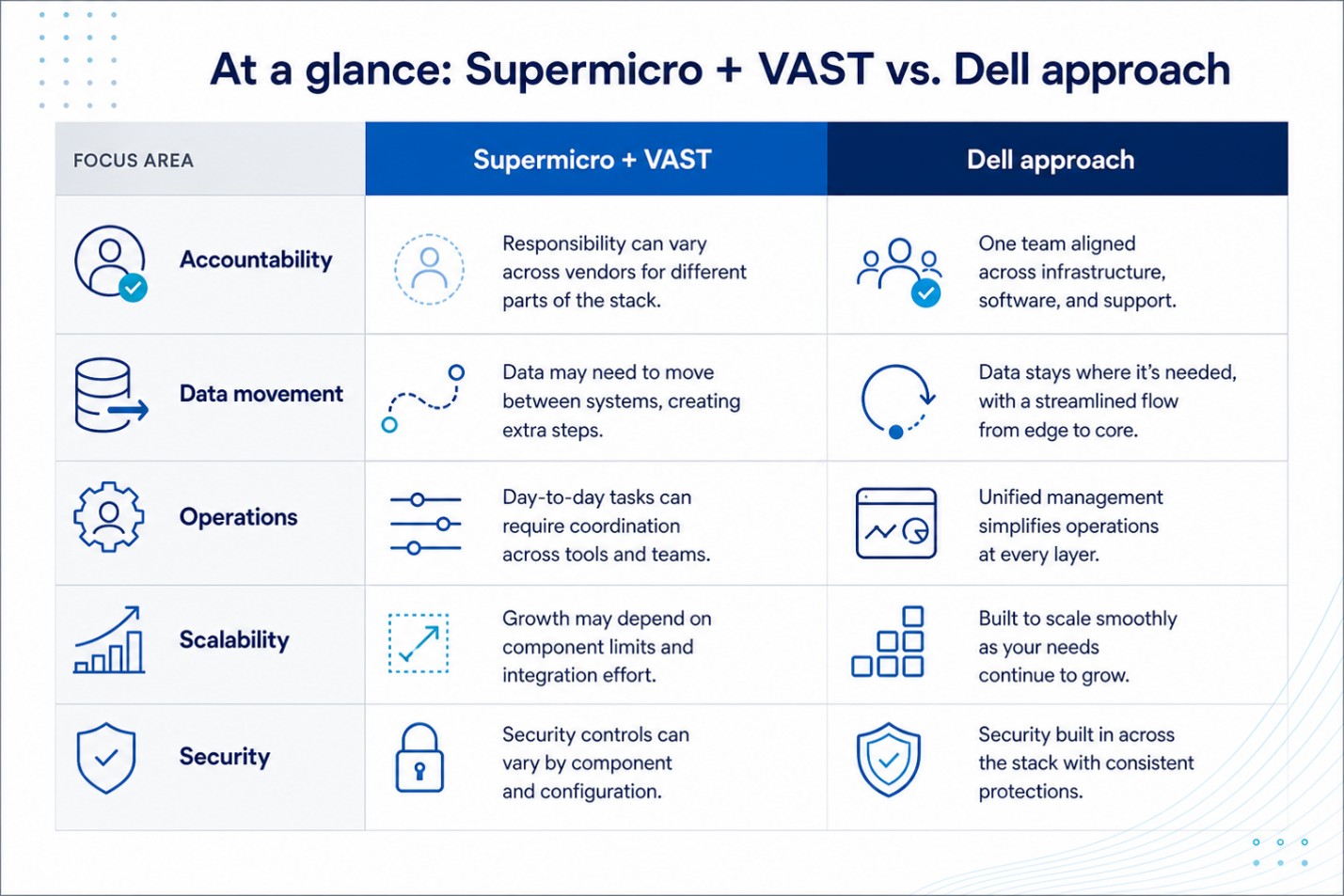
5. Dell Removes the Tax Bill Supermicro + VAST Leave Behind
The Dell AI Factory removes the tax bill because the integration work happens before the rack ships, not after. Dell delivers factory-integrated, rack-scale systems that combine compute, networking, storage, cooling and management under one vendor instead of leaving you to assemble and validate the environment yourself. That removes the escalation tax.
That simplification carries into execution. Third-party analysis commissioned by Dell found that ProDeploy Services can deploy AI infrastructure up to 84% faster than a do-it-yourself approach,⁵ which helps explain why Dell’s model is easier to operationalize.
The bigger test is whether a platform can be deployed again, patched, expanded, observed and supported without creating new integration work. PowerEdge provides embedded control through iDRAC and OpenManage, while Dell Automation Platform adds consistent Day 0 through Day 2 orchestration across infrastructure and validated blueprints. The result is fewer manual handoffs and a more repeatable operating model. That reduces the lifecycle tax.
Secured Component Verification matters here too because supply-chain risk is operational risk. In a multi-vendor stack, a tampered firmware image or unverified GPU tray can reach production before anyone notices. SCV confirms each component matches Dell’s build record, closing that window.
Dell’s data story is also more practical. Data stays where governance already lives; no forced migration into a vendor-controlled namespace. Dell AI Data Platform connects storage, pipelines, orchestration and AI applications in one vertically integrated stack while remaining open enough to work across the broader estate. That is a better answer to the real AI bottleneck: not just where data sits, but how quickly it can be governed, prepared and made usable. That reduces the data-gravity tax.
Prowess Consulting stated that the integrated, GPU-accelerated Dell platform delivers advantages in breadth, GPU efficiency, pipeline simplicity and end-to-end manageability — differences that can accelerate AI development, reduce engineering effort and create a more cost-effective path to production at scale.⁶
Conclusion
A Supermicro + VAST AI factory may look compelling on paper, but in practice it is still DIY: separate compute, separate storage, separate support and the customer left to make it work like a platform.
Dell’s AI Factory is different. The advantage is not just day-one performance. It is tighter integration, data that stays closer to where it already lives and one clear owner when the environment has to scale, change or recover.
The real question is simple: are you buying an AI platform, or signing your team up to run a multi-vendor assembly project after the sale? Before you choose Supermicro + VAST, identify which data cannot move into the VAST namespace and quantify the copy, governance and escalation overhead that follows.
1Cooper, Barry. “The Frankenstack: Why Enterprises Are Shifting To AI Platforms.” Forbes, March 4, 2025. https://www.forbes.com/councils/forbestechcouncil/2025/03/04/the-frankenstack-why-enterprises-are-shifting-to-ai-platforms/.
2Super Micro Computer, Inc. “Supermicro and VAST Data Launch a New Enterprise AI Data Platform Solution with NVIDIA to Accelerate AI Factory Deployment.” February 25, 2026. https://ir.supermicro.com/news/news-details/2026/Supermicro-and-VAST-Data-Launch-a-New-Enterprise-AI-Data-Platform-Solution-with-NVIDIA-to-Accelerate-AI-Factory-Deployment/default.aspx.
3“Enterprises Are Building ‘AI Frankenstacks’— And They Are Becoming Unmanageable.” The AI Journal, April 13, 2026. https://aijourn.com/enterprises-are-building-ai-frankenstacks-and-they-are-becoming-unmanageable/.
4Çıtak, Emre. “Tech Industry Averages Just 5% GPU Utilization, Report Finds.” Dataconomy, April 23, 2026. https://dataconomy.com/2026/04/23/tech-industry-averages-just-5-gpu-utilization-report-finds/.
5Principled Technologies. Accelerate AI Time to Value with Dell Services”. https://www.principledtechnologies.com/Dell/ProDeploy-Services-AI-deployment-0526/index.php
6Prowess Consulting. “Why Open, Modular AI Data Platforms Win Over Closed, Storage-Embedded AI Data Stacks.” April 15, 2026. https://prowessconsulting.com/resources/dell-ai-data-platform-outperforms-vast-ai-os/.