

AI Data Platform
Why AI Infrastructure Is Not Enough
Your AI is only as strong as your data. Dell AI Data Platform turns fragmented enterprise data into AI-ready fuel for production.
Key takeaways 8 min read
- Enterprise AI stalls when data is fragmented, not when infrastructure is missing.
- Open, modular data engines beat tightly coupled and DIY approaches by improving flexibility, governance, and operational simplicity.
- Dell AI Data Platform makes enterprise data usable for AI across storage, retrieval, processing, and orchestration.
- Different data tasks require different engines: analytics, processing, retrieval, and orchestration each play a distinct role in making enterprise data usable for AI.
- The real advantage in AI is not just faster infrastructure, but continuously AI-ready business data.
Your AI strategy is only as strong as your data
Your infrastructure may be ready for AI. Your data probably is not.
Most enterprises are not struggling to use AI effectively. They are struggling to operationalize it because the real bottleneck is no longer compute. It is whether data is available, contextualized, governed and orchestrated well enough to power AI in production.
Dell AI Data Platform addresses that gap by turning fragmented enterprise data into a governed, AI-ready foundation for production-scale AI.
Why infrastructure alone fails
Infrastructure is the backbone to AI, but it cannot solve the data fragmentation, quality and cost challenges that determine whether AI actually is useful in production.
- Modern GPUs can consume data faster than traditional storage can deliver it, leaving expensive accelerators underfed and underutilized.
- Enterprise data is scattered across unstructured files and objects, and structured applications like databases meaning agents, models and AI applications rarely have a complete view of the business context they need.
- In agentic AI, token-heavy machine-to-machine reasoning can quickly turn into runaway cost when every workflow depends on cloud-hosted services.
That is why infrastructure alone is no longer enough. AI needs a data platform that makes enterprise information discoverable, usable, and continuously ready for inference.
What the Dell AI Data Platform changes
The Dell AI Data Platform is built to turn raw enterprise data into AI-ready data by bringing together AI-optimized storage, modern data engines to make enterprise data ready for AI, and orchestration in one operating layer.
Within Dell AI Factory, it serves as the backbone that helps infrastructure, models, and software operate as a complete AI system with governed, high-performance access to enterprise data.
In that architecture, storage engines such as PowerScale, ObjectScale and Lightning File System are designed to store, serve, and scale data securely for AI workloads. Our Data engines like the Dell Data Orchestration Engine, operate above the storage engine to coordinate how data is discovered, prepared, enriched, synchronized and governed across the full AI lifecycle and across cloud, on-prem and hybrid environments. Finally, our AI Factory consumes both storage and data engines to deliver AI effectively into enterprises using their business data
Competitors may tell a simpler story: put everything on the same hardware and the problem goes away. But in practice, tightly coupled architectures can limit flexibility, performance and economics—forcing customers to buy more compute when what they really need is more storage, or accept the constraints of one fixed stack. Dell AI Data Platform is designed differently: storage engines, data engines, and AI infrastructure work together as one system, but they are not locked together. That gives customers the freedom to scale each layer independently, match the platform to the workload, and avoid the inefficiencies of one-size-fits-all AI infrastructure.
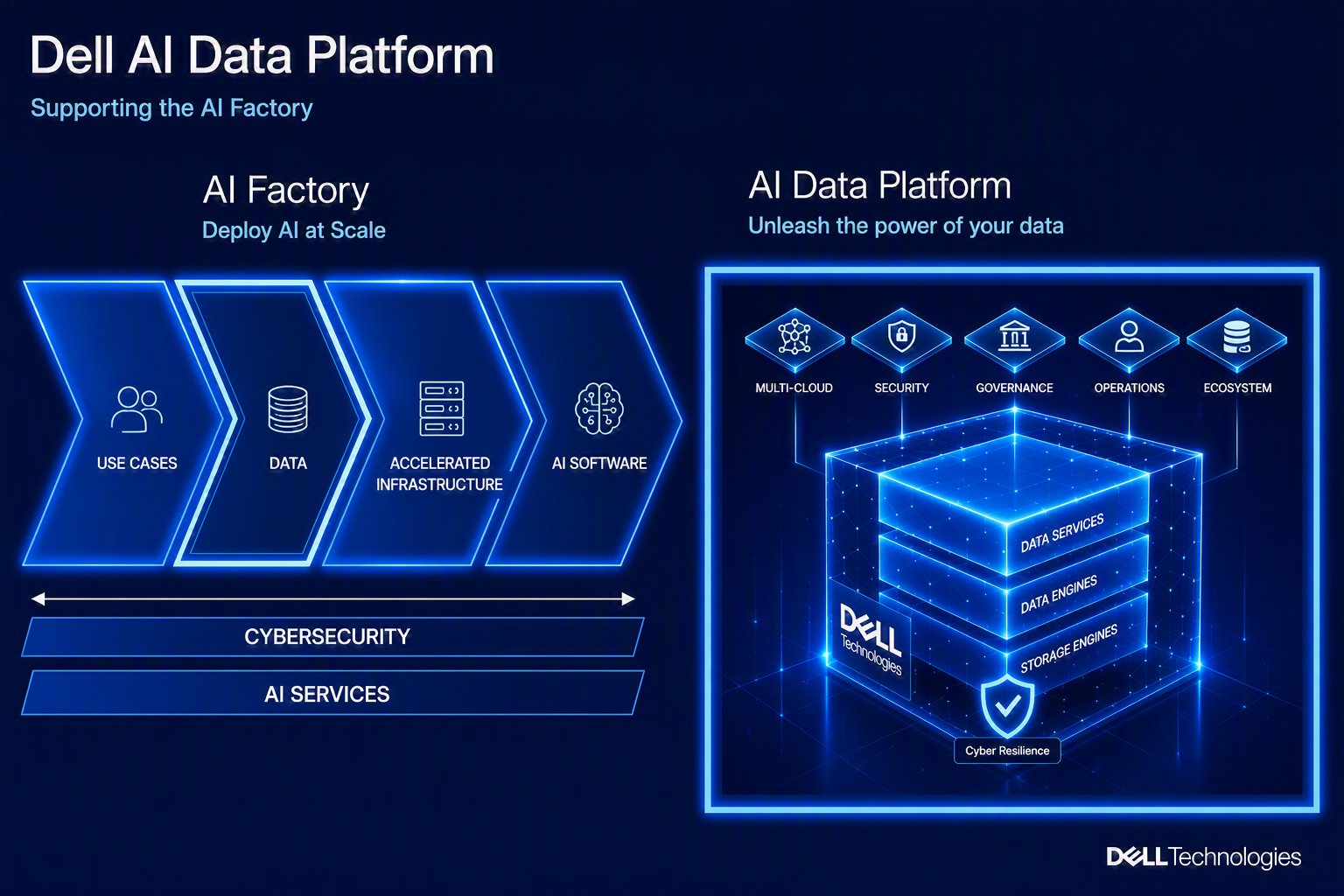
- AI-optimized storage engines such as PowerScale, ObjectScale and Lightning File System provide scalable file and object storage that can keep up with AI workloads.
- Modern data engines such as Starburst and Elastic help teams query, transform and retrieve value from structured and unstructured data, including vector-based context for retrieval workflows.
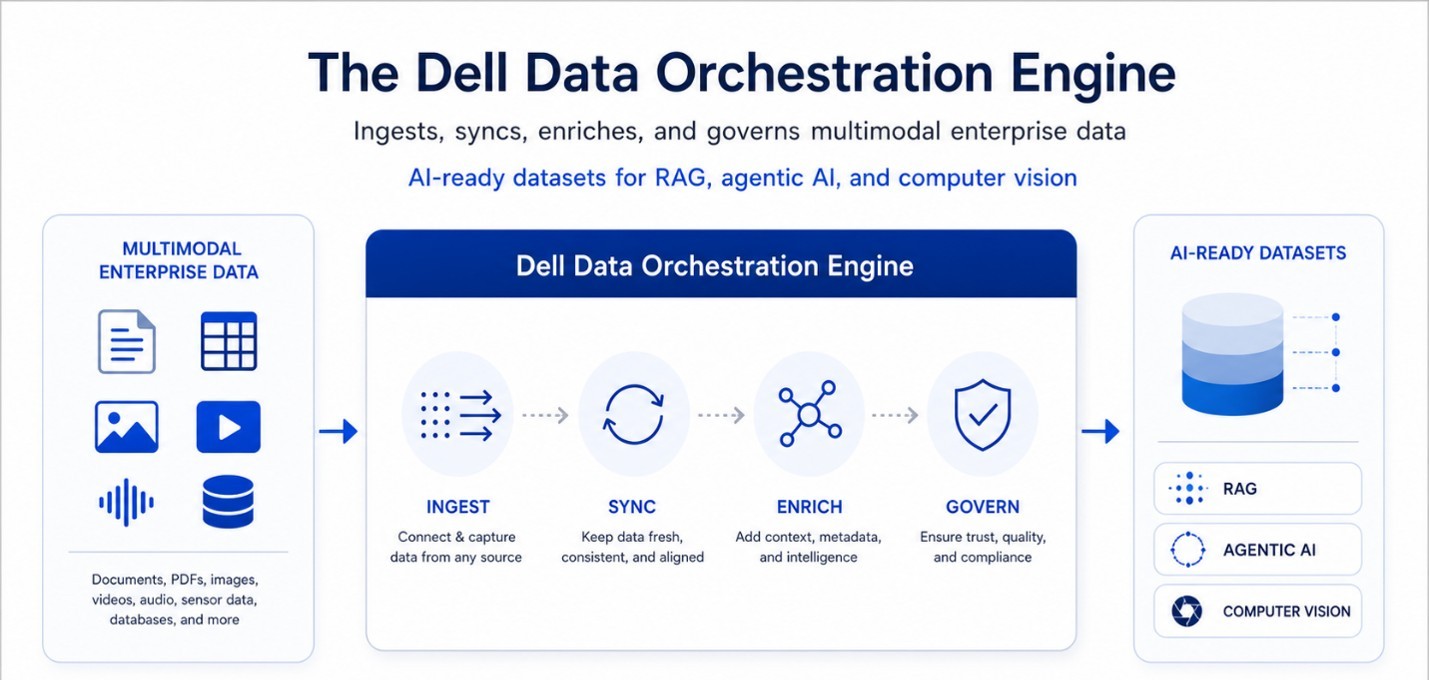
- The Dell Data Orchestration Engine prepares, indexes and governs pipelines so multimodal enterprise data becomes usable for AI models and applications.
Why a platform beats a patchwork approach
Dell AI Data Platform gives enterprises an open, modular architecture with integrated storage, data engines, orchestration and a simplified support experience. Instead of stitching together disconnected tools and custom pipelines, enterprises get a platform designed to operationalize AI faster while avoiding the constraints of a proprietary silo.
Making data AI-ready
Storage alone does not make enterprise data useful for AI. Data engines are the working layer that turn raw, distributed information into something AI systems can query, transform, retrieve, govern and act on across the full lifecycle.
Dell Data Analytics Engine powered by Starburst
This is the query layer for structured and distributed enterprise data. It lets teams query data in place across heterogeneous systems instead of copying everything into yet another repository, which reduces data duplication, avoids slow ETL-heavy approaches, and simplifies governance. Typical uses include federated analytics, ad hoc business queries, and preparing enterprise data for AI and decision support.
Dell Data Processing Engine
This is the large-scale transformation layer, built for preparing and processing data for analytics and AI workloads. Instead of hand-assembling pipelines for every source and workflow, customers get a platform-aligned processing engine designed for batch, streaming, ETL, and ML data preparation at scale. Typical uses include large-scale ETL, feature and dataset preparation, batch analytics, and real-time processing for model pipelines.
Unstructured data/search engine with Elastic
This is the retrieval layer for the massive share of enterprise data that lives outside traditional databases. It brings vector search, semantic retrieval, and hybrid keyword search into the platform so documents, emails, logs, images, and video can become usable context for RAG, agentic AI, and intelligent search use cases. Compared with a DIY stack, Dell positions this as a validated, lifecycle-managed architecture rather than a separate integration project customers have to design and test themselves.
Dell Data Orchestration Engine
This is the coordination and governance layer that connects pipelines, models, retrieval systems, and human feedback loops. It helps enterprises ingest, sync, enrich, index, and govern multimodal data across cloud, on-prem, and hybrid environments so AI systems are working from fresh, production-ready enterprise context instead of brittle one-off pipelines. Typical uses include RAG pipelines, agentic AI workflows, multimodal dataset creation and computer vision pipelines.
The real AI advantage
What makes the Dell AI Data Platform different is not just that it stores enterprise data for AI, but that it applies the right engines to make that data usable. Analytics, processing, retrieval and orchestration each have different requirements, and Dell brings them together in one platform without forcing customers into a rigid, all-in-one stack. The result is a more practical path to enterprise AI: data that stays governed, becomes searchable and reusable, and can continuously support better retrieval, better inference and better outcomes.
Ready to build your AI data foundation?
Talk to a Dell Technologies specialist about the Dell AI Data Platform powered by Starburst — and learn how enterprises like CTBC Bank, NTT DATA, and Dell itself are turning their data layer into a competitive advantage for agentic AI.
→ Explore the Dell AI Data Platform
→ Explore the Dell Orchestration Engine
Frequently Asked Questions
Why do GPU investments stall even in well-funded enterprise AI programs? The most common reason is data fragmentation. GPU clusters are powerful, but they’re only as productive as the data supplied to them. When data is scattered across silos, locked in structured and unstructured data silos, or difficult to operationalize at scale, even the most advanced compute infrastructure sits underutilized. The Dell AI Data Platform is specifically designed to close this gap.
What’s the difference between the three Dell storage engines? Each engine is optimized for a different point in the AI lifecycle. PowerScale handles the broadest range of AI workloads — ingestion, curation, training and inference — with enterprise NAS simplicity. Lightning File System is built for extreme-scale parallel training, where thousands of GPUs need continuous, high-throughput data supply. ObjectScale is purpose-built for massive unstructured datasets and data lakes. The right choice depends on workload, scale, and performance requirements — and you can use all three.
What does “query in place” actually mean, and why does it matter? Federated SQL, powered by Starburst, enables AI applications to query data across heterogeneous systems without first copying it into a centralized warehouse or data lake. This eliminates slow, expensive ETL pipelines, reduces data duplication, and simplifies governance — because there’s only one copy of the data, and it stays where it lives.
How does the platform handle unstructured data? Unstructured search, powered by Elastic, makes the 80%+ of enterprise data that lives outside structured databases — documents, emails, logs, images, video — discoverable and usable for RAG pipelines and agentic AI applications. This turns previously invisible enterprise data into an active AI asset.
Is this platform locked to Dell infrastructure? No. The platform is built on open table and file formats, with modular, best-of-breed engines. It supports deployment across core, cloud, and edge environments and is designed to evolve as new frameworks and engines emerge — without requiring a full-stack replacement.
