Endpoint Security
Building a Quantum-Ready Foundation with Advanced BIOS Security
Take a step towards quantum resistance with the latest release of the Dell Trusted Device App.
Key takeaway: BIOS security is the foundation of cyber resilience. The Dell Trusted Device App delivers quantum-resistant BIOS verification, hardening PCs against firmware attacks and future cryptographic threats, ensuring your organization stays secure in the post-quantum era.
In our pursuit of long-term cyber resilience, attention often gravitates toward software, networks, and cloud solutions. Yet, at the heart of every secure IT infrastructure is the system BIOS—a foundational layer that’s frequently underestimated. As one of the first pieces of code to run on a machine, BIOS security sets the tone for everything built above it. When BIOS is compromised, every other defense becomes vulnerable.
Looking ahead, the need to protect this pivotal firmware grows even more crucial as we enter the age of quantum computing. Quantum technology promises remarkable advancements, but it also brings risks that could undermine the cryptography in today’s security standards. At Dell, we’re proactively building security solutions for what’s next—embedding the expertise and innovation needed to safeguard your organization, both now and in the emerging post-quantum era.
Today, we want to share how Dell is helping customers prepare with advanced built-in security. This starts with an upgraded, quantum-ready version of our unique off-host BIOS verification.* Just keep in mind, evolving your security to meet future needs is a journey; nothing will happen overnight. We’ll build the best foundation step by step.
Why BIOS security matters
Before we dive into the upgraded feature, let’s review why Dell emphasizes BIOS security across our commercial lineup.
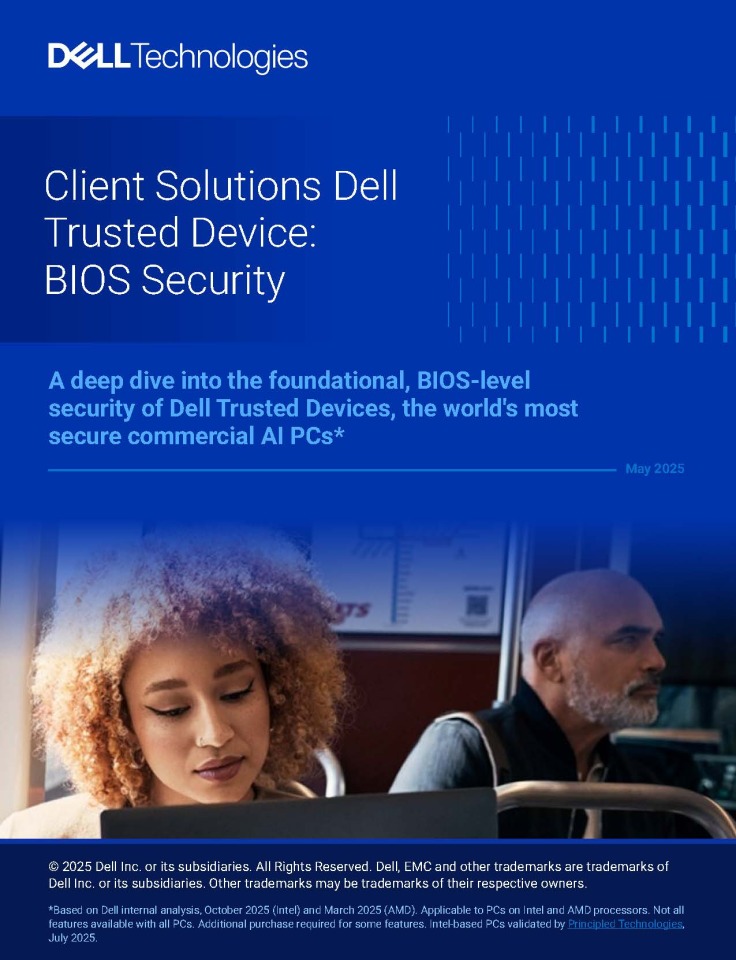
BIOS, or its modern counterpart UEFI, forms the bridge between your hardware and operating system. It initializes and verifies hardware integrity
before your OS even launches. A successful attack at this layer grants adversaries persistent, nearly invisible control. Firmware-level attacks, for example, can survive reboots, OS reinstalls and even hardware replacements, remaining deeply embedded across your environment. Stealthy BIOS malware attacks can lurk “below the OS,” evading classic antivirus tools and endpoint detection solutions. With BIOS access, attackers can bypass OS-level security, capture sensitive data and deactivate critical protections—long before your primary defenses activate.
The Dell Trusted Device Application (DTD or DTD App) and Dell SafeBIOS directly address the risk of these below-the-OS attacks. The DTD App enables off-host BIOS verification by comparing device firmware against trusted golden measurements held securely in the cloud—a capability that is unique to Dell.* If anomalies are detected, it can trigger alerts, capture an image of the potentially compromised BIOS, and empower your team to remediate issues confidently. These insights integrate into leading endpoint security and management platforms, like CrowdStrike, Absolute and Microsoft Intune—making previously hidden threats visible and actionable.
The quantum leap: Preparing for a new frontier in cybersecurity
Quantum computing introduces a transformative leap—not just for innovation, but for the digital threat landscape. With the power to break many of today’s asymmetric cryptographic algorithms, quantum computers represent a challenge to data protection, ownership and trust.
Adversaries are likely already exploiting a “harvest now, decrypt later” (HNDL) approach—collecting encrypted data today, above the OS, with plans to decrypt it once quantum technology matures. For organizations retaining sensitive or regulated data for years, this is a clear and present concern.
Upgraded, post-quantum cryptography (PQC) ready data encryption systems can mitigate HNDL attacks, but they require a secure BIOS foundation. If the underlying BIOS isn’t protected from quantum attacks on cryptographically signed firmware first, threat actors will seek the weak link in the BIOS to undermine PQC-ready capabilities above the OS. The security of quantum-resilient systems must start at the foundation, with technology like PQC-ready BIOS verification.
Transitioning to quantum-resistant cryptography isn’t just about deploying new algorithms; it means rethinking where and how cryptography is used across your enterprise—from data in motion and at rest, to device identification and secure code signing. The scope of upgrading cryptographic foundations is immense and must be top of mind for IT leaders today. Understanding your current cryptographic modules and partnering with vendors on their post-quantum journeys is now an essential step in building cyber resilience.
Dell is fully aligned with emerging PQC standards, including those defined by NIST and global cybersecurity agencies. PQC uses advanced mathematical approaches—such as lattice-based cryptography and hash-based signatures—designed to resist both classical and quantum attacks, ensuring data confidentiality and integrity for years to come.
To help your PC fleet stay secure, one of our key steps is to improve quantum-threat resistance below the OS and ensure the first code that runs on a machine is protected, at all costs.
Cyber resilience starts at the heart of the PC
Our upgraded off-host BIOS verification hardens the attack surface against advanced attacks, such as quantum threats. This reduces the chances of hash collisions and ensures the firmware verification results can be trusted. In addition to SHA256, Dell BIOS verification now supports SHA512, hardening PC security against threats—even those accelerated by quantum capabilities. By designing firmware validation to meet new PQC standards, we’re preparing your infrastructure not just to resist known attacks but to actively defend against looming future threats.
Our solutions, like BIOS verification are designed for rapid adaptation with no disturbance in daily security functionality—enabling quick updates to cryptographic processes and algorithms as industry standards evolve. This “crypto agility” is critical, ensuring your enterprise remains secure as new best practices and requirements emerge globally.
A secure, quantum-resilient future starts now
In today’s shifting landscape, your choice of technology partner matters. Dell is committed to being a trusted advisor, supporting large enterprises with forward-thinking security solutions both above and below the OS. Strong, multifaceted BIOS security is the invisible engine of trust behind every user. By investing in advanced protection now, you lay the groundwork for growth and long-term peace of mind.
As you refresh your fleet, you will soon see Dell’s quantum-resistant BIOS verification roll out to upcoming commercial platforms. This release is the first of a number of quantum-threat-resistant upgrades we’ll be introducing to maintain a secure boot process.
To learn more about BIOS Verification and the DTD App, view the datasheet here and contact your rep or a Dell security specialist.
*Based on Dell internal analysis, October 2025 (Intel) and March 2025 (AMD). Applicable to PCs on Intel and AMD processors. Not all features available with all PCs. Additional purchase required for some features. Intel-based PCs validated by Principled Technologies, July 2025.