

NativeEdge
Modernize SMB Infrastructure with Dell NativeEdge
SMBs can modernize infrastructure, boost productivity, and prep for AI with Dell NativeEdge. Learn how to simplify your IT operations.
Key takeaways: Simplify IT operations by managing virtual machines and containers from a single, centralized platform that scales with business needs. Boost productivity and reduce costs through automated, zero-touch provisioning that secures infrastructure without requiring on-site technical staff. Accelerate AI adoption with an open, flexible foundation designed to deploy workloads securely at the edge, where data originates.
Small and midsize businesses (SMBs) are under pressure to do more with less. They’re expected to deliver modern digital experiences, empower a hybrid workforce, and start capitalizing on AI. All this needs to be done without the deep IT teams and budgets of large enterprises.
Research shows that improving employee productivity, adopting AI, and strengthening security are top drivers of technology investment for SMBs. In a recent survey conducted by Enterprise Strategy Group (now part of Omdia), 500 IT decision-makers (ITDMs) from SMBs were asked about their top justifications for new IT investments:¹
-
- 63% of medium business and 60% of small business ITDMS selected “Increased employee productivity.”
- 60% of medium businesses and 51% of small business ITDMs selected “Supports AI and/or GenAI initiatives.”
- 58% of medium business and 44% of small business ITDMs selected “Improves cybersecurity and resiliency against cyber-attacks.”
These are big ambitions, and they increasingly depend on distributed IT, including small data centers, remote offices, and edge locations where data is created and used in real time.
While the goals are clear, the path forward is not. Many SMBs find their infrastructure to have become complex, fragile, and expensive to manage.
The new reality of SMB infrastructure
Most SMBs operate a single data center and a few small clusters, often with minimal local IT presence at remote sites. The traditional virtualization stack many rely on was never designed for small, distributed environments. As virtualization markets and licensing models change, SMBs are feeling the impact.
-
- Operational complexity: Manual provisioning, patching, and troubleshooting across sites drain time and introduces risk. This is especially true when only a few IT generalists support everything from endpoints to business applications.
- High entry and expansion costs: Solutions built for large data centers can require rigid hardware, specialized skills, and licensing bundles that force SMBs to pay for features they don’t need.
- Security vulnerabilities: Inconsistent configuration and patch levels across sites create gaps that attackers can exploit. Many existing environments lack a true zero-trust approach from device onboarding to lifecycle management.
- Limited flexibility: Traditional hyperconverged stacks can lock customers into specific ecosystems, limiting their ability to choose the best hardware, cloud providers, or applications for each use case.

The result is a growing disconnect. Business leaders expect fast, secure, AI-ready digital services, but the underlying infrastructure is fragile and increasingly costly to operate.
What SMBs need from modern infrastructure
To close this gap, SMBs need more than small tweaks to existing platforms. They need a different approach, one that treats edge and small data center infrastructure as a strategic asset, not a patchwork of boxes.
In practice, this means:
-
- Simplicity at scale: Centralized deployment, policy-based management, and lifecycle automation across all locations without adding operational overhead or requiring niche skills.
- An open, flexible foundation: Support for both virtual machines and containerized workloads across diverse hardware and multicloud environments, so SMBs can modernize at their own pace.
- Built-in security: Zero-trust principles baked into the platform, from secure device onboarding to consistent configuration.
- AI-ready by design: The ability to deploy and operate AI workloads where they create the most value, close to the data, while still integrating with cloud services.
- Economics that fit SMB realities: Enterprise-class reliability and automation that works for smaller clusters, constrained budgets, and lean IT teams.
This brings us to Dell NativeEdge…
Dell NativeEdge: built for how SMBs really operate
Dell NativeEdge is a full-stack, automated, secure edge operations solution. It centralizes the deployment and lifecycle management of infrastructure and applications in small data centers and distributed environments. It’s built to address the real-world constraints SMBs face while giving them a modern, future-ready foundation.
NativeEdge delivers:
-
- Unified operations for VMs and containers: Run traditional virtualized workloads and modern container-based applications side-by-side on the same platform. This means you can modernize at your own pace without maintaining separate stacks.
- Centralized, policy-driven management: Through a single control plane, you can automate secure device onboarding, standardize configurations, roll out updates, and orchestrate applications across all your locations.
- Open, multicloud ecosystem: NativeEdge is designed for heterogeneous environments, supporting NativeEdge-enabled endpoints as well as existing Dell and select third-party infrastructure. You’re not locked into a single provider’s stack.
- Zero-Trust Security and Zero-Touch Provisioning: NativeEdge incorporates a hardware root of trust and Secure Device Onboarding, combined with zero-touch provisioning, to ensure devices are configured and updated in line with zero-trust principles, without sending IT staff to each site.
Turning complexity into real business value
The operational impact of this approach is significant. In a recent technical validation, Enterprise Strategy Group (now part of Omdia) modeled a mid-sized manufacturing organization expanding from 10 to 30 locations, comparing a traditional manual approach to using Dell NativeEdge for deployment and operations. They found that NativeEdge delivered:²
-
- 92% time savings for secure device onboarding
- 75% time savings for automating updates and re-imaging
- 68% time savings for application orchestration

Taken together, this resulted in 79% overall time savings and an estimated $3.3 million in cost savings over three years. For an SMB, those numbers can be transformational, freeing scarce resources to focus on innovation rather than maintenance. When you replace manual, site-by-site work with centralized, automated operations, the savings compound quickly.
Real SMBs, real outcomes
Around the world, SMBs are already using Dell NativeEdge to transform how they operate at the edge and distributed data centers.
MatrixSpace: accelerating smart city safety
MatrixSpace, a U.S.-based startup, builds AI-enabled radar platforms that provide real-time situational awareness for public safety. They needed a way to deploy and manage fleets of sensors and radars at scale without building their own edge operations stack. By adopting Dell NativeEdge, MatrixSpace can deploy, manage, and maintain its radar fleet with centralized automation. This saved about a year of software development time and reduced ongoing maintenance costs. For city customers, that translates into faster time-to-value for critical response capabilities.
Nature Fresh Farms: sustainable agriculture with AI at the edge
Nature Fresh Farms, one of North America’s leading greenhouse growers, operates 250 acres of high-tech greenhouses. To maximize yields while minimizing resource use, they rely on real-time insights from sensors and AI. With Dell NativeEdge, Nature Fresh Farms has achieved 100% PLU sticker accuracy, eliminating manual inspections and boosting efficiency. They also cut water purification cycles by approximately 60%, supporting both cost reduction and sustainability. Keith Bradley, VP of Information Technology, explained that edge automation and AI have “drastically improved processing speed and efficiency, saving valuable time day‑to‑day.”
What this means for SMB IT and business leaders
For ITDMs at SMBs, Dell NativeEdge offers a way to:
-
- Simplify your environment and reduce operational risk
- Navigate virtualization disruption with a flexible, open alternative
- Support today’s applications and tomorrow’s AI workloads on a single platform
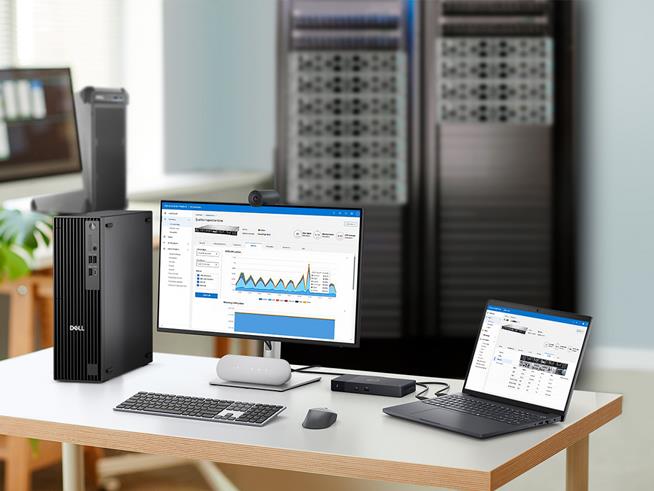
For business leaders, it’s a way to support growth without a linear increase in IT complexity and cost. You can improve resilience and security at the edge, where many business-critical processes now live. It helps turn distributed infrastructure from a cost center into a strategic advantage.
Moving forward
If your organization is grappling with virtualization changes, struggling to manage multiple small sites, or wondering how to prepare for AI, it may be time to rethink your approach.
Dell NativeEdge was designed for exactly that inflection point. It helps SMBs move from fragile, fragmented environments to a secure, automated platform that scales with your ambitions. By simplifying operations, embracing an open ecosystem, and baking in zero-trust security, NativeEdge gives SMBs the tools to deliver the outcomes modern business demands, today and in the future.
Learn more at Dell.com/NativeEdge
1Enterprise Strategy Group (now part of Omdia) eBook commissioned by Dell Technologies, “Small and Midsize Organizations Modernize for Productivity and Security, While Embracing an AI Future,” February 2025.
2Enterprise Strategy Group (now part of Omdia) Technical Validation commissioned by Dell Technologies, “Dell NativeEdge – Edge Operations Software Platform,” February 2025.