PowerScale
Storage for your AI containers: PowerScale and ObjectScale
Containers are the future of app development, but stateful vs stateless? Dell PowerScale & ObjectScale have you covered. Dive in!
tl;dr: Containerized applications thrive with the right storage strategy. Dell PowerScale excels in stateful workloads with persistent file storage, while ObjectScale powers stateless apps with scalable object storage. Together, they ensure flexibility, performance, and reliability for modern infrastructures. Choose the right tool for your workload and optimize your container journey with Dell’s enterprise-ready solutions.
Application development in 2025 means working with containers. This is truer than ever for AI applications that need to be both consistent and modular across various infrastructures. Whether it’s doing model training, fine-tuning, or inferencing, a persistent storage layer is key. The good (and bad) news is that there are options here in both the file and object storage worlds. In all cases, Dell has you covered with PowerScale and ObjectScale. Let’s dig in:
The journey to containerization and Kubernetes is not only about orchestration; it requires some careful planning around how your applications manage data. While there are many factors that influence this choice, one of the fundamental questions involves stateful versus stateless architectures.
Stateless pods lend themselves well to cloud-native architectures, serverless compute, and microservices. Since the pod does not store any session data, it allows those pods to be mostly independent and ephemeral. Do you need to scale up a particular set of services in a larger application? Auto-scale up more pods and have them get to work immediately.
However, persistent session data is still a “thing” and saving application state data matters, (think user session data or PostgreSQL with CNPG: https://cloudnative-pg.io). Of course, there are ways to offload or fake statefulness in a stateless design, but doing so can lead to complicated interdependence and compromise.
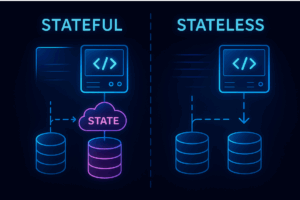
So, what to do? It is not an either/or choice: use stateful persistence where required and leverage stateless scalability everywhere else. This brings us to the main point of this blog: ensuring your enterprise storage portfolio can handle both designs with the stability and performance modern workloads demand.
Whether stateful or stateless, Dell PowerScale and Dell ObjectScale provide clear, production-ready infrastructure by using established Container Storage Interface (CSI) drivers and the S3 API.
For stateless applications: ObjectScale and PowerScale
Containers were originally conceived as stateless entities and this approach adheres to cloud-native design. Because there is no persistence, it allows application pods to auto-scale and achieve resiliency without managing session state. The key here is accessing data without the complexity of a mounted file system. Instead, data is accessed over HTTP(S) using the S3 API.
For these applications, object storage is the way to go, and Dell offers two powerful choices:
Dell ObjectScale: An object storage platform built for massive scale and geo-distribution. It is engineered for the future of cloud-native data.
Dell PowerScale: PowerScale is a high-performance, unified file and object platform with robust S3 support. In addition to S3, PowerScale presents the same data over traditional SMB/NFS protocols, making it a truly integrated platform.
As mentioned above, your stateless pods will use S3 to access either platform: no mounted file systems, no fuss. Choosing between ObjectScale and PowerScale comes down to minute details around scale, geo-distribution, mixed workloads, and various nitty-gritty details that we storage nerds love to dig into. Although beyond the scope of this humble blog, get in touch and Dell will be happy to help guide this journey.
For stateful applications: PowerScale
A stateful application requires data persistence and file semantics because its operation depends on saved or established information.
Trying to “fake” statefulness by offloading session data or using complex cookie management can introduce operational overhead and architectural complexity. It’s better to use the right design for the right application.
Dell PowerScale is the answer here. It offers massive parallel performance and proven data integrity for file-based I/O.
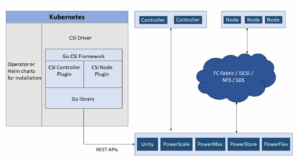
PowerScale integrates with Kubernetes using a Container Storage Interface (CSI) driver. A CSI driver is required for containers to dynamically provision, mount and interact with persistent file storage as a standard file system. This storage layer is essential for stateful pods and provides developers with a friendly interface for working with PowerScale.
There are CSI drivers for most Dell enterprise storage platforms. Support detail can be found here: Container storage modules. The diagram below shows a high-level architecture of the driver with these various Dell storage platforms, though for the purposes of this blog we describe PowerScale and NFS.
What about COSI?
There has been some significant noise in the containerization community about COSI, and it is worth mentioning what COSI is and what COSI is not.
Container Object Storage Interface (COSI) is an emerging community standard for bucket provisioning and access control on object storage. It is an alpha-stage project in the early days. Being new does not take away from the hard work that has been done to move the COSI forward. And COSI may someday be the standard method for simplifying pod interaction with object storage, but it is still a moving target.
COSI does not solve Stateful Needs: COSI is fundamentally designed for provisioning object storage (stateless). It does not magically (or non-magically) make object storage the right solution for stateful applications. That mission remains firmly with PowerScale.
Object storage is inherently stateless and accessed over HTTP(S) using S3. Containers do not require extra layers of abstraction to perform read/write operations to an S3-compatible service. Containers can use the S3 API directly, which is what all modern stateless apps are designed to do.
ObjectScale and PowerScale for containerized environments
Successful infrastructure choices hinge on making informed decisions and staying nimble. It is not about choosing one architectural approach over the other; it is about leveraging the right approach for the right workload.
This strategy ensures that enterprise applications have the support, stability, and performance they require, regardless of whether they need persistent file storage using CSI or highly scalable, accessible object storage using S3. Move forward with confidence: PowerScale for unified file and object needs and ObjectScale for massive-scale object storage. Optimize your container journey for both flexibility and dependability.
For more information on Dell PowerScale and ObjectScale storage, please visit us online.