

AI Solutions
Now Shipping: Dell AI Platform with Intel
Introducing Dell AI Platform with Intel, powered by Intel Gaudi 3 AI accelerators, the latest addition to the Dell AI Factory.
Artificial intelligence is transforming industries by driving breakthroughs in healthcare, logistics, and commerce, among others. Yet, for enterprises eager to fully harness AI’s potential, choosing the right tools and infrastructure is complex but essential. To meet this need, Dell Technologies has collaborated with Intel to deliver the latest expansion of Dell AI Factory infrastructure – Dell AI Platform with Intel. Powered by Intel® Gaudi® 3 AI accelerators, this comprehensive, end-to-end solution simplifies AI adoption, scaling, and integration, empowering enterprises at any stage of their AI journey.
Whether you’re an IT professional responsible for enabling AI workflows, a business leader aiming for strategic innovation, or a developer seeking robust performance, this platform is engineered to meet your needs.
What Is It?
The Dell AI Platform with Intel is a fully validated end-to-end solution engineered to accelerate AI adoption through high performance with exceptional ROI, scalability and flexibility.
At its core, Intel Gaudi 3 AI accelerators deliver exceptional computation efficiency for complex AI workloads. Designed for tasks such as large language models and computer vision, these accelerators provide faster insights while optimizing total cost of ownership (TCO).
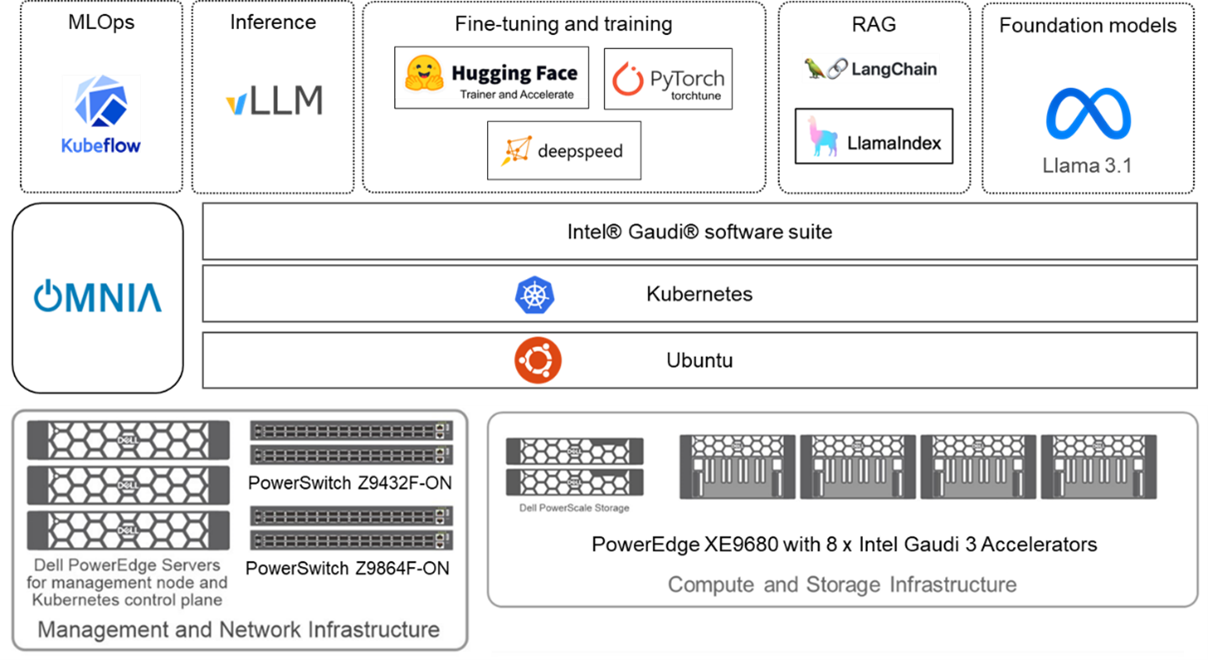
Complementing the Intel accelerators, Dell integrates powerful computing systems, advanced storage solutions, robust networking, professional services and an open-source software stack. This marriage of cutting-edge hardware and flexible software ensures maximum performance across AI applications.
The platform champions open standards, utilizing Ethernet networking and a validated open-source software stack that works seamlessly with Dell’s hardware, allowing organizations to avoid vendor lock-in and build solutions tailored to their needs.
By combining Dell’s trusted infrastructure expertise with Intel’s AI accelerator technology, this platform offers a versatile solution that directly addresses real-world business challenges.
Why Choose Dell AI Platform with Intel?
Enterprises often face challenges such as balancing performance, cost-efficiency, scalability and flexibility when adopting AI. The Dell AI Platform with Intel directly tackles these issues with several key benefits.
Powered by Intel Gaudi 3 accelerators, this solution delivers high-throughput and exceptional price/performance for inference workloads, ensuring that enterprises can process AI workloads efficiently and cost-effectively.
The Dell AI Platform with Intel supports businesses at every stage, from pilot projects to enterprise-wide AI deployments. It is designed to grow with your organization by adapting to expanding data needs, user numbers and diverse use cases without requiring major upgrades.
Open networking and open-source tools provide the freedom to select the right technologies for your workflows. This flexibility ensures businesses aren’t constrained by proprietary solutions and can pivot as their needs evolve.
“Dell AI Platform with Intel simplifies unlocking enterprise data to drive business outcomes. It combines Dell hardware like PowerEdge XE9680, Intel Gaudi 3 accelerators and expert services, with fully validated use cases, all offered through the Dell AI Factory.”
– Bill Pearson, VP, Data Center Group, Software Solutions & Ecosystem, Intel
Leading Dell Infrastructure, Designed for AI Workloads
Dell PowerEdge XE9680 Server
At the heart of the Dell AI Platform with Intel is the PowerEdge XE9680, a robust server purpose-built for AI workloads. Its key features include:
-
- 8x Intel Gaudi 3 Accelerators with 128GB HBM memory and 3.7TB/s bandwidth, ideal for tasks like large-scale language models and computer vision.
- 5th Gen Intel Xeon Processors with up to 64 cores and PCIe Gen 5 slots handling intensive computations.
- Scalable Storage and Networking, featuring 32 DIMM slots, 16-drive capacities and 6 integrated OSFP 800GbE Ethernet ports, preventing storage and connectivity bottlenecks.
Designed with sustainability in mind, the XE9680 utilizes air-cooling to support large-scale deployments efficiently. Whether working with generative AI, machine learning, or other intensive workloads, this server sets a new benchmark for enterprise AI infrastructure.
Dell PowerSwitch Z9864F-ON
The Dell PowerSwitch Z9864F-ON forms the networking backbone of the Dell AI Platform with Intel. Designed for end-to-end Ethernet AI fabrics, this switch delivers exceptional throughput and scalability with 64 ports of 800GbE and a switching capacity of 51.2Tb/s.
The PowerSwitch Z-series features Dell’s Enterprise SONiC Distribution 4.5, an open-source based network OS with AI-optimized features for dynamic load balancing and advanced congestion control, driving peak AI fabric performance. With SONiC 4.5, Dell is the first vendor to support AI fabrics with LPO integration, delivering up to 69% lower transceiver power consumption while reducing latency and costs. Paired with SmartFabric Manager for SONiC 1.4, customers gain AI-optimized blueprints and deployment automation for the Dell AI Factory for seamless integration and error reduction, allowing businesses to scale AI confidently. By combining 800G SONiC connectivity, SmartFabric Manager automation and monitoring, and Dell’s validated designs, this ecosystem eliminates complexity, delivering secure, scalable solutions that accelerate AI for every industry.
Dell PowerScale F710
Dell AI Platform with Intel features Dell PowerScale F710 storage, delivering high performance and scalability for AI innovation. Featuring Intel® Xeon® CPUs, it supports up to 10 all-flash NVMe SSD drives in a single 1U form factor and scales up to 2 PBs per node in an appropriately sized configuration, optimizing efficiency with inline compression and deduplication. Recognized as the world’s most flexible, secure and efficient storage, PowerScale runs on the OneFS operating system, supporting diverse workloads, eliminating data silos and ensuring seamless data management across edge, core and cloud environments, making it the trusted solution for AI and high-demand applications.
Open-Source Tools for AI Development
Dell AI Platform with Intel features a pre-validated open-source stack, so developers can leverage a range of open-source tools like PyTorch and the Hugging Face platform for model fine-tuning, Kubernetes for resource scheduling and observability tools like Grafana and Prometheus for monitoring system performance. We’ve also worked with Intel to optimize popular open-source models specifically for Dell Servers with Intel® Gaudi® 3 AI accelerators, now available on the Dell Enterprise Hub on Hugging Face.
Simplified Resource Management
Dell Omnia, an open-source toolkit for deploying and managing high-performance clusters, plays a key role in the Dell AI Platform with Intel, dynamically allocating resources so IT teams and developers can optimize workflows for rapidly changing workloads, cutting deployment times and increasing productivity.
With seamless integration across tools and frameworks, the Dell AI Platform with Intel offers a perfect blend of enterprise-grade reliability and developer agility.
Experience the Solution at Dell Technologies World 2025
Curious about how the Dell AI Platform with Intel can elevate your AI initiatives? Explore live demonstrations, interact with experts and gain deeper insights at Dell Technologies World 2025 in the Dell booth (#833) OR the Intel booth (#654). Can’t make it to the show? Learn more about the solution here.