

AI Solutions
Secure Edge AI Before It Breaks
Small Models, Big Threats: The Hidden Security Gap in Edge AI
Key takeaways:
-
- Edge AI is accelerating rapidly, but its security foundation is not keeping pace. Attackers increasingly compromise edge devices, which now account for roughly 30% of initial SMB intrusions, giving adversaries direct access to downstream AI pipelines. At the same time, small edge‑optimized models introduce new risks that can expose prompts and model outputs even over encrypted connections.
- Threat actors are also weaponizing AI itself – auto-generating malware, scaling reconnaissance, and even orchestrating high-impact deepfake attacks. Combined with weak governance – 97% of AI-breached organizations lacked proper access controls—the edge becomes an easy, high-value target.
- The bottom line: Techniques like confidential computing, model isolation and zero-trust edge governance are now mandatory OR AI becomes an operational liability rather than an advantage.
At a recent analyst dinner over an excellent Malbec, we were asked a simple question: “What’s the edge AI issue no one is talking about—but should be?”
After decades of building systems in factories, clinics, and retail outposts, I’ve learned to pay attention when seasoned analysts and practitioners fall silent. That night, the pause told the story: Edge AI is accelerating faster than its security foundation.
And unless we confront that gap, our most distributed AI systems will become our most vulnerable.
The fragile perimeter at the Edge
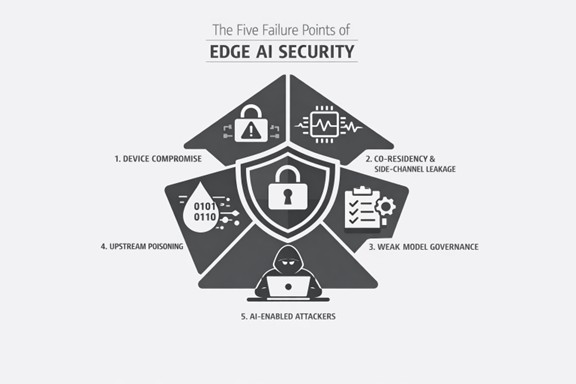
One issue that rarely gets top billing is the structural fragility of edge infrastructure. Attackers have shifted their focus from the cloud to the outer boundary, targeting firewalls, VPN appliances, and remote-access systems—devices that now account for roughly 30% of initial compromises in SMB environments.¹ Once breached, these systems give attackers immediate proximity to model pipelines. From there, it becomes straightforward to poison sensor inputs, intercept or alter prompts, and scrape embeddings.
Edge AI models run alongside other services in environments with minimal isolation, so their security posture is dictated by the device and adjacent processes, making them far more exposed to introspection, interference, and data leakage than in a protected data‑center environment.
The quiet risks in small models
Another under‑discussed challenge lies in the small models that power most edge deployments.
These compact, latency-optimized models are engineering achievements, but their efficiency makes them more susceptible to side-channel leakage. Researchers have already shown that prompts and responses can be inferred using token-length patterns, timing signals, or KV-cache behaviors, even when communication is encrypted. Edge systems frequently share hardware across functions, making co-residency attacks not just possible but likely. The result is an uncomfortable truth: Research increasingly shows small models leak more than teams expect, and they do it silently.
Breaches beyond the lab
Model-level breaches are no longer theoretical.
IBM’s 2025 breach study found that 13% of organizations experienced AI model or application breaches, and an astonishing 97% lacked proper AI access controls.² Meanwhile, a majority of AI-related incidents resulted in data compromise. Too many organizations treat models, embeddings, RAG connectors, and prompts like simple configuration artifacts rather than the high-value, sensitive intellectual property they truly represent. Without stronger governance, edge AI deployments risk becoming an attacker’s easiest foothold.
Attackers using AI too
Perhaps the most transformative shift is that attackers have begun using AI offensively.
Threat intelligence groups reported adversaries integrating generative AI directly into malware development, reconnaissance automation, and exploit workflows throughout 2025–2026. Then came the high‑profile Hong Kong deepfake heist, where an employee was tricked by an entire AI‑generated video conference into authorizing $25 million in transfers. It was a stark demonstration that synthetic voices and faces can deceive even trained humans—so imagine what they can do to edge AI systems that rely on camera, microphone, or multimodal input streams without strong validation.
Toward a secure Edge AI architecture
Addressing these risks requires a fundamental shift: AI at the edge must start from isolation, not bolt-on security. The core principle is simple—the model must be shielded from everything else running on the device. That means placing AI workloads in strongly isolated, hardware-enforced environments so other local processes can’t introspect memory, interfere with execution, or hijack context. Isolation can be achieved through multiple techniques—including trusted execution, virtualization, or hardware separation—but the goal is always the same: keep other processes out of the model’s memory.
Because edge devices lack data center-grade perimeters, small models must be treated like high-value assets. That requires tightly controlling what they can interact with, ensuring their memory and execution context can’t be observed by neighboring processes, and minimizing metadata or behavioral leakage. Zero trust principles must apply to every edge node, every service running alongside the model, and every inference request entering the system. Governance must evolve accordingly—with signed and attested model artifacts, strict role-based access to prompts and embeddings, input validation for multimodal data, and hardened retrieval pipelines that resist poisoning.
A leadership moment for Edge AI
For leaders shaping edge AI strategy, the takeaway is straightforward: small models may enable distributed intelligence, but without secure isolation and robust governance, they also expose it. In the next decade, the organizations that scale edge AI safely will be the ones that treat isolation, attestation, and zero trust as engineering fundamentals—not optional controls Edge AI’s reach is its power. Securing that reach is now the defining leadership challenge.
I will be discussing these topics and more at the upcoming Edge AI Foundation Event being held in San Diego (March 24th–26th). I welcome you to share your thoughts either online or in person at the exciting event.
1Infosecurity Magazine “Network Edge Devices the Biggest Entry Point for Attacks on SMBs” April 17, 2025.
2IBM Newsroom “13% of Organizations Reported Breaches of AI Models or Applications; 97% Lacked Proper AI Access Controls.” July 30, 2025.
