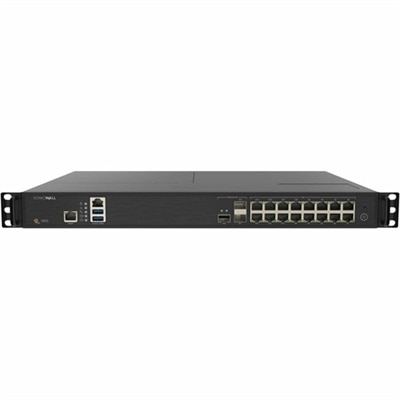
Firewall Components
In today's digital age, safeguarding your network is paramount, and firewall components play a crucial role in fortifying your defenses. These essential elements are designed to protect data integrity and prevent unauthorized access, ensuring that your systems remain secure from potential threats. Whether you're setting up a new network or enhancing an existing one, understanding the various firewall components can help you build a robust security infrastructure tailored to meet your specific needs. Explore our range of options to find the perfect solutions that align with your security goals and keep your digital environment safe and sound.
This product is not available
Check out the following recommendations.
Firewall Components
Firewall components are the software features and controls that help a computer decide which incoming and outgoing connections to allow, block, or record. For laptops and desktops, these components typically include a policy engine, traffic filtering, connection tracking, application permissions, and activity logs. Each serves a different purpose, but their value comes from working together: rules define acceptable activity, filtering applies those rules, and logs make the results visible. A firewall provides one layer of protection rather than a complete defense against every digital threat. It does not replace operating system updates, strong account security, or protection against malicious files. Its particular role is to limit unwanted communication while allowing approved applications to function. That balance matters on a laptop carried between a home office, a campus library, and a coffee shop, as well as on a desktop used for coursework, creative projects, or household paperwork. A personal firewall can apply different settings to trusted and public connections, helping keep the computer less exposed when its surroundings change. The policy engine evaluates conditions such as the application making a request, the direction of communication, the destination address, and the type of connection involved. Depending on the software and configuration, the resulting action may be to allow the connection, block it, or ask for a decision. Clear application names and readable explanations make those decisions easier to understand. For everyday use, firewall components should support familiar activities without turning every video call or document upload into a series of unexplained interruptions. Useful distinctions include whether protection covers incoming connections alone or also manages outgoing activity, whether permissions apply to individual applications, and whether settings adjust automatically when the computer connects somewhere new. These differences shape how much visibility and control a person has over the applications communicating from a device, especially when several people use the same computer for different tasks.
Traffic inspection is central to how firewall components work, although different methods examine different details. Packet filtering checks small units of transmitted information against rules involving addresses, ports, and communication protocols. Stateful inspection adds context by tracking active connections, allowing the firewall to distinguish expected responses from unsolicited attempts to connect. Application-aware controls can associate communication with a particular program, making it possible to allow a browser while restricting an unfamiliar utility. These capabilities are related, but they are not interchangeable, and their presence should not be assumed from the word “firewall” alone. Inspection also has limits: encrypted content is not automatically readable simply because a firewall can observe that a connection exists. For a student joining a live lecture, a remote employee sharing a screen, or a creator uploading a finished video, well-matched controls help preserve necessary communication without granting unrelated applications unrestricted access. Outgoing controls can be useful when a newly installed program begins contacting destinations that do not appear connected to its purpose, although an unfamiliar destination is not, by itself, proof of harmful activity. Logging and notifications provide the context needed to understand such events. A useful log may identify the time, application, connection direction, destination, and action taken. A notification is more helpful when it explains what was blocked than when it presents an unexplained technical code. Repeated blocked attempts do not necessarily mean that a computer has been compromised; they may indicate that protection is enforcing its configured rules. For shoppers comparing broader security capabilities, Advanced Firewalls offers a related category to explore alongside personal computer protection. The practical distinction remains the same: individual features matter most when their controls, visibility, and operating requirements match the intended use. More settings do not automatically produce better protection, particularly when they are difficult to interpret or maintain. A clear interface and sensible defaults can be as important to everyday usability as the depth of the available filtering options.
Compatibility, ongoing maintenance, and day-to-day performance are the main fit considerations for software-based firewall components. Unlike a physical accessory, firewall software has no material finish or mechanical wear to evaluate; its useful life depends on continued support, reliable updates, and compatibility with the computer it protects. Relevant requirements include the operating system version, supported processor architecture, memory needs, and any dependencies on other security software. Many operating systems already include firewall protection, so additional software should have a clearly understood role rather than simply duplicating existing controls. Multiple tools attempting to manage the same connections can introduce conflicting rules, repeated alerts, or unexpected interruptions. On a lightweight laptop used throughout a school day, background resource consumption and battery impact deserve attention. On a desktop handling photo editing, gaming, or frequent video meetings, responsiveness during sustained activity matters just as much as behavior while idle. No firewall should be assumed to have zero performance impact, and results vary with the device, settings, and workload. Maintenance generally includes keeping the software current, reviewing permissions when applications change, and removing exceptions that are no longer needed. A temporary allowance for a one-time collaboration session should not quietly become a permanent opening with no remaining purpose. Settings backup and recovery options can also be helpful, especially when a computer is replaced or restored, though transferred rules still need to suit the new setup. For families sharing a desktop, understandable controls reduce the temptation to approve every request merely to dismiss an alert. For people working on an employer-managed laptop, compatibility with required security policies is essential, and changes may need authorization. Accessibility features, readable text, and notifications that remain understandable without relying only on color can make routine use more manageable. Personal firewall components are most useful when they provide consistent boundaries without obscuring what the computer is doing. Their long-term value lies in dependable operation, appropriate control over application communication, and settings that remain understandable as daily routines and software needs evolve.
FAQs:
A firewall system typically includes several key components: packet filtering engines, stateful inspection modules, access control lists (ACLs), proxy servers, and logging or monitoring tools. Advanced systems may also feature intrusion prevention systems (IPS) and VPN capabilities, all working together to filter traffic and enforce security policies.
Firewall system components are designed to integrate seamlessly with other network devices such as laptops, desktops, and monitors. Through standardized interfaces and management software, these components can be configured to protect all connected devices, ensuring a unified approach to network security.
Firewall system components benefit a wide range of users, including home office professionals, small business owners, families, and students. Anyone looking to safeguard their network from unauthorized access or cyber threats can improve their digital security by implementing these components.
When selecting firewall system components, consider features such as ease of integration, scalability, user-friendly management interfaces, real-time monitoring, and support for advanced security functions like intrusion prevention and VPNs. These features help ensure the firewall system meets your current and future security needs.
Logging and monitoring tools provide continuous visibility into network activity, allowing users to detect suspicious behavior or unauthorized access attempts. These tools enable timely responses to potential threats and help maintain a secure and compliant network environment.